The Fabulous Forties #34: This Is The Army (dir by Michael Curtiz)


Titapos

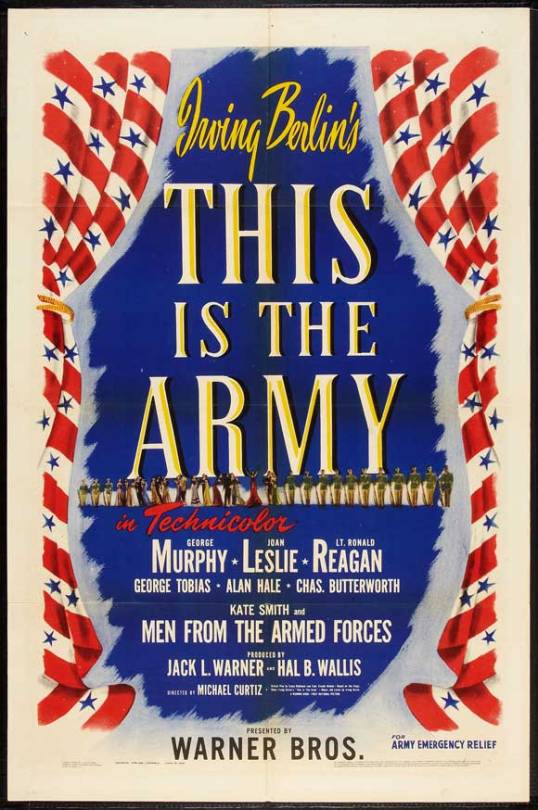
The 34th film in Mill Creek’s Fabulous Forties box set is the 1943 musical, This is The Army.

This Is The Army is based on a Broadway musical that was specifically conceived and written by Irving Berlin as a way to boost wartime morale.  The show, which was a collection of patriotic songs and comedic skits, was performed by members of the U.S. Army.  The film version starts with dancer Jerry Jones (George Murphy) being drafted at the start of World War I and putting together an all-army revue called Yip Yip Yaphank.  (Interestingly enough, this was also the name of a real-life show that Irving Berlin put together during World War I.)  The show is a big hit and, when the soldiers in the cast receive their orders to head to France, they literally march off the stage and out the theater.  It’s actually a pretty rousing scene but it’s almost immediately followed by a very sad one, in which we learn that only three members of the cast survived the war.  Jerry Jones is shot in the leg and when he returns home, the former dancer now walks with a cane.

Twenty-five years later, another world war has broken out.  Jerry’s son, Johnny (Ronald Reagan), has joined the army.  Johnny is ordered to put together another revue, in the style of Yip Yip Yaphank.  At first, Johnny is reluctant but orders are orders.  Soon, Johnny and the cast of This Is The Army are touring the U.S. and even performing in front of President Roosevelt (played by Jack Young, though, from a historical perspective, wouldn’t it be neat if President Roosevelt had appeared as himself in a film with Ronald Reagan?).  Along the way, Eileen (Joan Leslie) tries to convince Johnny to marry her even though Johnny wants to wait until the war is over.

It’s really not much of a plot but then again, the film is about showcasing the musical performances.  The soldiers sing.  The soldiers dance.  The soldiers tell jokes and imitate people who were famous in 1943.  There are several scenes that attempt to wring laughs from soldiers dressed up like women.  What’s interesting is that, at a time when the army was still segregated, the performances in This Is The Army feature both white and black soldiers.  Irving Berlin apparently demanded that black soldiers be allowed to appear in both the stage show and the film and, as a result, the unit that performed This Is The Army was, for a time, the only integrated unit in the U.S. Army.

Of course, that makes it even odder that there’s an extended sequence in which white soldiers perform while wearing blackface and standing on a set that’s been designed to resemble a pre-Civil War plantation.  It’s a scene that pops out of nowhere and then it keeps going and going and going and I could only stare at the screen in shocked horror as it played out.  It’s an odd contradiction that the same Irving Berlin who demanded that black soldiers be honored on stage and screen was also apparently the same Irving Berlin was put a minstrel show sketch into the middle of This Is The Army. 

Interestingly enough, George Murphy later retired from acting and was elected to the U.S. Senate in 1964.  Murphy’s success inspired his co-star, Ronald Reagan, to run for governor.  If Murphy had never been a senator, Reagan would probably never have been a president.  Both Reagan and Murphy give likable performances in This Is The Army and it’s easy to see how that likability, while it may not have often translated into great acting, did eventually lead to political success.

This Is The Army is a time capsule film, one that is mostly interesting as a view into the psyche of 1940s America.  The humor is often corny and the storyline is predictable but there’s also a very sad subtext to the film.  Since both the film and the stage show were performed by actual enlisted men, you watch with the knowledge that some of the men singing and joking on stage won’t return from the war.  Often times, during the performances, we see random people in the audience crying as they realize the same thing.  Even in an otherwise light-hearted film, the sobering realities of life during wartime are right beneath the surface.

The Fabulous Forties #33: Boys of the City (dir by Joseph H. Lewis)


Boysofthecity

The 33rd film in Mill Creek’s Fabulous Forties box set was 1940’s Boys of the City.

As a classic film lover, I have to admit that I groaned a bit when the opening credits announced that Boys of the City starred “East Side Kids.”  The East Side Kids were a group of actors who appeared in a number of B-movies from the 1930s through the 50s.  Many of the actors started out as members of the Dead End Kids and a few more were members of a group known as The Little Tough Guys.  In the 40s, they merged to become the East Side Kids and then eventually, once the East Side Kids started to hit their 30s, they became known as the Bowery Boys.  Their movies started out as tough and gritty melodramas but, by the time they were known as the Bowery Boys, they were making cartoonish comedies.  Occasionally, one of their films will show up on TCM.  Their early serious films (Dead End, Angels With Dirty Faces) remain watchable but, from what little I’ve seen of them, their later comedies appear to be damn near unbearable.

Boys of the City finds the East Side Kids in transition.  The kids still have an edge to them.  They are definitely portrayed as being juvenile delinquents who are walking a thin line between either a short life of crime or a long life of poverty.  But them film itself, while it may not be as cartoonish as the films that were to come in the future, is definitely a comedy.

Basically, the East Side Kids (Bobby Jordan, Leo Gorcey, Hal E. Chester, Frankie Burke, Sunshine Sammy, Donald Haines, David Gorcey, and Algy Williams) have been arrested for vandalism and are given a choice.  They can either go to juvenile hall or they can spend the summer at a camp in upstate New York.  Somewhat reluctantly (and hopefully remembering the unlucky fates of Humphrey Bogart in Dead End and James Cagney in Angels With Dirty Faces), the kids agree to go to the camp.

However, on the way to the camp, their car breaks down and they are forced to stay at the nearby home of a crooked judge (Forrest Taylor) until they can get the car repaired.  The judge, however, is killed and it’s up to the East Side Kids to solve the murder!  Was the judge killed by the gangsters that he was set to testify against?  Was he killed by his niece (Inna Gest)?  Or maybe it was his housekeeper, Agnes (Minerva Urecal, who appears to be parodying Judith Anderson’s performance in Rebecca)?  Or was he murdered by Knuckles (Dave O’Brien), who the judge wrongly sentenced to die and who, following his vindication and release from prison, has become a guardian to the East Side Kids?

Who knows?  Who cares?  I certainly didn’t.

Clocking in at 68 minutes, Boys of the City is a typical 1940s second feature.  Designed to keep audiences entertained without requiring them to think, Boys of the City moves quickly and adds up to nothing.  I know that there are some classic film lovers who can tell the difference between the various East Side Kids (or Dead End Kids or Bowery Boys or whatever you want to call them) but they all pretty much blended together for me.

Not surprisingly for a film made in 1940, Boys of the City is full of casual racism.  Sunshine Sammy plays an East Side Kid named Scruno.  As soon as Scruno sees the cemetery next to the house, his eyes go wide and he says, “G-g-g-ghosts!”  Apparently, that was very popular in the 40s but today, it’s impossible to watch without cringing.

Boys of the City has some interest as a time capsule but otherwise, it’s a film that is easily and happily forgotten about.

Fabulous Forties #32: Outpost in Morocco (dir by Robert Florey)


Otmorpos

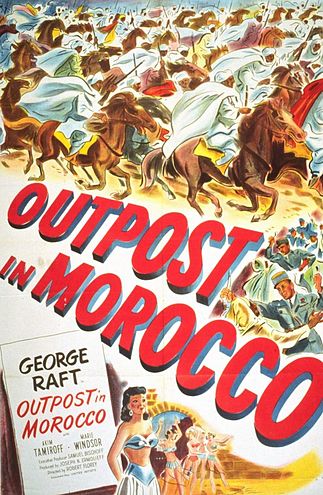
After watching the excellent The Last Chance, I was really hoping that the 32nd film in the Fabulous Forties box set would turn out be a classic as well.  Sadly, that was not the case.  1949’s Outpost in Morocco is a generally forgettable adventure film about the French Foreign Legion.

George Raft plays Capt. Paul Gerard, a captain in the French Foreign Legion.  Now, I happen to like George Raft.  He may not have been the greatest actor of Hollywood’s Golden Age but he did have a roguish charm and he was a great dancer.  Unfortunately, while the role of Paul Gerard did call for a bit of charm, it didn’t call for much dancing.  Instead, Paul Gerard is rather stolid and dependable and a little bit boring.  Needless to say, George Raft was more than a little miscast in the role.

Speaking of miscast, the beautiful but very American Marie Windsor plays Cara, the daughter of the Emir of the Moroccan city of Bel-Rashad.  The French are not allowed to enter the city and there are rumors that the Emir has been using this situation as an opportunity to plot against France.  Since Cara has spent the last few years studying in France, she is willing to go into Bel-Rashad and report on whether or not the rumors are true.  Gerard is assigned to escort her to the city.  Gerard’s superiors suspect that Cara might even fall in love with Gerard and, as a result, will be willing to turn against her father.

And that’s exactly what happens!  It takes exactly 10 days for Cara and Gerard to fall in love.  (We know this because the film is full of excerpts from a journal that Gerard keeps as he escorts Cara across the desert.)  However, once they reach Bel-Rashad, Cara does discover that her father is indeed conspiring against the French.  It is up to Gerard to put down the revolution and defeat the Emir, even if it means potentially sacrificing his love for Cara.

It’s interesting to note that there’s a few scenes where Raft sounds like he’s trying to imitate Humphrey Bogart, which immediately reminded me of how so many of Bogart’s great roles were initially offered to Raft.  I found myself wondering if Raft agreed to do Outpost in Morocco to make up for refusing Bogart’s role in a certain other film that was set in Morocco.

Unfortunately, Outpost in Morocco is no Casablanca.  Whereas Casablanca is a classic that holds up to this day, Outpost in Morocco is best described as being … well, dull.

How boring in Outpost in Morocco?  George Raft looks bored.  Marie Windsor looks bored.  Even the great character actor Akim Tamiroff looks bored!  Portions of the film were shot on location in Morocco so there are a few nice shots of the desert (if that’s your thing) and the ending is a bit darker than you might normally expect for a 1949 adventure film but otherwise, Outpost in Morocco is a fairly forgettable film.

The Fabulous Forties #31: The Last Chance (dir by Leopold Lindtberg)


12022809425545_l

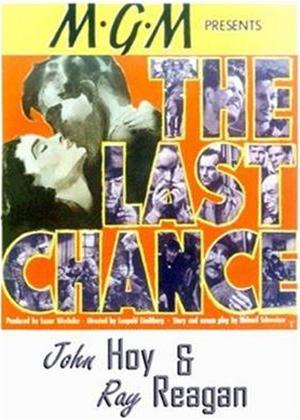
The 31st film in Mill Creek’s Fabulous Forties box set was a 1945 film called The Last Chance.

I have to admit that one reason why I’ve been struggling to finish up the relatively simple task of watching all 50 of the films included in this box set is that a lot of the films just aren’t very good.  Along with suffering from the typically poor Mill Creek transfer, quite a few of the movies are forgettable filler.  You can only watch so many movies like Freckles Comes Home before you start to lose your enthusiasm.

Fortunately, even if most of the films are forgettable, there are still a handful of outstanding productions to be found in the Fabulous Forties.  You just have to have a lot of patience and you have to be willing to look for them.  For instance, if I had given up on the Fabulous Forties after sitting through Drums of Africa, I would never have discovered The Last Chance.

And that would have been a shame because The Last Chance is an excellent film!  It’s certainly the best of the 31 Fabulous Forties films that I’ve watched so far.

Directed by Leopold Lindtberg, an Austrian who fled to Switzerland shortly after the Nazis came to power, The Last Chance tells a deceptively simple story.  Two POWs — an American named Braddock (Ray Reagan) and a British soldier name Halliday (John Hoy) — are being transported across Italy via train.  When the train crashes, Braddock and Halliday escape.  They spend the rest of the film trying to reach Switzerland.  Along the way, they struggle to avoid Nazis, deal with civilians who mostly just want the war to be over, and eventually meet and hook up with the Italian resistance.  (The resistance here is represented by a self-sacrificing priest, who was well-played by real-life refugee named Romano Calo.)  Eventually, the two soldiers meet up with another escaped POW (Ewart G. Morrison) and the three of them lead a group of refugees to the Swiss border.

What distinguishes The Last Chance is its authenticity.  Reagan, Hoy, and Morrison were not professional actors.  Instead, they were real-life soldiers, all of whom had once been POWs and all of whom managed to escape to Switzerland.  What these three actors lacked in polish, they made up for in reality.  When they talked about the risks of trying to reach the Swiss border and the ruthless barbarity of the Axis regime, they knew what they were talking about.  As well, the film was actually shot in Europe during the war.  When we see the three soldiers leading the band of refugees through bombed out villages, we’re not just seeing a bunch of actors on a safe Hollywood sound stage.  Instead, we are watching real-life refugees walking through the ruins of their former home.  Though the story may be fictionalized, Leopold Lindtberg directed the film as if it were a documentary and the result is both a passionate condemnation of fascism and an emotional anti-war piece that remains powerful to this day.

I don’t care how many bad films that I had to sit through (and have left to sit through) as a result of my decision to review all of the movies inside the Fabulous Forties box set.  Discovering a film like The Last Chance makes it all worth it.

http://www.youtube.com/watch?v=S2umn94XT0s