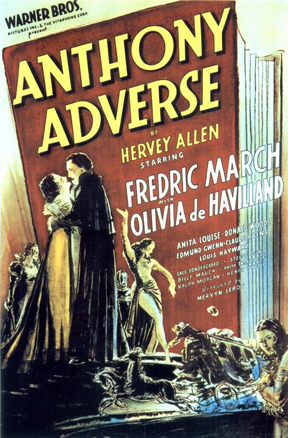
Late last night, I continued to clean out my DVR by watching the 1936 film, Anthony Adverse.
I recorded Anthony Adverse off of TCM, where it was being shown as a part of that channel’s 31 Days of Oscars. Anthony Adverse was aired because it was nominated for Best Picture of 1936. That’s significant because, if not for that nomination, I doubt that anyone would ever have a reason to watch Anthony Adverse. It’s certainly one of the more obscure best picture nominees. Despite a prestigious cast and being directed by the respectable Mervyn LeRoy, Anthony Adverse only has a handful of reviews over at the imdb. And most of those reviews were written by Oscar fanatics like me.
Anthony Adverse is an epic historical film, one that tells the story of Anthony Adverse (Frederic March). Anthony is the illegitimate son of Denis Moore (Louis Hayward) and Maria (Anita Louise), the wife of evil Spanish nobleman, Don Luis (Claude Rains, convincing as a nobleman but not as someone from Spain). Luis murdered Denis and Maria died giving birth so Luis abandons the baby at an Italian convent. Anthony is raised by nuns and priests and then, 10 years later, is apprenticed to an English merchant named John Bonnyfeather (Edmund Gwenn). Bonnyfeather just happens to be Anthony’s grandfather! Though Luis told him that Anthony died as soon as he was born, Bonnyfeather quickly figures out that Anthony is his grandson. However, Bonnyfeather doesn’t share that information with Anthony and instead, he gives Anthony the surname “Adverse.”
Bonnyfeather raises Anthony as his own son. Anthony grows up to be Frederic March and ends up falling in love with and marrying the beautiful Angela (Olivia De Havilland). However, Anthony is suddenly called away on business to Havana, Cuba. He doesn’t even have a chance to tell Angela that he’s leaving. He does leave her a note but it blows away. Assuming that she’s been abandoned, Angela goes to France, becomes an opera singer, and is soon the mistress of Napoleon.
Meanwhile, in Cuba, Anthony becomes convinced that Angela has intentionally abandoned him. Consumed by grief, he ends up running a slave trading post in Africa. He takes one of the slaves, Neleta (Steffi Duna), as his mistress and becomes known for his cruelty. However, he eventually meets Brother Francois (Pedro de Cordoba) and starts to reconsider his ways.
(The film’s treatment of the slave trade is …. well, it’s awkward to watch. The film is undoubtedly critical of slavery but, at the same time, it’s hard not to notice that the only slave with a prominent part in the film is played by a Hungarian actress. Anthony may eventually reject cruelty but it’s left ambiguous as to whether or not he rejects the slave trade as a business. If Anthony Adverse were made today, one imagines that this section of the film would be handled much differently.)
Meanwhile, back in Europe, Bonnyfeather is dying and his housekeeper, Faith (Gale Sondergaard, who won the first ever Oscar awarded for Best Supporting Actress for her performance here), plots to claim his fortune.
After I watched the movie but before I started this review, I did some research and I discovered that Anthony Adverse was based on a 1,222-page best seller that came out in 1933. I’m going to guess that the film’s long and ponderous story may have worked better on the page than it does on the screen. As a film, Anthony Adverse clocks in at 141 minute and it feels even longer. Despite the impressive cast, the film just never clicks. It’s never that interesting.
At the same time, I can understand why it was nominated for best picture. It’s a big movie, full of characters and extravagant sets and ornate costumes. You can tell it was an expensive movie to make and there’s enough philosophical dialogue that you can pretend there’s something going on underneath the surface. In the 1936, Anthony Adverse may have been quite impressive but seen today, it’s forgettable.
Anthony Adverse lost best picture to another overproduced extravaganza, The Great Ziegfield. Personally, I would have given the award to the unnominated My Man Godfrey.
 Through the Shattered Lens
Pingback: The Best Picture Race: The 1930s | Through the Shattered Lens