Just looking at the poster for the 1972 film The Stepmother, I bet you think it’s a pretty scandalous and sordid film. I mean, there’s a picture of a woman wearing a black bra and there’s a tagline that reads, “She forced her husband’s son to commit the ultimate sin!”
Well, perhaps not surprisingly considering that this is a Crown International film, The Stepmother‘s poster and tagline have very little do with the actual film. Yes, the film does feature a stepmother and, during the final 20 or so minutes of the film, her stepson does finally show up and she does end up sleeping with him. It’s consensual. There’s no forcing involved. And, as far as the ultimate sin part is concerned — well, her husband has been doing a lot worse.
The film itself is actually about the husband. Frank Delgado (Alejandro Rey) is a wealthy architect who is also insanely jealous of his new wife, Margo (Katherine Justice). Whenever he suspects that Margo is cheating on him, he ends up killing someone. And, as a matter of fact, even when he doesn’t think Margo is cheating on him, he ends up killing someone. Frank, of course, has to find a way to cover up all of his various murders. It doesn’t help that Inspector Darnezi (John Anderson) is constantly snooping around. And then, once he discovers that his stepson actually has slept with Margo (as opposed to all the people he killed just because he assumed they had slept with Margo), Frank is forced to decide whether or not to kill his own son.
The Stepmother is available in about a dozen Mill Creek boxsets and it’s fun in a 1972 sort of way. Frank and all of his friends are decadent rich people so you could argue that the film is meant to be a portrait of the immorality of the 1%. (That would actually be a pretty stupid argument but it’s one that you could make if you’re trying to impress someone who hasn’t read this review.) Director Howard Avedis tries to liven up the plot by including a lot of artsy touches that don’t really add up to much but which are still fun to watch. Occasionally, he’ll toss in a freeze frame for no particular reason. As well, Frank has a habit of hallucinating. He continually sees his first victim running across the beach in slow motion. Make a drinking game out of it. Every time it’s obvious that The Stepmother was trying to fool people into thinking it was a European art film, take a drink.
To be honest, the most interesting thing about The Stepmother is that it is the only Crown International film to have received an Oscar nomination! That’s right! The Stepmother was nominated for Best Original Song. The name of the song was Strange Are The Ways Of Love. You can listen to it below if you want. Feel free to dance.
Anyway, that’s The Stepmother for you. It’s not my favorite Crown International film but, as a historical oddity, it’s still worth watching.
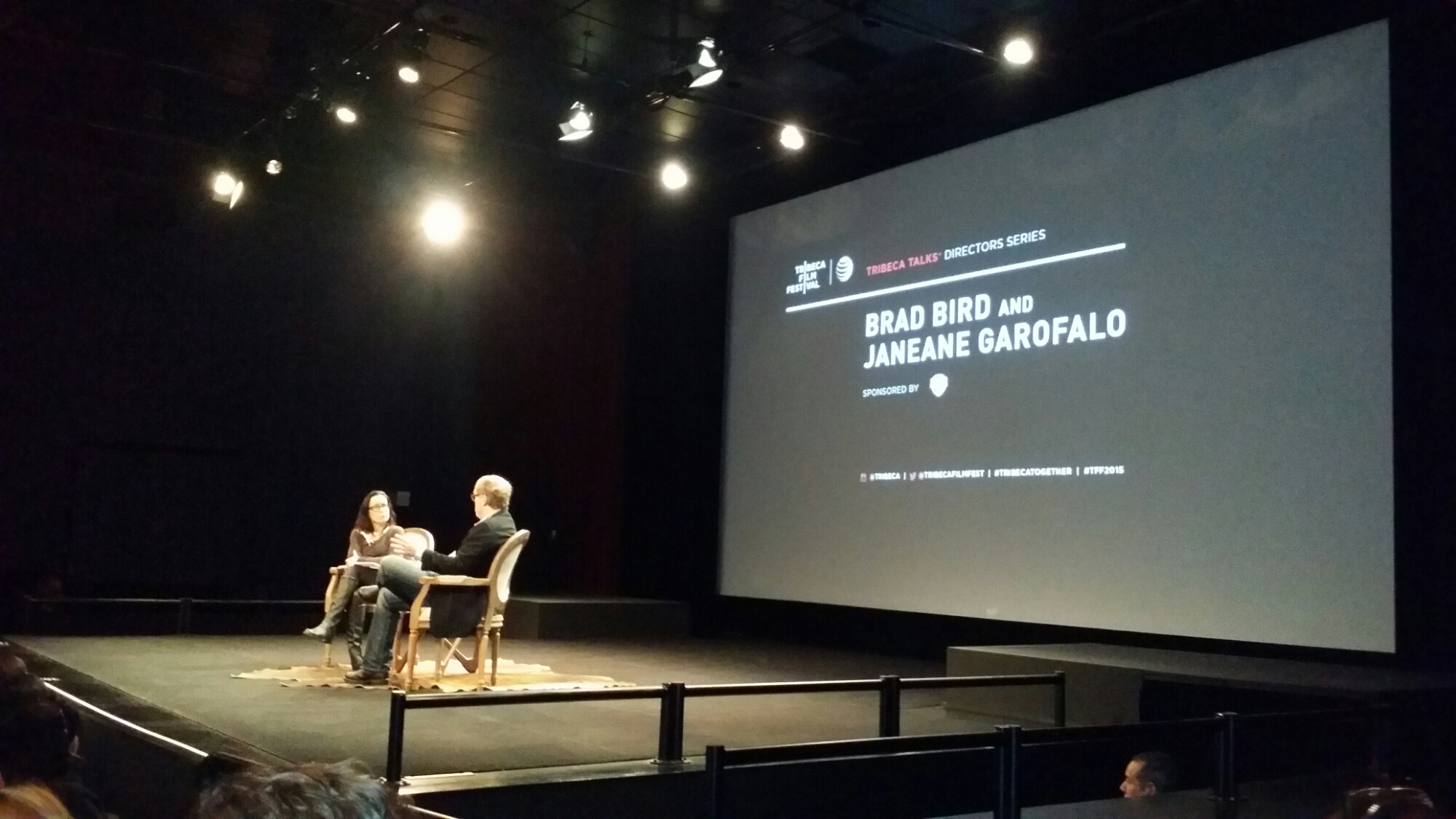
Brad Bird and Janeane Garofalo have a sit down at the Tribeca Film Festival to discuss film, animation and the mediums in between.
This is going to be a long one, ladies and gents. My apologies if this becomes TL;DR material.
Here’s the short of it:
I was able to see Brad Bird speak at The Tribeca Film Festival. For the hour, he discussed the changes and challenges he faced with moving from animation to live action features. The audience was shown a set of clips – one from Ratatouille, one from Mission: Impossible – Ghost Protocol, and one from his latest film, Tomorrowland. Near the last half of the interview, Bird fielded questions from the audience. I had a great time.
And here’s the Interstellar 3-Hour Neverending Edition:
When I was a kid, there used to be this show on network television called Amazing Stories. Produced by Steven Spielberg’s Amblin Entertainment, it ran for about 2 years or so between 1985 and 1987. It was kind of like a cross between Darkroom, Tales From the Darkside, and The Twilight Zone. One of my favorite episodes was “The Family Dog”. The big push with The Family Dog was that it was produced by Tim Burton and the animation style was the basis for his future films The Corpse Bride, The Nightmare Before Christmas and Frankenweenie. I loved it. It was weird and funny, about a family that adopts a dog only to find that their house is robbed, with the dog inside and failing to stop the intruders. The dog is sent to a canine boarding school, where he’s reforged into a “white hot ball of canine terror” by Miss LeStrange (voiced by The Exorcist’s Mercedes McCambridge). There’s more to it, but after recording the show and watching it a zillion times, I paid attention to who wrote it.
And that’s how I started following Brad Bird.
Bird would later go on work on Batteries Not Included, and spent some time on the Simpsons before directing and writing The Iron Giant for Warner Brothers. While the movie wasn’t the commercial hit everyone hoped, it put Bird on Disney / Pixar’s radar, who brought him on to do both The Incredibles and Ratatouille. Pixar would end up adding Bird to their Brain Trust, that includes Pete Docter, John Lassiter and Andrew Stanton. Bird’s big jump from Animation to Live Action would come with 2011’s Mission Impossible: Ghost Protocol. Next month (as of this writing), he’ll release Tomorrowland, which he shared writing responsibilities with Prometheus / Lost writer Damon Lindelof.
Bird was on hand at the Tribeca Film Festival’s Director Series in an interview hosted by his Ratatouille star, Janeane Garofalo. I was able to attend this, and took as many notes as I could. Some of this may be a little sketchy, based off of both what I wrote & how I interpreted it, to which I apologize beforehand. Although we were able to use phones for pictures, we couldn’t record anything. Assume that most of the questions and answers here are somewhat paraphrased.More than likely, you can find recaps of the interview at the Tribeca Film Festival website.
At first, Janeane was a little curious about what she should ask, opening the floor with her humor, which had everyone laughing.
Question – So you said something about a tour taken as a child?
Bird spoke about a tour he took of Disney Studios, back when he was about 11. He saw the Jungle Book as a kid and just loved it. He also realized that there were all of these cool jobs in animation. According to Bird, he owned an album with some of actor Jonathan Winter’s voiceover work and would listen to that as well. Though his parents who knew a composer at Disney, they were able to meet with Frank Thomas and Ollie Johnston. Both Ollie and Frank were two of the original animators responsible for most of the Disney Classics, known as the Nine Old Men. Unexpectedly, Bird went home and ended up creating a 15 minute film for the animators. After that, they were eager to mentor him.
Garafolo praised Bird on how he’s taken Narrative storytelling to another level but asked about technical challenges in Animation.
Bird noted that from a tech standpoint, The Incredibles was a harder film to create because the design abilities were just being born. An example of this is the wet hair textures after the plane crash sequence. At the time, that was one of the latest things that Pixar learned to do. By the time Ratatouille came along, there were a number of improves, which made things easier. Bird went on to say that “People think there’s an easy “Make Movie” button that will produce work.” However, if you want imperfections, the computers had to be taught this. In Ratatouille, Bird described how working on the floors, the lighting needed to have a variant because tiles may be higher or lower than others or have damages. The computer would normally smooth out the surface, but they had to reprogram the system to support natural flaws. A later question that came up dealt with focus, where Bird found that CGI Cameras can act like real cameras. When you normally focus on something small with a regular camera, the depth of field becomes small. The computer would assume that the director wanted a high Depth of Field throughout, but again, Bird and Pixar had to train the machines to un-learn that.
At one point, Janeane started a question and asked about different genres in Animation to which Brad replied “Animation is a medium, not a genre.” There was a bit of back and forth chuckling between them, and their chemistry is just cool.
“With the actors you choose, how much control do you have in that?” Bird’s response was along the lines of it all being about actor interest. He had to “woo” Peter O’Toole for Ratatouille. Some actors thing that voice acting is easy, but it can be difficult. What takes an actor 5 minutes to say may take an animator weeks to come up (with regards to facial animations and the like, I’m guessing). Patton Oswalt would say sometimes that he was beat after a run. My personal speculation on this is that with animating, sometimes re-recording needs to happen to get a phrase sound right. I could be off here, but that was my interpretation of the statement. The audience was presented with a clip from Ratatouille where Linguini is introduced to Collette for the first time.
Janeane apologized for her French here. There was a bit of laughter as Bird shared a story of how with Janeane, she didn’t seem to take praise very well. He would have to pretty much tell her she sucked to motivate her, even though she did good. The conversation then moved on to Mission: Impossible – Ghost Protocol.
Ghost Protocol happened as Bird was working on a pet project he called 1906, the adaptation of James Dalessandro’s novel on the events surrounding the San Francisco earthquake during that year. He was very animated in discussing 1906. It was a rich project, but there were some problems getting all of the elements Bird needed into the story at the time. He didn’t want to make it a life project (without working on anything else), so he paused to jump onto Ghost Protocol. The audience was then shown the Hallway sequence from the movie, where Simon Pegg and Tom Cruise mask their entrance into a room in the Kremlin. The scene picked up some chuckles from the Audience with Pegg’s “face in the camera” moment.
A question came up on whether he was hindered in any way, working on a big project like Ghost Protocol. Bird wasn’t really hindered, but what attracted him to the film was that the franchise was willing to let him accommodate his individual style. The Brian DePalma version of the first Mission Impossible was different from John Woo’s work on the 2nd and J.J. Abrams work on the 3rd film. Bird added that he was given the chance to do “five out of six things” he wanted to do in a spy movie. Both Cruise and Abrahams were behind Bird on the film and he felt protected by them. On Cruise in particular, he praised his work ethic, pointing out that it was easy to have him climb the Burj Khalifa in Dubai because he keeps himself fit for every film. Garofalo took a moment to reference the HBO Documentary “Going Clear” with a “LRH” remark. “We could go on about that all day.” She said, though they moved on to their next topic.
Before continuing, Bird made a quick gesture to the screen and pointed out to the audience that he and Cruise talked about some Silent classic films and comedies. These were part of the influence for that particular hallway scene.
Janeane brought up a question on the toll with working on a big film (after doing animated features). Bird’s response was that it was like being thrown in the deep end of a shark infested pool. He jumped to work with Cruise and Abrams, and it was a lot of fun. “Big canvas stuff”, were the words used.
Control on Post Production came up (in terms of how much he had). So far, so good, was the reply. Bird stood up, leaned down to the floor of the stage and knocked on it. “Knock on wood.” He said as he sat back down with a smile before adding that he only had to bark a few times, if any.
With that, we were given a sneak peek at Bird’s latest project, Tomorrowland. In checking online, I found that it was an expanded version of the one showcased at Disney’s D23 Event last year. Unfortunately, the clip we were shown isn’t online in any form (at least I can’t find it online), so I’ll have to explain it here:
The scene opens with a young child sitting on a bus, holding quite a large bag. Screeching to a halt, the bus driver opens the door and announces the stop. The driver tells everyone to “enjoy the future”. As the patrons go to leave the bus, they’re suddenly blocked by the boy’s bag, which falls into the main aisle. The passengers give him some weird looks, but he smiles, apologizes and scoops up the bag, making his way off of the bus.
We’re given his perspective, a behind the character shot that showcases that he’s at the entrance of a festival. At the bottom of the screen, a caption appears, informing the audience that we’re at the 1964 World’s Fair, held in Queens, New York. We’re given a wider shot and it’s very much like Disneyworld, it’s bustling with people walking around and enjoying themselves. We focus on one area, with a name like The Hall of Invention. The boy enters and plops his bag on top a table where we find David Nix (Hugh Laurie) staring at him with a look of annoyance on his face. Note that his name isn’t given to the audience and that I’ve pulled it from the Internet Movie Database.
The boy unzips the bag, explaining that he had to partly disassemble it (it looking a lot like a vacuum cleaner) for transportation. As Nix looks on, he asks the boy who he is and what the contraption is supposed to be. The boy introduces himself as Frank Walker and states with pride that the device is a jetpack. He goes on to say that he’s still working on it, and as he says this, we’re given a quick cut to him standing in an open field. Wearing the jetpack, he dons a pair of goggles, a flight helmet and we see two sets of controls by each hand. The look is pretty much the whole James Bond Thunderball look.
The shot cuts back to the boy standing at the table, who adds…”though it doesn’t quite exactly….”
We’re back at the field, and the kid clicks the power button. Instead of shooting straight up high into the air, he is vaulted forward, bounces and taken through some cornfields about a good hundred yards out. The first thing I thought of was The Rocketeer (also a Disney Production).
“…Fly.” The boy says, finishing his pitch.
“And what would this be used for?” Nix asks, looking from the machine to Walker.
“It would be fun.” Walker responds.
Nix shoots him down, stating that fun isn’t what anyone’s looking for. Clearly, he seems to already be looking at the idea of monetizing or weaponizing it.
“If someone walked up to me and showed me a jetpack, I’d think that would be pretty fun.” Walker says something to this effect. A young girl in a dress comes into view just off of Nix’s left, who’s been watching this play out. She approaches Walker and asks him a few questions that leave him at loss for answers, which the audience seemed to really enjoy. After the stammering on Walker’s part, Nix interrupts the girl (who we find is named Athena) and sends Walker on his way. The girl watches on.
We find Walker sitting on a bench outside, clutching his bag. People walk back and forth around him. To his right, we see Athena take a seat next him on the bench, but facing the other direction. They talk for a bit without looking at each other.
“Look over there, at your five o’clock.” She says. Walker looks ahead and to his left and then to his right, a little unsure. She looks at him as if he’s little crazy and gestures to her left. “Don’t know what 5 O’Clock is, it’s that way.” Which brings more audience response of chuckles. Looking in the direction she points out, she sees Nix pass by with someone else. Athena asks him to follow them, “but not too close”. She then proceeds to put something in his hand and leaves. Opening it, it reveals one of the Tomorrowland pins before fading to black and cutting to a scene where he’s in his garage, arguing with his father (played by Chris Bauer, True Blood’s Andy Bellefleur).
“But I can make it work! I can figure it out!” Frank says. His father asks him to let it go and stop tinkering with these silly notions. There seemed to be a divide between the theme of Frank’s optimism and his father’s point of view before we fade to black again and the lights come up.
The audience loved it. On Tomorrowland, Bird pointed out that he and Lindelof asked “Why did the Future change?” The attitude of the world was “We can figure it out.”, Which seems missing today. The magic of World’s Fairs are dispersed. Janeane shot back that are a number of people out there that are changing things and used Elon Musk as an example. Bird added that the Zeitgeist is doom and gloom, and any hope of a bright future is somewhat stemmed. People seem resigned that we’re going down. “You have to do things, to change things.”, He said. On a personal note, there appears to be a lot of Optimism in Tomorrowland, something that Bird seems to carry with him.
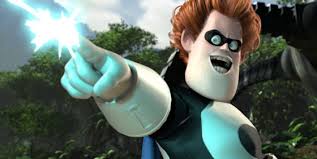
Brad Bird took questions like Syndrome – “You! Up there in the back with the red hat! Your question, give it to me!!”
After all that, a few questions from the audience were given. This was fun, with Janeane started the picking and then Brad targeting the hands that flew up. It was like watching Syndome use his wrist lasers in The Incredibles. They included the following:
What was the Sixth Thing (for the 5 out of 6 things he was able to do in a spy film)?
“That would be giving up the idea.” Bird laughed. Most of the ideas are reusable somewhere else. He had a concept for an animated version of Will Eisner’s The Spirit, but some of the ideas for that feature ended up becoming part of The Iron Giant.
How do you handle lighting in Animation vs. Live Action?
– When dealing with lighting, it’s almost the same way. A shorthand of cinematographer’s work was used to build setups. I can kind of see where Bird is coming from there. If you look at How to Train Your Dragon 2, the cinematography there was assisted by Roger Deakins. Lighting’s just as important in animation as it is in any medium. It’s just teaching the computer to handle it or drawing from that (at least, that’s my thought on it all).
How different is TV Work from movies?
“If you slow down, you can get eaten alive.” Bird said. He used the I Love Lucy chocolate assembly line as a reference here, stating that he learned a great deal on his time with the Simpsons. TV forces one to make very quick decisions. Iron Giant’s budget was different from Ratatouille’s and there was room to build more from that.
On creating genuine peril:
Bird loved that Disney wasn’t afraid of creating general fear in children, citing Pinocchio’s donkey transformation as something that terrified him. If animation should do anything, it should try a “balls out horror movie”. Dead Space: Downfall came to mind, personally.
Ever consider doing a live action / animated feature (like Who Framed Roger Rabbit?)
– Some of those work and can play together. Others come out pretty bad, like the Pagemaster. Bird wouldn’t be entirely opposed to doing one, but he didn’t appear to be too enthralled about it.
What are your processes for generating Ideas?
Here, Bird said that it’s different for each film. As an example, he wanted to do a film called “Ray Gun”. The idea came from a song he heard on the radio that he thought sounded like the Peter Gunn theme. Janeane smiled and caught the song right away – “Planet Claire” by the B52’s. Basically, it’s coming up with answers that entertain you.
With that, he and Janeane thanked the audience to tons of applause, and a bit of optimism. Below is the song that Bird was referencing:
Bosse-de-Nage (pronounced something like “Boss De Nazh”) are a four-piece band from San Francisco. They pumped out their first three albums in a span of three years, between 2010 and 2012, and then took their time getting this one together while cultivating a friendship with Deafheaven that lead to a split 12″ and some enhanced name recognition. All Fours was just released via Profound Lore Records last week, and any serious student of extreme music owes it to themselves to check it out. Just when I thought nothing in 2015 could be more stylistically unorthodox than Liturgy’s The Ark Work (ok, that claim probably still stands), Bosse-de-Nage turn up with an album that’s going to leave me scratching my head for a long time to come. What’s so interesting about All Fours is that you can walk away with a totally different impression of what the band is doing depending on your personal musical background.
Track: At Night
The album kicks off in post-metal mode, ebbing and flowing through a brooding, pessimistic mire beneath Bryan Manning’s desperate screams. Two minutes and change in, the song transitions to the sort of pounding fuzz that might call to mind Converge’s “Jane Doe”. As things continue to change, you get the feeling that it’s progressing towards an ever more desperate state. Black metal seems to play a major role in that intensification, with earlier passages reappearing in a more tightly packed onslaught of notes. The ending, for instance, revisits that Jane Doe sound, but the once cymbal-centric drumming is now competing with blast beats. “At Night” is a song in constant flux, and it could have been an erratic mess, but instead it’s strikingly fluid. Bosse-de-Nage manage to keep a thread of accelerating emotions taut throughout the long chain of ideas and influences that comprise it.
The next song, “The Industry of Distance”, sends a similar message. A simple, clean guitar lick repeats over bassy feedback for the better part of two minutes. Drums sneak up into a slow roll to cue distorted drawling guitar chords, and soon the song explodes in one of those beautiful melancholy post-black metal anthems we’ve been growing accustomed to. Instead of lightning quick tremolo and blast beats though, the drum and guitar initially seem to execute at half the frequency while Manning screams in his uniquely heartbroken style. It creates a sort of oscillating effect for an ear expecting black metal, every other note appearing to be missing. This eventually fills out into full speed tremolo and blast beats to complete another build-up through higher stages of emotional breakdown.
That’s my general metal take on All Fours. While a lot of what we’re calling post-black metal today diverges melodically from the genre’s origin, Bosse-de-Nage go further in exploring the techniques that characterize it. The drumming especially diversifies the package. Tremolo guitar and blast beats signify climaxes in a post-metal progression rather than perpetual constants, and a lot of care is given to make the development taking us there feel natural and captivating. Instead of the instant gratification of say, Liturgy or Krallice, Bosse-de-Nage effectively tap that post-rock tradition of “building up” to it.
Track: Washerwoman
That is probably a more accurate approach to understanding this album, because the band is firmly rooted in black metal. Manning at least has stated that he’s never heard of a lot of the other bands Bosse-de-Nage has been compared to lately. But the more this band diverges in technique from black metal, the more they find themselves labeled screamo and post-hardcore. If you’re familiar with that world of music, it’s a pretty fascinating truth. When bands play with the framework of a classic style, the boundaries of genre dissolve. Yes, “Washerwoman” could easily pass as a post-metal/black metal hybrid. Around the two minute mark it begins to sound strikingly similar to Isis. When the song breaks at four, they could be toying with black metal guitar by letting some of the notes ring out–a precursor to the proper bm onslaught that comes at five. But is that what you hear? Or do you hear a song straight off A Dead Sinking Story by Envy, peppered with spoken lines a la Indian Summer? It depends on where you’re coming from.
Envy-worship is actually how my brain interpreted “Washerwoman” on first listen, and I made immediate associations with other screamo acts throughout the album. I am not alone here. In the early reviews I’ve found so far, this album has been compared to Orchid, City of Caterpillar, Heroin, Moss Icon… Almost every track on All Fours feels extremely influenced by screamo. But it is not. It’s the same sort of thing that happened with Neige on Le Secret and Souvenirs d’un autre monde, when the pioneer of “shoegaze black metal” came out that he didn’t have a damn clue what “shoegaze” was.
I first mentioned screamo and black metal in the same sentence when Drudkh released Microcosmos (2009). “Ars Poetica”‘s climax screamed Orchid and The Kodan Armada and a half dozen other names to me as it slid up and down the neck with drum accents to punch it home, introduced by that classic clean guitar over tense, snare-centric drumming. Deafheaven’s Roads to Judah (2011) resurrected the idea, and Portals to a Better, Dead World (2013) by Cara Neir ultimately sealed it, making black metal screamo crossovers a certain reality. But was there any actual direct influence in any of these cases?
I used to think there was, and I know that Liturgy at least has a post-hardcore background, but any of these bands might have landed on their sounds totally independently. All Fours really sends that message home to me. It’s a window into natural affinities between genres. When Bosse-de-Nage break down the components of black metal into longer, more ringing tones while maintaining that post-bm sense of desperation, they are essentially playing screamo, and the way they seamlessly fuse it back into black metal instrumentation uniquely highlights the similarity. They’re playing post-black metal by definition, but in their approach the two styles are totally indistinguishable save through the cultures surrounding them. When a band can give me a new perspective on an entire genre of music, hey, that’s pretty cool.
Track: The Most Modern Staircase
Of All Four‘s seven proper songs, I am sold on all but “In a Yard Somewhere”. Each builds its way through catchy melodies and interesting stylistic digressions to a convincing emotional climax, and they do it differently from what I have heard before. That it is unique is obvious by the fact that so many people are tossing around band names from way outside of the box in an effort to define it. But there is one other hidden gem in Bosse-de-Nage that stands them apart from the crowd: the lyrics. Bryan Manning has an impeccable flare for the grotesque. From facepalm punchlines about poop and hookers, to really disturbing tales of insanity, to poems that make no discernible sense whatsoever yet pretend to hide some esoteric truth, nearly everything he writes is a ride in itself, independent from the music. Their previous album, III, defies any attempt I could make to describe it, and you should really just go read it all right now. Whether he’s meditatively contemplating a contortionist entering a box or explaining why turning yourself into a human tree was a bad idea, the wording is totally surreal.
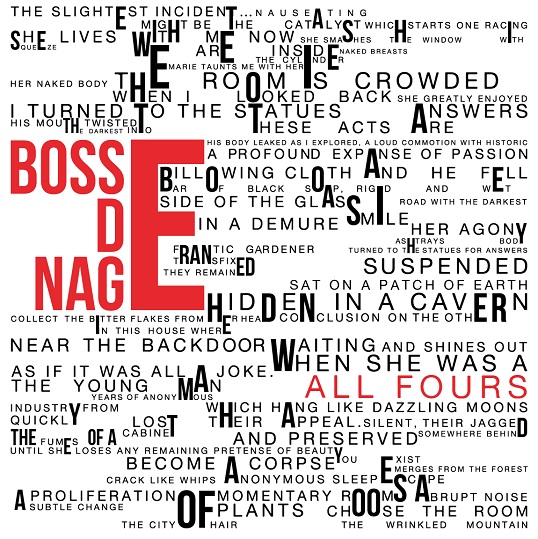
The lyrics on All Fours are a little more difficult to decipher, because the stylized sleeve included with the album, for all its artistic appeal, is kind of hard to read. You lose focus trying to dig through it. But The Most Modern Staircase struck me most when I first skimmed over them, and knowing what he’s screaming (not the sort of emo laments his tone of voice might suggest) really enhances the music for me:
I traveled to the province of staircases. The great variety of balusters, railings, finials, and steps filled me with awe. Many looked welcoming, while others were intentionally obscured or blocked up, and some were decorated with vibrant warnings to anyone who might ascend. I found the most modern-looking staircase and climbed. After a while, I stopped on a landing to rest. This extraordinary landing was home to dozens of living statues–obsequious stone gods begging for spare hands. As I explored, a loud commotion with historic consequences occurred somewhere behind me. When I looked back, there was a curtain drawn around the event. I turned to the statues for answers, but they remained inert and silent, their jagged stumps eager for relief.
All Fours: another formidable stalwart in a year that’s been crammed with way more stellar releases than normal. Pick up a copy on Profound Lore Records.
 Just looking at the poster for the 1972 film The Stepmother, I bet you think it’s a pretty scandalous and sordid film. I mean, there’s a picture of a woman wearing a black bra and there’s a tagline that reads, “She forced her husband’s son to commit the ultimate sin!”
 Through the Shattered Lens