
A funny thing happened on the way to writer/director David Robert Mitchell’s 2014-lensed indie horror It Follows finding its way into the VOD dump-off land most contemporary scare flicks have reluctantly learned to call home : it got noticed. In fact, it got noticed a lot, and evidently by at least some of the right people, because on the basis of positive “buzz” alone, the aforementioned relegation to so-called “home viewing platforms” was quickly scuttled in favor of a limited theatrical release — which just as quickly became a wide theatrical release — which finally ended with this being one of the most-talked- about “supernatural thrillers” in years.
What I can’t figure out is, I’m sorry to say, is why.

Don’t get me wrong — It Follows certainly isn’t bad by any stretch of the imagination, and I’m naturally disposed towards rooting for any sort of original horror film that tries to navigate its way through the contemporary morass of remakes and might-as-well-be-remakes because they’re based on concepts that were played out three or four decades ago, but by the time I got around to seeing this flick yesterday, the hype surrounding it was so all-consuming that my expectations were sky high. Maybe it’s not fair to expect any movie to live up to all that, much less a modest production out of Detroit like this one, but I like to think that I’m honest enough with myself (and, hopefully, with the rest of you) to recognize that my belief that this is just a more-stylishly-done-than-usual presentation of a rather poorly-thought-through, and in many cases bog-standard, story would be unchanged even without the profound sense of “well, that was a bit of a letdown” I left the theater with. I’m not holding Mitchell’s rave reviews against him by any stretch, nor is it fair to judge his work against a yardstick fashioned from others’ praise, but hey — I’m only human, and when I come out of a movie that most everyone else has gushed one superlative after another about feeling decidedly unimpressed, I’ve gotta wonder where the disconnect comes from. Am I really that hard to please, or is everyone else just that wrong?
I mentioned my feelings about the film in a horror and exploitation group I belong to on facebook, and a friend on there made an interesting observation — most of the more glowing reviews for It Follows have come from “establishment” critics (as in, those who routinely guffaw at the horror genre in general, when they even bother to pay attention to it at all), while hard-core “horror hounds” have been decidedly less enthusiastic. A quick bit of research on my part found this to be pretty true — sure, most of the “big” horror sites and publications have been effusive in their praise, but by and large the die-hards out there have been a lot more cool towards it.
My theory is pretty simple — they (as in, your major newspaper and magazine critics) haven’t seen this done a hundred times before, while we (as in, Mr. and Ms. horror aficionado) have. And therein lies the entire difference in perception.
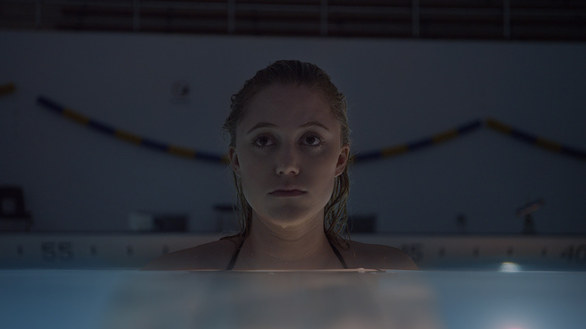
To be sure, Michell has concocted a very stylish little number here — the cinematography and shot composition, the performances, and particularly the sound design are all top-notch. If you don’t watch a lot of horror flicks and are inclined to write the ones you haven’t seen off completely, you could be forgiven for being surprised that some of them are this well done. But when you do watch a lot of horror, and you see vastly superior fare like Starry Eyes garnering far less attention, well — you’re bound to wonder what all the fuss is about in this case.
Likewise, the central premise involving a young woman named Jay Height (played my Maika Monroe, who does a fantastic job) contracting the attention of some sort of malevolent entity after a casual sexual encounter “transmits” it to her might feel reasonably original to somebody who doesn’t “speak fluent horror,” but if you do, you’ll recognize it as a slapdash combination of Shivers-era Cronenbergian body horror and dime-a-dozen, regulation-issue “possession movie” tropes. Furthermore, the idea that sexual “promiscuity” (as in, being female and actually enjoying sex) equals death is the oldest card in the “slasher” movie hand, Mitchell just has the nerve to obfuscate it under a thick enough layer of pretense that you can be swindled into believing he’s “deconstructing” the whole notion rather than reinforcing it. Trust me when I say he’s clearly doing the latter.

Another thing that bugged the shit out of me about It Follows is how flat-out pleased with its own supposed “cleverness” it is. Jay and her sister, Kelly (Lili Sepe) live in a house that’s pure 1970s throwback, and most of their friends drive cars that date to that era, but one member of their slacker clique has a flip-open plastic toy seashell that doubles as a Kindle-type device, while their mom has a fancy-ass modern refrigerator to go along with her Curtis Mathes console TVs and outdated brown shag carpeting. The streets and driveways of their suburban neighborhood seem to be populated with decidedly modern cars and SUVs and mini-vans, as well. This dichotomy of past and future might feel right at home in, say, a David Lynch film, or some other equally-channeled-from-the-subconscious story, but in a narrative as by-the-numbers as this one, it just feels like weirdness for its own sake, and a rather naked plea for attention that the filmmakers don’t trust you enough to get on the first pass, so they keep hammering the point home. Think of the scene in the thoroughly risible Juno where she takes a call in her bedroom on one of those old plastic hamburger-shaped phones and, afraid that you’ll miss how cool and “shabby-chic” the whole thing is, they actually have her say into the receiver “sorry, I can’t hear you so well — I’m talking to you on my hamburger phone,” and you”ll get what I’m driving at here.
The final major flaw in Mitchell’s little opus I feel the need to call attention to is the fact that he apparently hasn’t taken the time to think through how the whole “STD possession” thing works. The guy who gave Jay the “curse” admits he’s still being pursued by the ultra-slow-motion killer(s) after even after playing hide the salami with her, and in due course Jay herself can’t seem to shake it either after screwing some loser friend of hers in the hospital — even after it kills him. She finally seems to manage to lose her pursuers-from-beyond-the-grave when — spoiler alert! — she has sex with her long-suffering male friend/lap dog Paul (Keir Gilchrist, the second of the film’s pitch-perfect leads), but if this is supposed to be some heavy-handed metaphor for the idea that it’s true love that finally sends the spirits packing, I have to say it falls pretty flat, because when Jay finally relents to allowing Paul’s dream of getting his schlong inside her to come true, it feels more like a combination of pity fuck and resignation to pass it on to him just because she’s tired of being — you know — followed. Yeah, sure, he’s clearly over the moon about her, but she seems to have just finally “settled” for a guy who was convenient and cared about her. Talk about playing into the old “you can’t have everything you want, ladies” and “don’t aim for higher than your station in life” pieces of received “wisdom.”
The big denoument here comes when Paul concocts a totally lame-brained scheme to kill the “stalker force” in a public swimming pool — a plan that has disaster written all over it from the outset (disaster that’s only averted due to the fact that every single one of the literally dozens of electrical appliances they toss into the drink doesn’t start shooting sparks; go figure that one out), but I’ll gave that a pass because stupid teenagers do a lot of stupid shit. I find it rather useful to mention, though, simply because it’s such a handy representation in microcosm for why the movie itself doesn’t work, much less live up to all those hyper-congratulatory blurbs we’ve been reading : it all sounds good on paper for about a minute, but ultimately can’t stand up to any sort of even semi-rigorous examination.

 Through the Shattered Lens