Back to School #7: if… (dir by Lindsay Anderson)


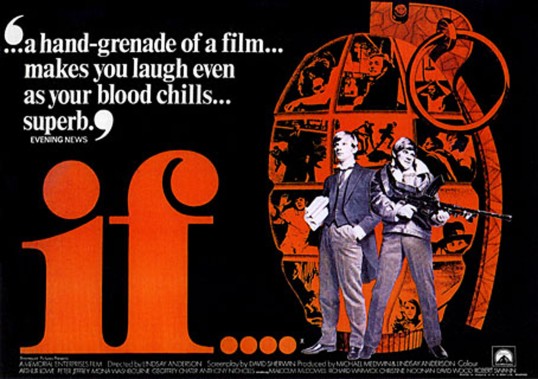
For today’s final entry in our series of Back to School reviews, let’s close out the 60s by taking a look at a 1968 British film.  Directed by Lindsay Anderson, if… not only won the Grand Prix du Festival International du Film (now known as the Palme d’Or) at the 1969 Cannes Film Festival but it also featured the film debut of future icon Malcolm McDowell.

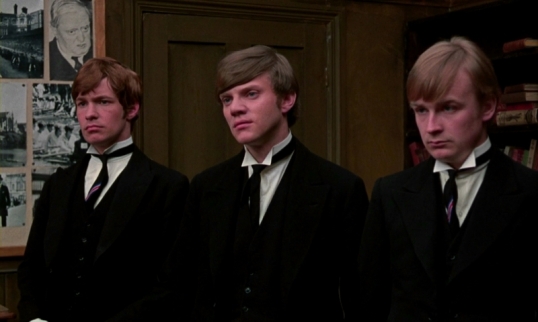
if… takes place at a British public school (or, as we would call it here in the States, a private school) that is mired in a long tradition of conformity and oppression.  For roughly the first half of the film, we see how the school works.  The teachers are stern and out-of-touch.  The headmaster (Peter Jeffrey) considers himself to be something of a reformer and is clueless as to just how little respect the students have for him.  Discipline is maintained by the Whips,sadistic upperclassmen who revel in their power and who spend most of their time speculating about which one of them will claim 13 year-old Bobby Phillips (Rupert Webster) as his own.  Three students — Mick Travis (Malcolm McDowell), Johnny (David Wood), and Wallace (Richard Warwick) — are considered to be nonconformists and soon find themselves being targeted by both the school’s faculty and the Whips.  During this first half, the film plays out as harsh but relatively realistic.

And then something happens.
If2

About 45 minutes into the film, if… starts to grow increasingly more and more surreal.  In a scene that plays out in languid, sensual slow motion, the otherwise dim-witted Wallace gracefully exercises on a high bar while an entranced Bobby Phillips watches.  When Rowntree and his fellow whips decide to punish Mick, Johnny, and Wallace with a particularly brutal caning, the disturbing sound of it echoes throughout the entire school.  During a war game, Mick fires an automatic rifle full of blanks at the chaplain and is subsequently forced to apologize while the chaplain sits up in a drawer kept in the headmaster’s office.  Mrs. Kemp, the wife of the housemaster, wanders naked through the dormitory.  Perhaps most famously, the film goes from randomly being in color to black-and-white and then back again, all adding to the movie’s dreamlike feel.

Perhaps most importantly, Johnny and Mick manage to sneak off campus and spend a day roaming around the city.  After they steal a motorcycle from a showroom, they stop at a cafe where they are served coffee by a character known only as the Girl (Christine Noonan).  The Girl tells Mick that sometimes she’s a tiger and soon, they are wrestling naked on the floor while Johnny sits in a corner booth and drinks his coffee.  Later, when Mick returns to the school, he looks through a telescope and sees the Girl staring back at him and waving.

Johnny, the Girl, and Mick

And finally, the Girl shows up while Mick, Johnny, Wallace, and Bobby are cleaning out a storeroom as a part of their punishment for scaring the chaplain.  Among the dusty shelves, they find not only a jar containing a fetus but a cache of weapons as well.  This leads to the film’s famous conclusion, a shocking act of violence that, in the 60s, was probably viewed as a show of solidarity with rebellious youth everywhere but, when seen in this time and age, draws disturbing parallels with the American tradition of school shootings.

Seen today, if… remains a surprisingly potent celebration of rebellion and a harsh condemnation of conformist society.  Occasionally pretentious in that wonderful way that only a British film made in 1968 could be, if… is also a surprisingly stinging satire that doesn’t leave anyone — even the film’s heroes — untouched.  Perhaps best of all, if… is also the film debut of Malcolm McDowell and he gives a strong performance here.  It’s easy to understand why, after seeing if…, Stanley Kubrick cast McDowell in A Clockwork Orange.  Interestingly enough, despite if’s apocalyptic ending, McDowell would play Mick Travis twice more, in Anderson’s O Lucky Man, a film that is even more surreal than if…, and in Britannia Hospital.

Tomorrow, we’ll continue our journey back to school by taking a trip to the 70s!
If

Back to School #6: High School Caesar (dir by O’Dale Ireland)


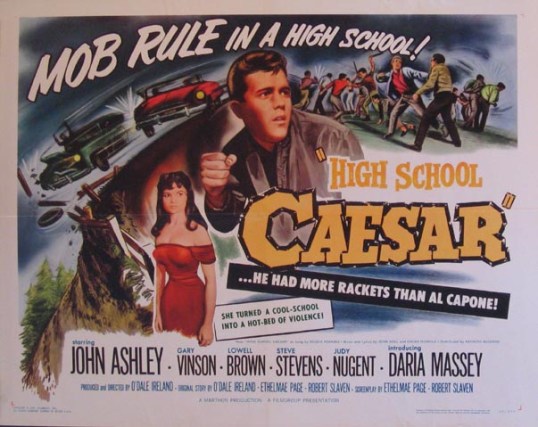
High School Caesar

We continue our trip back to school with a film that I so truly love, 1960’s High School Caesar!

High School Caesar tells the story of Matt Stevens (John Ashley), a high school student who also happens to be an aspiring crime boss.  With the help of his ever present entourage of leather jacket-wearing acolytes, Matt shakes down his fellow students for protection money, sells copies of tests, and even goes so far as to rig the student elections to make sure that he’s elected Student Body President over the idealistic (but rather boring) Kelly Roberts (Lowell Brown).  His classmates may hate him but, along with his jumpy second-in-command Cricket (Steve Stevens) and his sultry girlfriend Lita (Daria Massey), Matt rules the school.

When we first meet Matt, he’s busy beating another student into unconsciousness.  (“He won’t ever pay late again,” Matt explains to his gang.)  In fact, Matt is such a tough guy at school that I’m sure that 1960 viewers were quite shocked to discover that, away from school, Matt actually lives in a mansion.  (Today, the idea that a spoiled rich kid might turn out to be a jerk is no longer all that shocking.)  Matt’s parents are touring Europe and have basically abandon Matt.  The only two people taking care of him are a butler that he talks down to and a maid that he adores you.

As quickly becomes obvious, Matt is intent on controlling the entire school.  However, what he doesn’t know is that a group of the “good” kids (all of whom voted for boring, old Kelly Roberts) have been getting together and having drag races.  When Matt finds out and decides to take that over as well, his classmates finally start to fight back…

So, why do I love High School Caesar?  Well, first off, it’s an out-of-control youth film and I love out-of-control youth films.  After all, this entire back-to-school series pretty much exists because of my love for films about teenagers who are growing up too fast and taking things too far.  But even beyond that, High School Caesar is distinguished by John Ashley’s excellent performance as Matt.  If Buzz hadn’t gone over that cliff in Rebel Without A Cause, he probably would have turned out to be a lot like Matt.  Matt might be a bad guy but, as is evident from his relationship with the family maid, he just needs someone to care about him.

And finally, how can you not love the High School Caesar soundtrack?

Personally, I hope that, at some point in the future, Peyton Reed remakes High School Caesar.  But until then, you can watch the original below!

http://www.youtube.com/watch?v=HyID00xVo6w

Back to School #5: High School Big Shot (dir by Joel Rapp)


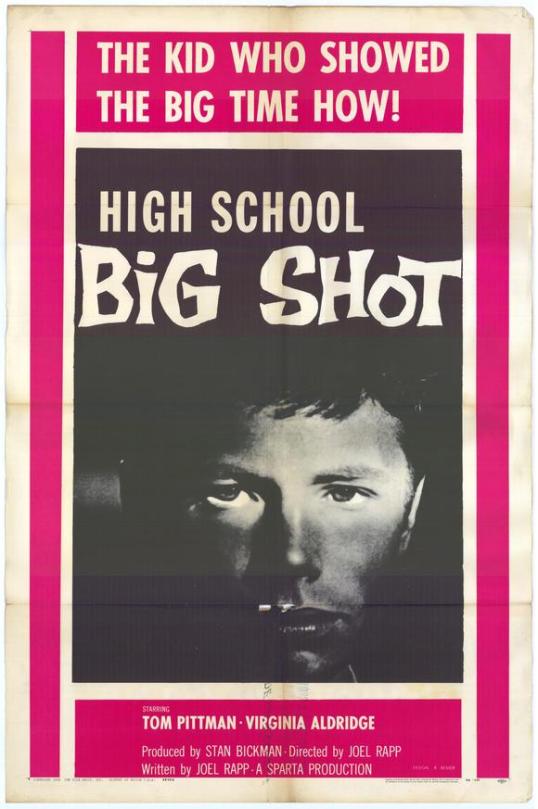
high-school-big-shot-movie-poster-1959-1020228183

We continue our trip back to school with the 1959 teenage heist film, High School Big Shot!

Oh my God, this movie is so dark.  Rebel Without A Cause and Blackboard Jungle weren’t exactly optimistic portraits of the youth of America but none of them could ever hope to be as cynical and bleak as High School Big Shot.  This film, which I guess could best be described as being a high school noir, tells the story of poor, socially awkward high school student Marv (Tom Pittman).  Marv is a genius and, while he’s not popular at school, he does seem to have a wonderful future ahead of him.  He’s recently applied for a scholarship and his English teacher has agreed to write him a letter of recommendation because, as he puts it, Marv is “different from all the others.”

And Marv needs that scholarship because his father is an alcoholic who can’t hold down a job.  Marv’s relationship with his father is perhaps best epitomized by an early scene where he asks Marv to loan him some money because he has a date.  Marv has a date too but he still loans his dad the money.  Cut to the next scene and Marv is telling his date that he can’t really afford to take her anywhere but he can get her a Coke if she wants one.

Seriously — dark.

Marv’s life starts to look up when Betty (Virginia Aldridge) suddenly takes an interest in him and even agrees to go out with him.  However, as Betty explains to her loutish boyfriend Vince, the only reason that she’s going out with Marv is so she can trick him into writing her English term paper for her.  Marv, of course, agrees to do just that and then asks Betty if she wants to get married after they graduate from high school.

Again, dark.  Dark and awkward.

When the English teacher figures out that Marv wrote Betty’s term paper, Marv loses his scholarship and it looks like he’s now destined to spend the rest of his life working down at the docks.  However, Marv discovers that his seedy boss has recently received a million dollars in drug money.  Looking to both buy Betty’s love and help out his suicidal father, Marv comes up with an elaborate scheme to steal the money.  However, Betty and Vince have plans of their own…

Needless to say, it all leads to a violent climax that leaves nearly every character in the film dead.

And all because poor Marv wanted to impress Betty.

Like I said, dark.

And yet, the film itself is so dark that it becomes oddly fascinating.  You watch because you’re genuinely curious about how much darker Marv’s life can get.  It also helps that Tom Pittman gives a sympathetic performance as Marv (even if he does appear to be a bit too old to be playing a high school student) and Virginia Aldridge makes for a great femme fatale.  If this film were made today, it would probably be directed by David Fincher and it would star Anton Yelchin and Jennifer Lawrence.

And it would be great!

But until that happens, you can watch the original below!

http://www.youtube.com/watch?v=5K_Y3tEPlSY

Back to School #4: Rebel Without A Cause (dir by Nicholas Ray)


You may have heard of this one.

Traditionally, films about teenagers tend to age terribly.  The language, the clothes, the attitudes, and even the humor; it’s all usually out-of-date within five years or so.  One need only watch something like A Summer Place to both see how dated a film can become and to see how one generation’s idol can appear rather ludicrous to future generations.  (And yes, I am talking about Troy Donahue…)  What makes Rebel Without A Cause unique is that it’s a movie about teenagers that was released way back in 1955 and yet, nearly 60 years later, it still feels fresh and relatable.

Of course, it helps that the title character is played by James Dean who, to put it lightly, was no Troy Donahue.

Rebel Without A Cause tells the story of three alienated teenagers trying to survive in the suburbs of Los Angeles.  (“…and they all came from good homes!” the film’s poster informs us.)  Plato (Sal Mineo) is a painfully sensitive 15 year-old who has been abandoned by his parents and is being raised by the family’s maid.  (Since this movie was made in 1955, the fact that Plato is gay is obvious but never explicitly stated.)  Judy (Natalie Wood) is the girlfriend of Buzz (Corey Allen) and is acting out because she feels that’s the only way she can can get her father to pay attention to her.  And then there’s Jim Stark (James Dean), whose family has just moved to Los Angeles and who is constantly in the middle of the fights between his overbearing mother (Ann Doran) and his weak-willed father (Jim Backus).

Rebel Without A Cause 2

During Jim’s first day at high school, he not only manages to make an enemy when Buzz spots him attempting to flirt with Judy but he also gets to go on a field trip to the Griffith Observatory, where the students are told that the entire universe is going to end eventually.  After the field trip, Buzz challenges Jim to a knife fight.  Jim agrees only after the rest of Buzz’s gang (including a young Dennis Hopper) accuse him of being “chicken.”  However, after a security guard breaks up the fight, Buzz challenges Jim to a “chicken run.”

(People in the 50s were obsessed with chickens.)

That night, Jim and Buzz both drive stolen cars towards the edge of a cliff.  The first driver to jump out of his car loses.  Before they start their engines, Buzz smiles and tells Jim, “I like you.”  Yay!  Jim’s finally made a friend!  Uh-oh, Buzz just drove over the cliff and his car exploded!  Well, so much for that friendship.  Now, with Buzz’s gang swearing revenge and their parents incapable of understand what happened, Jim, Judy, and Plato are on the run.  They end up hiding out in an abandoned house and find a brief moment of happiness before the gang and the police show up to ruin everything.

NW-nataliewood-rebel-love

The challenge of reviewing Rebel Without A Cause is trying to find a new way to say what everybody already knows.  Rebel Without A Cause is a great film that’s distinguished by Nicholas Ray’s sensitive direction and James Dean’s iconic performance in the lead role.  Whenever I see Rebel Without A Cause, I’m always struck by just how much unexpected nuance there is Dean’s interpretation of Jim Stark.  We always think of James Dean as being the epitome of cool and I think we tend to forget that, at least in the beginning of the film, Jim is anything but that.  Instead, he’s awkward and shy.  His attempts to flirt with Judy lead to her calling him “a real yo-yo.”  As much as he tried to fit in with the rest of his classmates, he’s a permanent outsider.  (Just consider what happens with his infamous “moooo” during the presentation at the observatory.)  He has a lot to say but he doesn’t know how to say it and every time that he tries to express what he’s feeling, he’s ignored by adults who don’t have the patience to listen.  Dean brings such a raw intensity to these scenes that I always find myself wanting to reach out and hug him and tell him that everything’s going to be okay, even though I know that it’s not.  Even today, it’s still easy to see why every teenager in the 50s either wanted to be or to be with Jim Stark.

Also, whenever I watch the film, I’m reminded of how much I relate to the character of Judy.  I think that’s because, when I was 16, I might as well have been Judy.  Natalie Wood’s performance might not be as showy as James Dean’s but it’s equally effective.

Of course, one reason why Rebel Without A Cause has become iconic is because James Dean died shortly after filming ended.  (In fact, some of his scenes had to be redubbed by Dennis Hopper, who reportedly could do an exact imitation of Dean’s voice.)  It’s interesting to wonder what would have become of James Dean if he had lived.  Would he have continued to be one of our best actors or would he have eventually been forgotten or forced to appear on television?  Personally, I like to think that James Dean would have remained a great actor but he would have been too much of an iconoclast to remain in Hollywood.  Eventually, in my alternative universe, James Dean moved to Europe and teamed up with Klaus Kinski to star in a series of spaghetti westerns.  And they were great.

As for Rebel Without A Cause, it remains a great movie nearly 60 years after it was first made.  And really, what more needs to be said?

Rebel


Back to School #3: Blackboard Jungle (dir by Richard Brooks)


http://www.youtube.com/watch?v=HA0_NRjx9KQ

You really can’t write about high school films without writing about 1955’s Blackboard Jungle.  While the film is often cited as being the first movie to feature a rock song on its soundtrack (Bill Haley’s Rock Around The Clock is played at the opening and the end of the film), Blackboard Jungle should also be remembered for being one of the first and most influential examples of the dedicated-teacher-in-the-inner-city film genre.

Blackboard Jungle tells the story of Richard Dadier (Glenn Ford), a newly hired teacher at an inner city high school.  As soon as he arrives for his first day at work, he meets his co-workers.  Josh Edwards (Richard Kiley) is another new teacher and is convinced that he can reach the students by talking to them about his valuable collection of jazz records. Mr. Murdock (Louis Calhern) is a burned out old cynic who believes that none of the students at the school have a future.  As Dadier quickly discovers, most of his fellow teachers have more in common with Murdock than with either him or Josh.

At first, Dadier struggles to reach his students, the majority of whom don’t see why they should waste their time in English class.  The head troublemaker, psychotic Artie West (Vic Morrow) sees the new teacher as being a rival and Dadier’s attempts to reach another student, Gregory Miller (Sidney Poitier), are made difficult by the racial animosity that dominates the entire high school.  Soon, Dadier is being targeted by his students and his pregnant wife (Anne Francis) starts to receive anonymous letters that imply that Dadier is having an affair.  It all leads to a violent classroom confrontation in which Dadier’s students are finally forced to pick a side in the battle between the forces of education and the forces of chaos.  (If that sounds melodramatic — well, it is kinda.)

It’s a little bit difficult to judge a film like Blackboard Jungle today.  We have seen so many movies about idealistic young teachers trying to make a difference in the inner city that it’s pretty easy to guess most of what is going to happen here.  In order to appreciate Blackboard Jungle, it’s necessary to understand that the only reason why it occasionally seems predictable is because it’s such an incredibly influential film.  And there are still moments in Blackboard Jungle that can take the viewer by surprise.  The scene in which Ford lists off all of the racial slurs that he doesn’t want to hear is just one example.  It’s hard to imagine that scene appearing in a movie made today.  (If it did, it would probably be played for laughs.)

That said, the performances in the film hold up surprisingly well.  Glenn Ford is a compelling hero and he and Anne Francis make for a likable couple.  Despite being 28 years old and having already played several adult roles, Sidney Poitier is a convincing high school student and, not surprisingly, he makes for a convincing leader.  However, for me, the film was dominated by Vic Morrow.

As played by Morrow, Artie Turner is a truly frightening villain.  In previous films about juvenile delinquency, the emphasis was always put on why the delinquent went bad and usually, the blame was put not on the teenager but instead on the environment around him.  He had bad parents or maybe he listened to too much jazz but, ultimately, he was not lost.  He was merely damaged.  However, Artie Turner has no convenient excuses for his behavior.  His parents go unmentioned.  When he’s exposed to jazz, he responds by breaking all of Mr. Edwards’ records.  Among all of Dadier’s students, Artie is unique in that he cannot be reached.  He’s a force of pure destruction and ultimately, Dadier’s success as a teacher depends less on reaching Artie and more on convincing his other students to reject Artie as a role model.

Blackboard Jungle may be a film that feels very familiar but it’s still one worth watching.

Artie Turner Acting Out

Artie Turner Acting Out


Back To School #2: Delinquent Daughters (dir by Albert Herman)


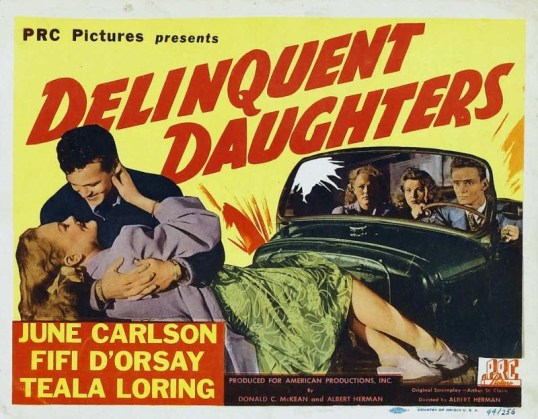
Delinquentdaughters22

As difficult a time as poor Jimmy Wilson may have had in I Accuse My Parents, he had it easy compared to the high school students in another 1944 look at teens-gone-wild, Delinquent Daughters!

In the tradition of many a great low-budget exploitation film, Delinquent Daughters starts out with a newspaper headline.  A teenage girl named Lucille Dillerton has committed suicide and, according to the headline, juvenile delinquency is on the rise!  Seeking answers for why the town’s teenagers have suddenly gone crazy, the very stern Lt. Hanahan (Joe Devlin) goes to the high school and starts a very heavy-handed investigation.  However, even in 1944, everyone knows that snitches get stitches.

Or, as student Sally Higgins (Teala Loring) says, “I’m allergic to quiz programs….I don’t know nothing and I forgot everything I ever knew.”  Sally, it quickly becomes obvious, is the ring leader of the town’s delinquent daughters.  She was also my favorite character in the movie because 1) she was a rebel, 2) she was independent, and  3) she didn’t take any crap from anyone.  The adults in the film might condemn Sally but I’ll bet most of the people sitting in the audience wanted to be her.

Anyway, it quickly becomes apparent that Lucille’s death was connected to the Merry-Go-Round club, a popular teen club that’s owned by a gangster named Nick (Joe Dawson) and his girlfriend Mimi (Fifi D’Orsay, and who wouldn’t want to live at least one day with a name like Fifi D’Orsay?).  Nick gets away with serving liquor and playing jazz at his club by providing adult “chaperones” for all the teens.  Or, as Nick puts it to Mimi, “We got chaperones so we can deal with the bobby sock trade.”

Delinquent Daughters is another one of those movies where the worst possible thing that could happen does happen.  Apparently in the 1940s, any act of teenage rebellion would eventually lead to murder and dancing.  Much as with I Accuse My Parents, this is a film that I like because it’s both a view into an earlier age and evidence that teenagers have always been viewed as being trouble.

And you can watch it below!

http://www.youtube.com/watch?v=-K5mQeMkB1E

Back To School #1: I Accuse My Parents (dir by Sam Newfield)


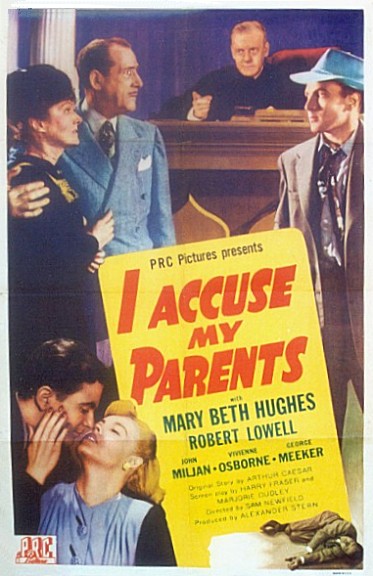
I_accuse_my_parents

Do you know what time of year it is!?  Well, yes — it is August and soon it will be September.  But even more importantly, it’s back to school time!  Summer is over and, all across the country, children and teenagers alike are getting ready to return to school.  Some schools in America have already opened.  In my part of Texas, school is officially starting on August 25th.  So, what better time than now for the Shattered Lens to go back to school?  Over the next 8 days, we’ll be taking a chronological look at 76 films about teenagers and high school.

And what better film to start with than the low-budget 1944 look at juvenile delinquency, I Accuse My Parents?  Well, technically, there’s probably a lot of better films that I could start with but, to be honest, I just love this film’s title.  I Accuse My Parents.  It’s just so melodramatic and over the top, much like this film itself.  And yet, the title also carries a hint of the truth.  After all, who hasn’t accused their parents at one point in their life?

I Accuse My Parents opens with Jimmy Wilson (Robert Lowell) standing in a courtroom and being addressed by a stern-sounding judge.  Despite the fact that Jimmy appears to be in his early 30s, the film continually assures us that he’s a teenager.  He’s been accused of manslaughter and, as the judge tells us, he has apparently failed to provide any help to his defense lawyers.  Does Jimmy have anything to say in his defense?  Jimmy looks down at the floor, obviously deep in thought.  Finally, he looks up and says, “I accuse my parents.”

“OH MY GOD!” everyone in the courtroom says in unison.  Or, at least, they would have if this film hadn’t been made in 1944.  Instead, they simply gasp in shock.

It’s flashback time!  We see that before Jimmy became a murderous criminal, he was just your normal 30 year-old high school student.  He even won an award for writing an essay about how wonderful his parents were.  Little did his fellow students suspect that Jimmy’s mom was actually a drunk and his father was more concerned with business than with raising his son.  When Jimmy’s mom showed up at the school drunk, all of Jimmy’s friends saw her and laughed.  Jimmy’s essay of lies had been exposed!

Even worse, when Jimmy got an after-school job as a shoe salesman, he met and fell in love singer Kitty Reed (Mary Beth Hughes).  Little did Jimmy suspect that Kitty was also the mistress of gangster Charles Blake (George Meeker).  Blake recruited Jimmy to start delivering stolen goods.  Unfortunately, award-winning essay aside, Jimmy was a bit of an idiot and never realized, until it was too late, that he was being drawn into a life of crime.  Even worse, his father was too busy working and his mother was too busy drinking to see what their son was getting involved with.

I have a soft spot in my heart for films like I Accuse My Parents.  These films take place in a world where the worst thing that can happen will always happen.  Being neglected by his parents doesn’t just leave Jimmy feeling angry or resentful.  Instead, it leads to him meeting a gangster and becoming a criminal.  And while most of the on-screen evidence would suggest that Jimmy’s main problem is that he’s a little bit stupid (and that would certainly explain why, despite clearly being in his 30s, Jimmy is still a senior in high school), the film wants to make it very clear that all of this could have been avoided if only he had better parents.

Add to that, it’s interesting to see that, even in the 1940s, it wasn’t easy being a teenager!

Finally, it should be noted that the film ends with a note letting us know that the producers had shipped copies of the film off to our fighting forces in Europe, which I think was sweet of them.  (Though I have a feeling that the soldiers might have preferred something featuring Lana Turner…)

Feel free to watch I Accuse My Parents below.

Enjoy!

http://www.youtube.com/watch?v=B2b-H4Y8190