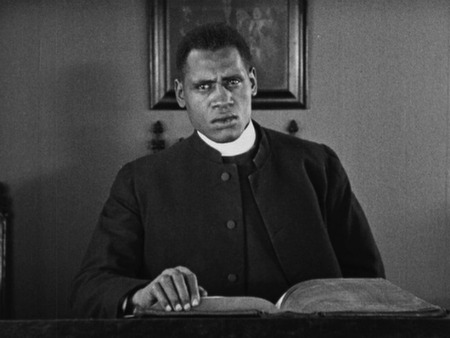
Let’s continue to embrace the melodrama with the 1925 silent “race” film, Body and Soul.
Body and Soul was directed by Oscar Micheaux, who may not be a household name but who is still a very important figure in the development of American film. Though he may be forgotten today, Micheaux was the first major African-American filmmaker. At a time when the major studios were only willing to use black actors as comic relief, Micheaux made films that attempted to seriously deal with race relations and provide a realistic portrait of black life in America. As a result, Micheaux’s films serve as a historical record of a community that, for most of the 20s, was either ignored or condescended to by the majority of American films. While Micheaux is believed to have directed 26 silent films, only 3 are known to have survived. Of those three, Body and Soul is the best known and the most acclaimed.
In Body and Soul, Paul Robeson plays an escaped prisoner who, upon finding himself in the predominantly black town of Tatesville, Georgia, takes on the false identity of the Rt. Rev. Isaiah T. Jenkins. While the majority of the citizens in town take one look at Jenkins’s collar and assume that he must actually be a man of God, Jenkins spends his private time drinking and coming up with schemes to swindle his congregation out of their money. Jenkins also pursues a member of his congregation, Isabelle (Julia Theresa Russell), despite the fact that Isabelle is in love with the poor but decent Sylvester (who also happens to be Jenkins’ brother and who is also played by Robeson). It all leads to tragedy, death, murder. Indeed, for a film that was made and released in 1925, Body and Soul is surprisingly critical of organized religion. Or, at least, it is until the awkwardly uplifting ending, which is best ignored.
For those of us who were raised on special effects and sweeping camera movements, there’s always a moment of adjustment that comes whenever we start to watch a silent film. We tend to take cinematic magic for granted and, as a result, we are often surprised by the largely stationary camera, the minimal sets, and the overly theatrical style of performance that largely typifies the silent era. All of these elements are present in this film but, once you adjust to the style of a different era, Body and Soul actually hold up fairly well. If nothing else, the film’s portrait of a corrupt and decadent clergy is just as relevant today as it probably was in 1925. But, to be honest, the film is mostly worth watching for Paul Robeson’s wonderful lead performance. While he’s a bit on the dull side as Sylvester (but, then again, Sylvester is a dull character), Robeson turns Rev. Jenkins into a charismatic and magnetic force of corruption. Whereas a lot of other actors (especially in the silent era) would have gone far too overboard with Jenkins’ villainy, Robeson plays up the reverend’s sinister charm. As a result, Body and Soul remains both a valuable piece of cinematic history and a watchable melodrama.
Watch it below!
 Through the Shattered Lens