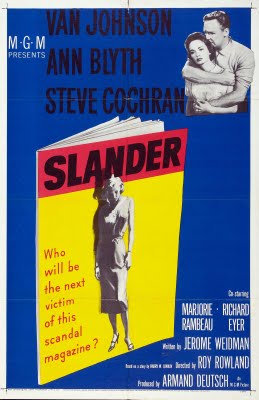
Slander, much like A Cry In The Night, is a B-movie from the 1950s that I recently discovered via Turner Classic Movies. It’s appropriate that both of these relatively obscure films recently aired on TCM because both Slander and A Cry In The Night serve as interesting time capsules of the decade in which they were made.
To truly appreciate Slander, you have to know that, during the 1950s, Hollywood was terrified of magazines with names like Confidential, Exposed, and Private Affairs. These were the magazines that claimed to tell the “sordid” truth about Hollywood. In the 1950s, image was everything and one well-placed story that suggested that an actor or actress was a drug user, a former criminal, a communist, or — gasp! — gay, could end a career. In the 50s, Hollywood filmmakers viewed the tabloids with the same loathing that they currently feel towards the paparazzi. Slander was Hollywood’s attempt to expose the tabloids. Perhaps that’s why it’s appropriate that Slander, in many ways, feels like a 50s version of Paparazzi.
Slander opens with tabloid magazine editor H.R. Manley (Steve Cochran) looking over him empire of scandal and searching for someone to destroy. From the minute that we see Steve Cochran with his slicked back hair and hear him delivering his lines through permanently clenched teeth, we know that H.R. Manley is a bad guy. Indeed, Cochran was best known for playing gangsters and that’s how he plays H.R. Manley. It’s not subtle but it’s definitely entertaining.
Manley wants to destroy Mary Sawyer, an actress who is never seen but who we are assured is America’s sweetheart (or, as Manley puts it, “Everyone thinks she’s practically a nun, right?”) . Manley becomes convinced that children’s entertainer Scott Martin (Van Johnson) has some damaging information on Mary. When Scott refuses to betray his friend, Manley sets out to destroy Scott by revealing that, before he become America’s most beloved puppeteer, Scott served time in prison on an armed robbery conviction.
(To understand just how ludicrous this revelation is, you have to understand that Scott is played by Van Johnson who was pretty much the epitome of the fresh-faced, likeable, All-American optimist in the 50s.)
Despite the pleas of his wife (played by Ann Blyth), Scott refuses to give into blackmail. Soon, Scott Martin is on the cover of the Manley’s magazine. In the great tradition of the 50s social problem film, this leads to the most melodramatic conclusion possible.
Watch, in amazement, as Scott’s son reacts to the scandal of his father being a former criminal by running out in the middle of the street and getting hit by a car.
Try to look away as Manley’s drunken mother (played by Marjorie Rambeau) considers killing her own son in order to end the evil of the tabloid press.
Listen, in shock and regret, as Scott goes on television and gives an overwrought speech in which he tells us that if we’ve ever read a tabloid magazine then we are responsible for his son’s death.
Or, as one extra says when he spots Scott and his wife walking down the street, “Maybe people will stop reading those tabloids…”
It’s a bit too overwrought for its own good but I have to say, as someone who looks forward to going to the doctor specifically so she can read the copies of US Weekly that he keeps in the waiting room, I enjoyed Slander. The film is melodramatic and totally over-the-top and, as a result, it’s also a lot of fun. If for no other reason, the film is worth watching just for the chance to enjoy Steve Cochran’s incredibly sleazy portrayal of the apparently soulless tabloid editor.
Slander shows up on TCM occasionally but it’s also available for viewing on YouTube. Or, if you’ve got 81 minutes to kill, you can watch it below.
 Through the Shattered Lens