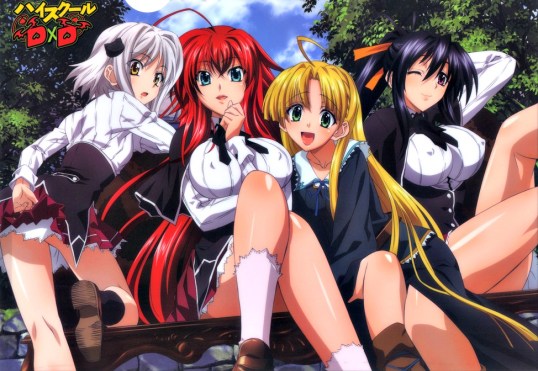
News that should make fellow site writer and contributor pantsukudasai56 very happy just came down the pipeline. According to Anime News Network the shonen series High School DxD has been given the greenlight for a second season.
While details about this second season has been, for the moment, quite sparse the fact that the season is now in production means that it’s not just a promise of one, but a guarantee that more harem hi-jinks involving the clueless Issei Hyodo and the beautiful, albeit demonic, girls of his high school. This is a series that’s definitely more about comedy than anything serious and/or thought provoking. Then again one can only survive on dramatic and deep anime for so long. Some levity needs to be mixed in with the dark and High School DxD certainly delivers in that front.
The popularity of the series (and the new season should get quite a welcome from its fans) also stems from the fact that it is a harem anime that also involves some very ecchi (fan service) moments. While this type of anime doesn’t appeal to everyone it still attracts a huge number of anime fans.
There’s no word when the new season will air, but until then I’m sure pantsukudasai56 will be anticipating ew stuff from his favorite character on the show: Koneko Toujou.
(This is not a political post but if it was, it would solely reflect my opinion and not necessarily the opinion of anyone else who writes for this site.)
The big news tonight seems to be that former President Bill Clinton is giving a speech at the Democratic National Convention. After being told by several people on twitter that Clinton is “one of the greatest speakers of all time,” I listened to a few minutes of “America’s greatest politician” and you know what?
I still prefer Clint Eastwood.
That’s not meant to be an endorsement of any political position that has or has not been advocated by Clint Eastwood over the past few weeks. This is not a political statement as much as it’s just an acknowledgement of the fact that Presidents give speeches but Clint Eastwood gets results.
And that leads me to tonight’s scene that I love. From the classic 1971 crime film Dirty Harry, here’s the famous scene that explains why so many people love Clint Eastwood in the first place.
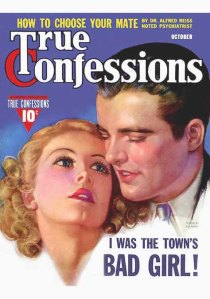
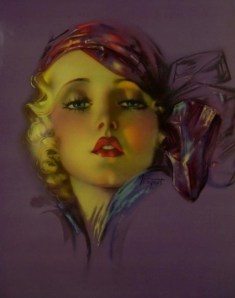
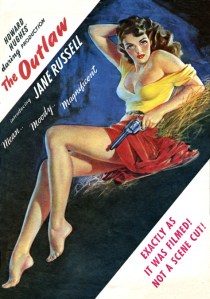
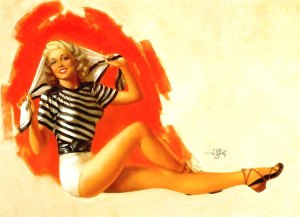
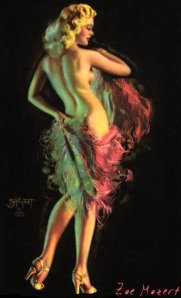
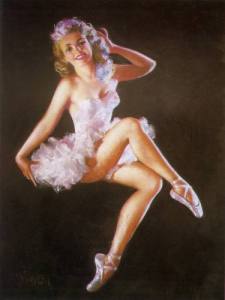
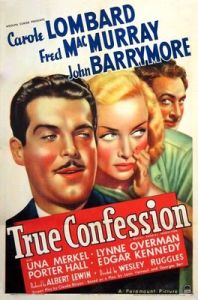
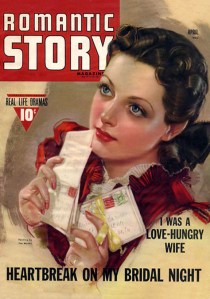
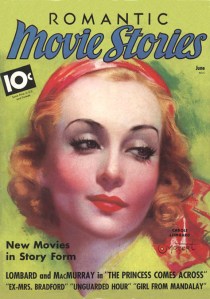
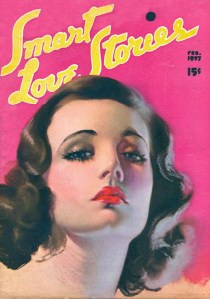
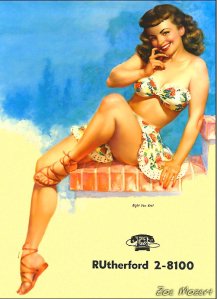
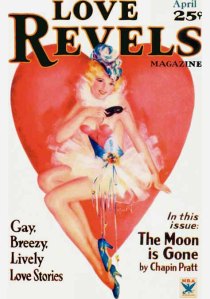
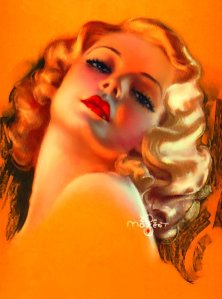
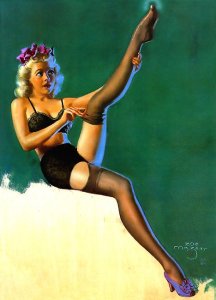
Zoe Mozert was one of the few female glamour/pin-up artists and she was one of the most famous. A graduate of the Philadelphia School of Industrial Art, Mozert began her career as an illustrator in 1932. She often used herself as her model and her illustrations were known for their realistic depiction of women. Along with her pin-up work, she illustrated hundreds of covers for magazines like Romantic Movie Stories and True Confessions.
VGM Entry 38: Follin’s Ghouls’n Ghosts
(Thanks to Tish at FFShrine for the banner)
Even as the Sega Genesis was coming into its own and the Super Nintendo was on the verge of release, Tim Follin reappeared to give the “old systems” a final touch of perfection. Though his non-ZX Spectrum works immediately following the 1987 Bionic Commando arrangement were fairly insignificant, he had learned a lot (not to mention ceased to be a teenager). By 1989 he was ready to take on the world, and put to the task of reworking the Ghouls’n Ghosts (Capcom) soundtrack for the Amiga and Commodore 64, he suffered a stroke of genius which few have yet to match.
This is the title theme to Ghouls’n Ghosts for the Amiga, released in 1988. Enjoy it.
Even the tracks which were not originally his took on a whole new life. With all due respect to Tamayo Kawamoto, Tim Follin’s work on the Commodore 64 rendition of “Stage Two” was a drastic improvement. From the very get-go, Kawamoto’s oompa tuba and staccato flute are replaced by a booming four-note bass line and a much smoother flute tone. The song exhibits delicious dynamics, with the flute sounding out loud for the first two seconds and then immediately quieting down to make room for a wavy, ghost-tone main melody line decisively more appropriate for the theme of the game than Kawamoto’s clarinet. Kawamoto’s counterpoint on the repeat isn’t entirely convincing, and after one time through the song transitions. Follin avoids layering the melody entirely, perhaps out of necessity, but the creativity of his additional repeats and the awkward yet delightful added percussion more than compensate. Limited in the number of tracks he could produce, Follin had no hope of replicating the second half of the song on a C64, so after faithfully playing out the lower track he just took off into his own imaginative world, leaving Kawamoto behind altogether from about the 1 minute mark on. Where Kawamoto’s entire song loops at 54 seconds, Follin’s is extended to a two and a half minutes and doesn’t loop at all, fading out as a completed piece before starting over.
The music to Level 5 on the Commodore 64 is another Follin original, and it kicks off with enough amplifier worship to make Sunn O))) proud. Unlike pretty much all of his previous works, Follin’s original tracks in Ghouls’n Ghosts exhibit a sense of awareness of the game itself. He wasn’t about to let the needs of the game hold him back, but he was for once shaping his music around an appropriate theme. Follin maintains the relativity until 1:18, at which point we’re suddenly treated to an Emerson Lake & Palmer progressive rockout. The soft distortion in the background of the whistle starting at 1:58 is just brilliant, if by now completely out of touch with the game. It briefly reminds me of foggy seaside songs like Jeremy Soule’s “Pirates of Crustacia” (Secret of Evermore, Square, 1995).
Make what you will of the “End Theme” track which follows. It’s nothing to brag about, but it’s part of the package. I think the “Hi-Score” tune wrapping up the video more than compensates.
So there’s perhaps your first encounter with Tim Follin outside of the ZX Spectrum. He’s by no means forgotten, but not overwhelmingly famous either. His work on Bionic Commando 1987 made a loud statement, and his ZX Spectrum works stand in a league of their own on the system, but the Commodore 64 and Amiga arrangements of Ghouls’n Ghosts are what really brought him into full form for the first time and cemented his place in history. He would never surpass his accomplishments in 1989, in my opinion, but he would maintain an impressively high standard for many years to come, and he would excel on a more diverse range of systems than most any other composer in the business.


 Through the Shattered Lens