It’s been awhile since I put up a scene I love from a film I love. Time to change that and what better way to do it than pick a favorite scene from one of the best films ever made: Apocalypse Now.
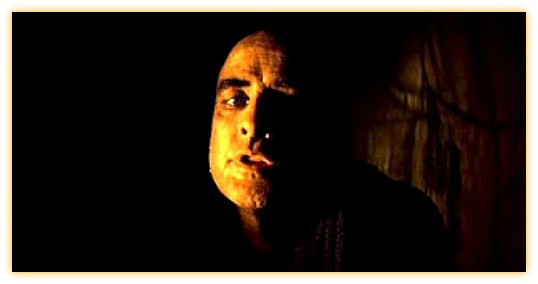
This particular scene occurs in the last act of the film which finally puts Capt. Willard (Martin Sheen) face-to-face with his target in the off-the-reservation Special Forces commander Col. Kurtz. This is the first time we actually see Marlon Brando in the role of Kurtz in a film that’s been obsessed with his character right from the very beginning. The glimpses we get of Kurtz are fleeting as he remains in the shadows with only his rumble of a voice giving weight to his presence in the scene. I have to admit that even after seeing this film for over a hundred times through the years it’s still pretty difficult to understand some of what he is saying. Yet, when such an occurrence would be a death for a scene it doesn’t for this scene. It only helps highlight just how far down the abyss this former paragon of American military might has put himself in to accomplish a mission given to him by people he dismissively call “grocery clerks”.
There’s no soundtrack to try and manipulate the scene for the audience. It’s just the ambient noises of the jungle and the ancient temple Kurtz and his people have called home. Even the dialogue in the beginning of the scene where Kurtz inquires about where Willard was from was full of menace and hidden dangers. It’s very difficult not to get hypnotized by this scene. There’s not a fake beat to the dialogue between Sheen and Brando. The way the scene unfolds almost acts like a metronome that lulls the viewer until the reveal in the end when we finally see Kurtz’s face in full for the very first time.
Coppola has done great work before this film with hi first two Godfather films but this scene in this film I consider the best he has ever put on celluloid.
“Kurtz: Are you an assassin?
Willard: I’m a soldier.
Kurtz: You’re neither, you’re an errand boy, sent by grocery clerks to collect a bill”
 Through the Shattered Lens
Great post, it’s one of those scenes that really sticks in the memory for a long time
LikeLike
I really dig the soliloquy where Kurtz talks about killing without judgement, without prejudice…there is so much to be mined from what Kurtz says. The whole irony is that Kurtz is considered by his superiors to be deranged, but the entire war is an act of madness. The entire film is as good an advertisment as any as to exactly why one shouldn’t enlist in the military. Taken as a whole, the film is a powerful anti-war statement.
LikeLike
For some it is while others actually think it’s a pro-war one. I’m with Coppola in what he was trying to convey. It’s a film that’s anti-lie. Just like the story it was adapted from the film looked at the concept of the “Lie” as the impetus for war, greed, murder and the other hosts of social problems mankind has had to endure since before written history. Take the Vietnam War setting Coppola used and put in Wall Street or Politics and many other scenarios where the concept of lying has become second-nature and the film would work just as well.
I always saw Apocalypse Now as a condemnation of the human species more than anything as provincial as a condemnation of war. Coppola has shared something similar with a fellow filmmaker from his generation, George A. Romero, in that he doesn’t see humanity in a positive light but one that’s doomed to self-destruct despite any attempts to civilize and improve itself. Kurtz realized this both in the novella and in the film. Its not that the war is an act of madness (something which both Coppola, Milius [to an extent] and Conrad attribute to the notion that mankind’s greatest skill is waging war and lying) but that trying to civilize and put rules to waging it is madness.
War is an endeavor that needs to be conducted as brutally and as uncompromising as possible to leave a lesson to those who may think to do it again.
Then again Coppola’s film has been seen as something different by untold numbers of people and none of them can be considered a wrong interpretation which just goes to show that Coppola hit his peak as an auteur (not just of film, but of art itself) with this film and has been downhill since.
LikeLike