A Grindhouse Quickie with Lisa Marie: The Demon (dir. by Percival Rubens)


Last summer, I decided to watch and review all 50 of the films to be found in Mill Creek’s Chilling Classics box set.  Mill Creek, of course, is a company that’s best known for releasing box sets that seem to primarily feature low-budget films that, for whatever reason, have now found themselves in the public domain.  If you’re a fan of old school B-movies in general, then you probably know just how fun it can be to read the back of a Mill Creek boxset and discover what obscure films are waiting inside.  The thing that I especially love about Mill Creek is the fact that — in the best grindhouse tradition — they describe every film that they distribute (whether it’s George Romero’s Night of the Living Dead or something like Las Vegas Bloodbath) as being a “classic.”

So, anyway, I started to watch and review the films in the Chilling Classics box set but, as 2011 drew to a close, things got rather hectic and busy here at the TSL Bunker.  In between covering the Oscar season and keeping the world supplied with weekly trailer posts, I had to set aside my plans to review the entire boxset for another day. 

Well, I’m happy to say that day is here!  Last night, I dug out the old Chilling Classics box set and I watched a South African slasher film from 1981, The Demon.
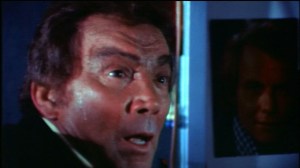
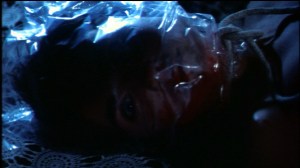
The Demon actually tells two separate but connected stories.  In the first story, a teenage girl is kidnapped from her bedroom by a masked killer.  Her distraught family calls in a tormented psychic who quickly proves himself to so superfluous and useless that you’d forget all about him except he’s played by the late Cameron Mitchell. 

If you’re a fan of old school grindhouse and exploitation films then you’ve undoubtedly seen a handful of films featuring Mr. Mitchell.  A former “legitimate” actor who, early on in his career, appeared in things like Death of a Salesman, Mitchell eventually became better known for appearing in low-budget exploitation films.  Mitchell could always be counted on to shamelessly overemote and, regardless of the film he was appearing in, he was always a lot of fun to watch.  If nothing else, Mitchell always seemed to be rather amused by the films he found himself in.  It’s a shame that Cameron Mitchell died before Quentin Tarantino could engineer a comeback for him. 

In The Demon, Cameron Mitchell spends most of his limited screen time standing on a rocky cliff while staring down at the ocean below and having psychic visions that don’t really seem to have much to do with anything else happening in the film.  Actually, visions is the wrong word.  As Mitchell says, “Sometimes…I get these feelings.  Vibes, as the kids would say.”

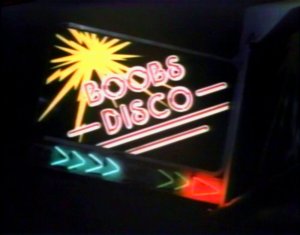
And the kids are in a lot of trouble because our nameless killer has moved on to the city where he spends his time hanging around outside of a place called Boobs Disco and stalking two teachers named Mary (Jennifer Holmes) and Jo (Zoli Markey).  This is the film’s second storyline and it mostly consists of Mary spotting the killer out of the corner of her eye and Jo pursuing a relationship with the most boring man on the planet.

Like quite a few films that seem to pop up in various Mill Creek box sets, The Demon is technically a pretty bad film but, once you accept that fact, it’s also an occasionally entertaining mess that delivers a handful of effectively creepy moment.

The scenes featuring Cameron Mitchell are entertaining for exactly the reason that you think they are.  These scenes are such obvious filler and were so obviously added as an excuse to get a “name” actor to join the cast that it’s impossible not to admire the nerve of the filmmakers.  They weren’t going to let a silly thing like narrative cohesion get in the way of producing a 90 minute film.  Playing the world’s worst psychic, Cameron Mitchell delivers his lines with such a truly unfocused intensity that I actually spent the first half of the movie convinced that he was the murderer.  The final fate of Mitchell’s character is truly shocking (if just because it kind of comes out of nowhere) and Mitchell plays his final scene as if he’s starring in a dinner theater production of some lost Shakespearean play.

If the scenes featuring Mitchell are mostly entertaining for being so bad, the scenes in which the nameless killer stalks Mary and Jo are actually pretty well done and the final confrontation between the final girl and the killer is handled surprisingly well (though I couldn’t help but roll my eyes at the fact that the film contrives to have the final girl fight for her life while topless).  The killer’s lack of personality makes him all the more intimidating and both Jennifer Holmes and Zoli Markey are likable and believable in the roles of Mary and Jo.  If nothing else, The Demon proves that even a really poorly produced horror film can be partially redeemed (if not saved) by a likable cast of potential victims.

Finally, and perhaps most importantly, The Demon — like many forgotten exploitation flicks — serves as a valuable time capsule of the society that produced it.  To offer up just one example:
Song of the Day: The Avengers (by Alan Silvestri)


To say that Marvel Studios’ The Avengers has become a hit sensation since it’s release this weekend would be an understatement of cosmic proportions. I think almost everyone has seen it or, if that’s not the case, then there was a lot of people who saw it multiple times (guilty of seeing it twice over a 24-hour period). People were amazed by the action, spectacle, comedy and everything in-between. One thing that really stuck to me was the theme for the team itself. It’s that theme which I’ve chosen as the latest “Song of the Day”.

“The Avengers” theme was composed by noted and veteran film score composer Alan Silvestri (he was also instrumental in composing the very good film score for 2011’s Captain America). While I thought that Silvestri’s score for the whole film was quite good it was the theme for the group that stood out best. It had hints of the old-school heroic them from Captain America but within an overarching sound that didn’t denote a singular hero but a team coming together as a group of heroes.

One thing that rarely gets used in such heroic themes (at least haven’t been utilized of late) would be the French Horn section. In this theme they’re used to great effect and, to be honest, it’s the best use of French Horns in a film score since Basil Poledouris used it to great effect in his classic soundtrack to Conan the Barbarian. In fact, I’d say that this theme wad primarily all about the French Horns being backed up by the other sections of the orchestra. If one doesn’t know what a French Horn sounds like will hear it at it’s most epic around the 1:10 mark of the video. Now those are epic notes.

Now I go back to listening to this track while I continue to gather my thoughts for a review of this film.

Burn “The Wicker Tree”


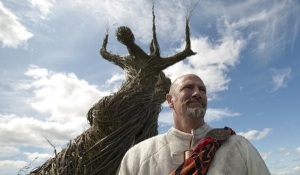
Honestly, friends, sometimes a person just doesn’t even know where to begin. I suppose I could individually list the catalogue of atrocities that make up writer-director Robin Hardy’s The Wicker Tree, but frankly that would mean spending more time talking about this film than I really have the energy to, and besides, our nearest thing to a “star” critic here at Through The Shattered Lens, Lisa Marie Bowman, has already done a pretty damn fine job of performing a blow-by-blow dissection of this thing’s rotted corpse in her capacity as occasional scribe over at HorrorCritic.com, so there’s no real need to duplicate what’s been done before. Allow and/or indulge me, then, as I take a slightly different tack and document my personal journey of despair with Hardy’s exercise in highly confused pointlessness.

To begin with, I should point out that the original Wicker Man is quite likely one of my ten-or-so all-time favorite films. Critics who say it’s “not actually a horror movie” are quite right, of course — it’s a unique — hell, frankly singular — amalgamation of so many different styles that the end product is well and truly unclassifiable. Part horror flick, sure, but also part musical, part (very) black comedy, part clash-of-cultures melodrama, part satire on Christian piousness, and part period-piece-albeit-in-a-then-contemporary-setting, it stands on its own as the only thing quite like it ever made. Screenwriter Anthony Shaffer perhaps put it best when he stated that his main goal was to pen a meditation on the nature of sacrifice, and everything else just sort of took off from there.

Obviously, there are so many elements about the first film that the 2011 “thematic sequel” could never hope to duplicate — songwriter Paul Giovanni is no longer with us, so right off the bat we know the music’s not going to be nearly as good because, quite frankly, it can’t be. Anthony Shaffer has passed away and therefore whatever follow-up material comes about wouldn’t in any way be his vision for how the story could or should  continue. Edward Woodward has likewise left behind this mortal coil, and his character died at the end anyway, so replicating his magnificently anally-retentive performance is probably going to prove to be out of the question, as well.  Christopher Lee is, while still awesome as hell,  also extremely frail and old at this point. And anyway — The Wicker Man still retains all its poignancy and power to this day and has only gained luster over the past 40 years. The abominable Nicolas Cage/Neil LaBute remake proved that revisiting the material was a lost cause, so why bother, five years on from that failed experiment,  with any sort of a sequel, “thematic” or otherwise?

Unfortunately, Robin Hardy wrote a book some years back called Cowboys For Christ that updated some of the concepts from his earlier film and he got the notion that it would make a decent-enough little flick. He was able to scour up $7 million-plus worth of financing, and got the folks at Anchor Bay so interested they promised not only a widespread “home viewing platform” release (and I caught this on a free screener copy that was sent my way so therefore can’t fairly comment on any extras the DVD and Blu-Ray might contain), but a even a little theatrical run, as well. It never made it to my area, and disappeared after a week from the markets it did make it into, but still —the fact that they chose to give this thing some theatrical burn when it seemingly had DTV written all over it was enough for me to, foolishly, get my hopes up.

I guess we believe what we want to believe (which is rather one of the points of the first film, after all), and a steady stream of reviews for this one that placed it at the “embarrassingly bad” end of the spectrum at worst to “maybe not quite as horrible as I’d been fearing but still pretty goddamn awful” at best weren’t enough to dampen my enthusiasm at this point. I figured it just had to be better than most folks were giving it credit for, because there’s just no conceivable way it couldn’t retain, say, at least 1/100th of the darkly charismatic charm of the first film, even if entirely by accident, right? After all, the original director was on board, and Anchor Bay wasn’t so ashamed of his finished product that they tried to hide the thing away at the bottom of some film vault (although given that it’s shot on HD, perhaps a “film” vault wouldn’t be the right place to stick it in, anyway).

It’s certainly fair to say that I wasn’t expecting greatness, or even anything of the sort, but something that still somehow cleaved to even a miniscule fraction of the spirit of the original would have been good enough for me. Unfortunately, what I got was a story about two painfully stereotypical Jesus-lovin’ Texas yokels who have gone on a mission (more typical of Mormons than of born-againers, it must be said) to evangelize in some small Scottish town that apparently has never heard the “good news.” One of our less-than-convincingly-portrayed country bumpkins, Beth Boothby (Brittania Nicol), was apparently a famous country singer with something of a “reputation” before turning her life over to Christ, while the other, her fiancee Steve Thomson (Henry Garrett), is little more just a walking, talking cowboy hat. Once in the “heathen land” of Scotland,  they enjoy the decidedly non-Southern hospitality of local nuke plant owner Sir Lachlan Morrison (Graham McTavish, in something more akin to a respectable performance than his colleagues seem capable of) and his OTT-in-the-deception-deaprtment wife, Delia (Jacqueline Leonard), but of course the dastardly couple, whose power plant has through some unexplained (and probably inexplicable, so it’s just as well Hardy doesn’t even try) means left the entire town sterile, have other plans for their simple-minded God-fearin’ visitors, plans that the Texas two-steppers are apparently too stupid to suss out even as they’re practically being openly prepared for the burning stake and, get this, the dinner table!

Yes, evidently the heathen folk of the United Kingdom’s northern reaches have taken to cannibalism in the four decades or so since our last visit, and while Hardy seems to think this somehow ups the “black comedy” factor of the proceedings, really it just serves as a cop-out by more clearly delineating who are the “good guys” here and who are the “bad guys,” a simple-minded, black-and-white approach that the first Wicker Man never resorted to even when Sgt. Howie was being burned alive (in, it must be said, one of the most visually dramatic sequences ever committed to celluloid).

And that’s a pretty much the problem at the crux of The Wicker Tree in a nutshell — sure, there are numerous and obvious others, ranging from wretched acting to dully-executed visuals to poor pacing to obvious run-time padding to inarticulate (at best) dialogue to recycled-into-a-less-involving-context story ideas to laughably one-dimensional caricatures standing in place of real, actual characters — but at the end of the day, it’s Hardy’s mistrust of his audience’s ability to make up our own collective mind, and the blatantly heavy-handed approach he takes in explaining everything for us that stems from that mistrust, that makes this such a condescending failure. I could live with the far-less-subtle approach to the “clash of cultures” theme that he takes here in comparison with the first film. I could live with the nowhere-near-as-compelling music. I could live with the rather — uhmmm — “broad strokes” with which he paints each and every character . I could live with the pointless and frankly even a bit insulting to the guy Christopher Lee cameo. Hell, I could even live with the Christian turning the tables on her pagan pursuers and winning in the end. But what I absolutely can’t abide is that Hardy thinks we’re all so unsophisticated and beneath the task of understanding his apparently-in-his-mind-quite-complex-and-challenging-themes that we need for him to hammer them home with a with a burning wicker stake through our heads. He’s had 40 years to think about how he wants to follow up a genuine, justly-lauded classic and this is what he comes up with? Set fire to me now, please, before the third installment, which he’s already working on, ever sees the light of day.