Don’t ask me why I love this scene from the 1980 grindhouse classic House on the Edge of the Park because I’ll go on and on. I could say that I love dancing in general. I could talk about how I own a red dress just like the one that Lorraine De Selle wears in this scene. I could rave about how pretty Annie Bell and Christian Borromeo were when they made this movie or the time capsule appeal of David Hess’s canary yellow suit.
But, in the end, I love this scene for two reasons:
1) The song playing in the background, composed by Riz Ortolani, is so bad yet so addictive and,
2) Giovanni Lombardo Radice is just so adorable doing his little dance.
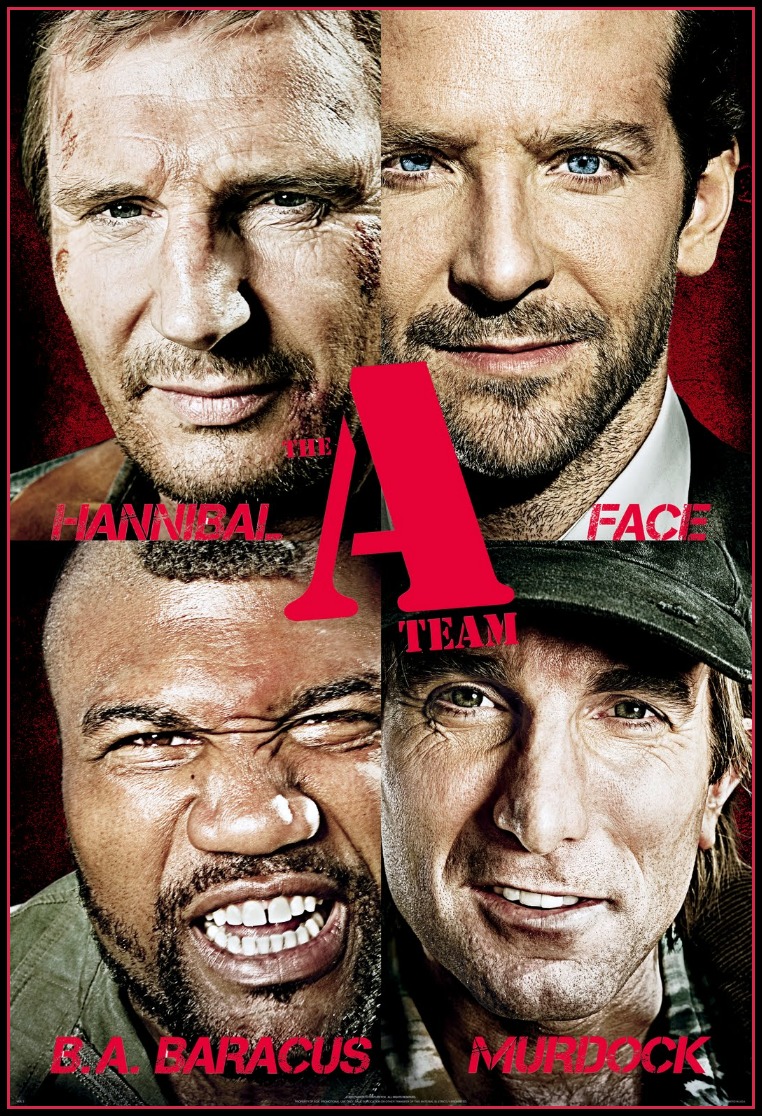
If my memory serves me correctly the year of 2010 ended up becoming the year of the Action Team Flicks. Arriving first was the comic book film adaptation, The Losers, which didn’t do so well. Coming out last was the Stallone testosterone action vehicle, The Expendables, which did much better though it lacked somewhat in the grindhouse it was promising. Smack dab in the middle of these two was the film adaptation of the classic 80’s action tv series of the same name, The A-Team, which in the end I thought was the best of the three Action Team Flicks of 2010.
The A-Team was a film project that once had Mel Gibson attached to it right up to Bruce Willis, but delays upon delays pared back what would’ve been a mega-budgeted action blockbuster into something in the bargain basement (for a summer film). It starred Liam Neeson in the iconic role of Col. John “Hannibal” Smith made famous in the 80’s by George Peppard. Surrounding him would be Bradley Cooper as Templeton “Face” Peck, Sharlto Copley as H.M. “Howlin’ Mad” Murdock and veteran MMA fighter Quinton “Rampage” Jackson as B.A. Baracus. Holding court over this A-Team was filmmaker Joe Carnahan working with a script he, Skip Woods and Brian Bloom (who also had a role as the amoral, sociopathic mercenary Pike).
The film took what was great and fun about the original tv series and gives it a 21st-century upgrade. To say that the film’s plot was secondary to watching the cast having fun on the screen would be an understatement. The story dealt with Smith and his team being accused of a crime they didn’t commit and must now escape from a military prison to find out who set them up and clear their name. It’s straight out of the tv series’ basic premise which managed to last a full on four seasons. Fortunately, Carnahan and his writers only had to make this premise last just a little over two hours. While some may think that two hours would be too long for this film it actually moved quite fast for something that went beyond the two hour mark.
Right from the beginning the cast looked to have been having the time of their lives. Neeson was Hannibal through and through while the other actors making up the rest of the team managed to imbue these well-known characters with their own brand of craziness, absurdity and panache. Just like the other two Action Team flicks of 2010 this film also had it’s share of scene-chewing villains in the form of Patrick Wilson as a duplicitous CIA agent and Brian Bloom as the sociopathic leader of a private military company at odds with Smith and his team. It’s these two groups who end up trying to outguess and outmanuever each other to get that final upper hand. Each encounter between these two groups just got more ridiculous with each passing event.
If one ever wondered if one could fly a tank while it was in freefall then this film answers that question. The climactic showdown at the LA shipyard at night has some of the most over-the-top action of the last couple years that wasn’t a scifi-actioner. Laws of physics doesn’t apply in The A-Team and the film revels in that notion as if telling the audience to either get onboard and enjoy the ride or get off and go on the Toad ride instead.
It’s a shame that The A-Team didn’t do as well in the box-office as some would’ve hoped because the film does set things up for further adventures for Neeson and his crew. What Carnahan ended up making won’t be breaking down the doors to the awards committee, but he did deliver on paying homage to the original tv series while adding his own brand of crazy to a film that had just the right amount of fun, ludicrous action to make it the best of 2010’s Action Team Flicks.
A few months ago I placed this album in my top 5 of 2011 so far, but I really didn’t have much to say about it. Despite having listened to ample amounts of this band over the years, I really am still in no position to thoroughly compare it to their past works (though I’ll certainly try). Moonsorrow has always been a band I’ve listened to in passing–something I put on for the mood it sets, not to appreciate its intricacies. In this sense Varjoina Kuljemme Kuolleiden Maassa is no different. But in the span of just, what, six months, I’ve listened to it more than all of their other albums combined since I first heard about them. So it’s got to have something special going for it.
Tähdetön
The first thing that makes Varjoina Kuljemme Kuolleiden Maassa so effective is showcased in the first minute of the opening song. That deep, crushing guitar tone that kicks it off doesn’t lose the spotlight until at least half way through the album, and it’s never abandoned completely. A quick skip through their larger discography tells me this is something fairly new. It’s not their first album to be largely driven by guitar chords, but I’ve found nothing as deep, encompassing, or persistent as this. The result is a fuller sound that keeps me connected as the surrounding styles vary. Tähdetön might move over time from something grim to something sweeping and beautiful, but a thread connects it all. The opening song doesn’t transition in the same sense as their previous works; it follows a steady progression.
Huuto (first 15 minutes)
The folk elements of the album are also worth noting. If a bit less authentic in feel than they used to be, they’re far more in touch with the music that surrounds them. I can’t help but think of Equilibrium’s Sagas throughout Huuto, and to a lesser extent on the other three tracks as well. You’ll find little in the raw here; it’s typically encased in or entirely consistent of dreamy keyboards that feel more fantasy than folk. This isn’t something entirely new for the band. They’ve always been pretty synth-heavy. But I don’t think you’ll find a parallel to Huuto’s intro on their past albums. I think it would have started out with just an acoustic guitar and the keyboards would have entered along with the distortion, or else would have been more of a drone than a dreamy accompaniment. Just like the intro to Tähdetön gives you a distinct example of what has changed on this album metal-wise, the intro to Huuto shows their new approach to folk. The keyboards and traditional sounds are inseparably fused, not two distinct elements of the band.
The third great thing for me is that they’ve returned to writing reasonably short songs. Their last couple releases have been made up predominantly of 30+ minute marathons that are hard to engage from start to finish. The longest song on Varjoina Kuljemme Kuolleiden Maassa is sixteen minutes. I have the option to single out a song once in a while and really get into it from start to finish, making each track a bit easier to appreciate.
Kuolleiden Maa (first 10 minutes)
A lot of what I’ve said about this album doesn’t really apply to the final song, Kuolleiden Maa, which is a fourth of the entire album. It is decidedly darker, and the only track that can really be described as black metal. It’s just as enormous as the rest of Varjoina Kuljemme Kuolleiden Maassa, but the feel is very different. That it’s my least favorite track should be no slight against it; it probably sounds more like what you would have expected on a new Moonsorrow album than any of the others. And it’s well placed to not disrupt the rest of the album. The three generally upbeat tracks come packaged together before the bleak conclusion. It also ends where the first track begins (though this sample doesn’t get that far into it), making the whole album very repeatable. The annoying bit of static you hear on the left in this sample is the product of youtube, by the way, and not something to worry about on the album proper.
In short, everything about Varjoina Kuljemme Kuolleiden Maassa feels bigger, more surreal, and all around more engaging than their past works. It has an incredibly dark ending, but I’d also say it’s all in all more happy and optimistic than their past works–something that certainly appeals to me when I’m in the mood for folk metal. As quintessentially Moonsorrow as it may be, it’s a definite step in a new direction, and the result is my favorite release by them to date. I didn’t actually sample my favorite track here. That would be Muinaiset. But all four feature songs (the rest are short intro/outro/transition tracks) are superb, and you’re definitely missing out if you don’t pick this one up.

 Through the Shattered Lens