Earlier today, I was looking through the list of recent death on Wikipedia (I do this several times a day. It’s one of my morbid habits.) and I came across the name of G.D. Spradlin.
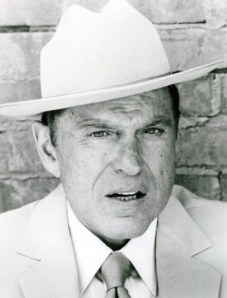
G.D. Spradlin died on June 24th, at the age of 90. While G.D. Spradlin is a great name, it’s hardly a household name. However, if you’re in any way interested film, you’ve probably seen G.D. Spradlin at least once. G. D. Spradlin was a character actor who played small but key roles in some of the best films of the 1970s.
Spradlin’s most famous role was probably as the corrupt Senator Pat Geary in The Godfather, Part II. We see Sen. Geary a handful of times over the course of the film. At first, he’s just another folksy politician who, behind close doors, proves himself to be coldly corrupt. A bit later, we meet Geary again. This time, Geary is sitting naked in a brothel, shaking as he tries not to look at the dead prostitute lying on the bed behind him. Though it’s never explicitly stated, the suggestion is that the Corleone — the film’s “heroes” — murdered the prostitute and framed Geary for the crime. To me, this is the pivotal scene in the film because it’s the scene that reveals just how much Al Pacino’s Michael Corleone has changed in between the two Godfathers. The Michael from the first film might have ordered Geary killed but he never would have deliberately ordered the murder of an otherwise innocent bystander, regardless of her profession. It’s lucky for Geary that Michael changed his ways because it gives Geary a chance to later accompany him and Hyman Roth to Cuba. Finally, Geary shows up towards the end of the film, passionately defending Michael Corleone before a Senate committee on organized crime.
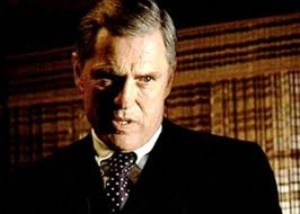
If you don’t remember Spradlin from The Godfather, Part II then maybe you remember him as the friendly yet sinister Gen. Corman from Apocalypse Now. When Martin Sheen is briefed on the man he’s been assigned to kill, it’s Spradlin who does the briefing.
Before going into acting, Spradlin was active in Oklahoma politics and he had the bearing of a man who was used to being in charge. If he had gone into acting a little bit earlier, he probably would have played countless ranchers and bank presidents in various Westerns. However, since he came to prominence as a character actor in the cynical cinema of the 1970s, it was his fate to play roles in which he epitomized the corruption of the American establishment. Though his roles were rarely big, he brought an unexpected depth to all of them and, as a result, played a key role in some of the greatest movies ever made.
Not too bad for a man who was never a household name.
 Through the Shattered Lens