VGM Entry 66: Super Metroid and Donkey Kong Country


VGM Entry 66: Super Metroid and Donkey Kong Country
(Thanks to Tish at FFShrine for the banner)

The release of Star Fox in 1993 was a sign of quite a few great games beyond the RPG/adventure genre to come. The following year would see another visually revolutionary blockbuster, this one completely blowing Star Fox off the map. Rare, a famous name on the Nintendo, held back developing much for the SNES until they were good and ready to take the system by storm.

http://www.youtube.com/watch?v=-Z29Mh80JiQ

Donkey Kong Country (Nintendo, 1994) essentially marked the peak of graphics on the Super Nintendo. It never got appreciably better than this, though plenty of other developers would rise to equal it by the end. Considering just how bad the graphics of say, Final Fantasy VII or Super Mario 64 look today, its amazing how well the best of the SNES have stood the test of time. Musically the game did not have quite as big of an impact, but it definitely maintained the cutting edge standard.

Composed by Dave Wise (Wizards & Warriors), Eveline Fischer, and Robin Beanland, the game’s sometimes hoaky jungle themes might be misleading; somewhat silly tunes out of context, they were ideally suited for the gameplay, and they completely defied the limitations of the SNES. I mean, plenty of great musicians were able to craft soundtracks that didn’t sound contrived. They weren’t obligated, as in the 8-bit days, to treat their audio chip as an instrument for any hope of success. But when Nobuo Uematsu added a pseudo-vocal track to Aria Di Mezzo Carattere he wasn’t fooling anybody; the extent to which SNES music could sound performed rather than programmed came in degrees and was not directly relevant to quality. (Final Fantasy VI, Uematsu’s opera included, was one of the best scores of all time despite sounding nowhere near as authentically orchestrated as Yuzo Koshiro’s ActRaiser 2.) But I feel like Donkey Kong Country was remarkably successful in its ability to distance itself from any sense of these limitations.

I mean, it’s electronic music in spirit (or more appropriately ‘new age’, though that is a dangerous term to throw about in so far as the musicians who have defined it share little in common with the finest musicians to have been branded with it) and it should not be compared to attempts at orchestration, but the subtle panning and fading, the outstanding percussion, the appropriate and convincing use of ambient jungle noises in the background… it all adds up to a sound that goes beyond the system, as if they had the nearly limitless possibilities of composers from the Playstation era and beyond.

http://www.youtube.com/watch?v=6EiIfQYDeYo

While Donkey Kong was enjoying his first incarnation as a well-defined, major franchise character, Samus was returning for her third venture, and her first on the SNES. Super Metroid (Nintendo, 1994) was one of the best games on the SNES, presenting a massive, open world for exploration that surpassed its series predecessors and remained unmatched until Castlevania: Symphony of the Night (Konami, 1997). And much like Castlevania, the Metroid series was synonymous with good music. Super Metroid was composed by Kenji Yamamoto and Minako Hamano (Link’s Awakening), and as best I can tell this was very much a joint effort. The ost on vgmdb credits both artists with 11 out of the 24 tracks. (Hirokazu Tanaka is credited for the last two.)

The two had their work cut out for them. While Tanaka’s original was, I think, far more novel in concept than as an actual finished product, his vision of the Metroid sound as carried on by Ryoji Yoshitomi in Metroid II: Return of Samus was nothing short of perfection.

Super Metroid took a slightly different approach from the get-go. The first two games featured eerie yet beautiful intro songs which really captured the conflicting nature of the metroids as morally innocent yet dangerous predators (one of Metroid’s unique features in early gaming is that some of the monsters aren’t evil or lifeless ‘bad guys’, but rather a natural species taken advantage of by, well, evil bad guys). Super Metroid, on the other hand, starts off on a human space station, and the opening conflict is between Samus and the Zebesian Ridley, not a metroid, so a different sort of musical theme was in order. Yamamoto and Hamano effectively captured that with dark and suspenseful music that offered none of the warmth of the first two games.

Furthermore, the majority of the game takes place on Zebes, the home world of the space pirates who are manipulating the metroid species for conquest. The original Metroid took place here as well, but a lot had changed plot-wise since then. The metroid species had been all but exterminated, and Samus at any rate had had a much more intimate encounter with them in Metroid II than would be possible on Zebes. Their presence here was no longer such a significant factor (in setting the mood, though they remained central to the plot), and the Zebesians presented a less mysterious and more sinister threat.

Yamamoto and Hamano wrote some pretty creepy music for Super Metroid, and it served its purpose well, but the bulk of the tunes were earthy in ambiance and more action-oriented, precisely in keeping with the mood of the game.

http://www.youtube.com/watch?v=IO2G6S5aQ1k

The SNES had some less famous gems in 1994 too. Demon’s Crest was the third installment in Capcom’s largely forgotten Gargoyle’s Quest series, which was in turn derived from the Ghosts’n Goblins series. It couldn’t have been much of a commercial success in North America; at the height of my teenage game obsession I managed to never even hear of it. It had a unique classical soundtrack which rarely stands out in any single instance but deserves a great deal of praise for its consistency. The composer never gives in to temptation by picking up the pace, keeping an even keel that succeeds in maintaining a sort of Halloween spook to the whole game from beginning to end.

Who composed it? I was about to say Yuki Iwai, because she’s almost universally credited for it, but this is yet another one of those gross misconceptions derived from failure of in-game attribution. Apparently Demon’s Crest has no credits (I never played it), and some time long ago someone decided Yuki Iwai must have composed it because she composed the previous series installment, Gargoyle’s Quest II (Capcom, 1992). Thankfully someone on Wikipedia caught on to this and did some research; a compilation cd of music from the series explicitly credits the score to Toshihiko Horiyama.

http://www.youtube.com/watch?v=x_qfPaZZycs

And then there’s Live a Live (Square, 1994), composed by the rising star Yoko Shimomura (Gargoyle’s Quest, Street Fighter II, some minor involvement in Breath of Fire). Shimomura left Capcom in 1993 and joined Square, with whom she would maintain a long and productive partnership up through the present day. Chances are you never heard of and almost certainly never played the RPG Live a Live. Even in the present day of classic game redistribution it has never received an official English language port. It’s a shame, because with a lively mix of adventurous western themes and oriental melodies, Live a Live presented one of the most spirited soundtracks on the SNES.

It was also one of Yoko Shimomura’s first independent scores. Though she receives solo credit for a few earlier games–F-1 Dream (Capcom, 1989) for the PC Engine and The King of Dragons (Capcom, 1991) for the arcade for instance–the bulk of her earlier games list joint credits, and these can be pretty misleading. (She only contributed one song to Breath of Fire from what I gather.) Live a Live then might be seen as one of her first really extensive works, and it was definitely a sign of good things to come. With a legendary repertoire to include Super Mario RPG and Kingdom Hearts, Shimomura would be making herself heard in video games for a long time to come.
VGM Entry 61: The RPG generation


VGM Entry 61: The RPG generation
(Thanks to Tish at FFShrine for the banner)

The Super Nintendo RPG/Adventure legacy didn’t come over night. But ActRaiser (Enix, 1990), Final Fantasy IV (Square, 1991), and The Legend of Zelda: A Link to the Past (Nintendo, 1991) did not necessarily set the stage, either. RPGs had been huge in Japan for quite some time. The Super Nintendo provided both the capacity to carry them and the consistency to focus costs on a single product (imagine the amount of time and resources which must have went into porting PC RPGs to a half-dozen different systems). This didn’t inspire computer gaming companies to switch gears–Nihon Falcom continued to pump out their titles for the PC-9801 all the way up to 1996, slowly switching to Windows with only one Super Famicom title, Ys V: Ushinawareta Suna no Miyako Kefin (1995), to show for themselves in between. But other publishers saw RPGs as a more viable option now, and Capcom, Taito, and Nintendo hopped on the bandwagon while Square and Enix picked up the pace. (Konami held off producing RPGs until the Playstation era.)

The fact that these types of games did not start to appear in abundance on the SNES until 1992 might have been a simple consequence of developers spending most of 1991 making them. 1992 to 1995 were the glory days of SNES fantasy gaming, and perhaps the crowning era in the history of video game music.

http://www.youtube.com/watch?v=LB4CmTMOkFw

Capcom’s first big RPG was Breath of Fire (1993), credited to a long list of composers including Yasuaki Fujita (Mega Man 3), Mari Yamaguchi (Mega Man 5), Minae Fujii (Mega Man 4), Yoko Shimomura (Gargoyle’s Quest, Street Fighter II), and Tatsuya Nishimura. Thankfully track by track authorship is actually available, and we can see that Yasuaki ‘Bun Bun’ Fujita did the grand bulk of the composing, with Mari Yamaguchi contributing five songs and the other three chipping in a song each.

Here’s a track list for the compilation:

(0:00) The Dragon Warrior
(1:24) Fate
(2:54) Starting the Journey ~Breath of Fire~
(4:11) Deep Forest
(5:18) Battling
(6:02) Sand Palace
(7:07) Dejection
(8:05) Fishing

As a series, Breath of Fire was not really all that well noted for its contributions to video game music. I don’t want to blow off the rest of the games here and now before revisiting them, but I distinctly remember playing through most of them with the radio on (I never actually played Breath of Fire V). The original Breath of Fire was definitely more of an exception than than the rule. The soundtrack is peppered with memorable, moody numbers. It’s most famous song, at least in so far as it was carried on in future installments, is Mari Yamaguchi’s overworld theme, “Starting the Journey”. But it is Yasuaki Fujita’s bleaker contributions that really make the game stand out from the crowd. “Deep Forest” and “Dejection” could both easily pass for ending credits themes to some complex plotline defying the good versus evil stereotype–the sort of RPG we all crave but rarely find outside of the Suikoden series. They’re both delightfully dark and finite, screaming “it’s over, but did you really win?”

Of course neither of them are actually credits music, and Breath of Fire was never known for its plot. The series had an incredible knack for being simultaneously completely forgettable and quite fun to play–perhaps a consequence of actually challenging combat (at least, in comparison to the vast majority of turn-based RPGs.) When it came to music, the original was the only one that actually made a lasting impression on me when I played it.

http://www.youtube.com/watch?v=jhE7rAG6rvY

Lufia & the Fortress of Doom, composed by Yasunori Shiono, was another series starter in 1993. There were actually only two Lufia titles in the 90s, and I suspect the later handheld releases came as an afterthought. Taito were prolific producers with a history in the gaming industry dating all the way back to 1973, but they had always shied away from the RPG market. With the cooperation of newly-established developers Neverland Co., Lufia would be their first attempt.

As for the history of Neverland, something on Wikipedia is clearly wrong. It claims Lufia‘s developer was founded on May 7th, 1993, and it claims the game was released on June 25th, 1993. But while Neverland certainly must have had an earlier origin, Lufia does appear to be their first of very few titles. In that regard, the Lufia series was kind of unique. I won’t pretend to know what goes on behind the scenes in the gaming industry (my dream of directing RPGs has always been a total fantasy), but I have to imagine when a producer develops their own game there’s a fairly more intimate degree of interaction between the two sides. Square and Nintendo as of 1993 nearly always developed their own games. The wildcards in the world of non-PC RPGs almost always went through Enix (the most famous developers being Quintet and Chunsoft). Neverland-Taito then seems like a pretty unique pairing–an independent developer working with a producer that had never marketed an RPG.

Lufia & the Fortress of Doom was in every manner a rough draft–a sort of prototype for Lufia II: Rise of the Sinistrals, which was infinitely better and one of the best RPGs in the history of the SNES. Unlike Final Fantasy, Dragon Quest (from what I gather), Breath of Fire, Seiken Densetsu, Quintet’s unofficial ‘Soul Blazer Trilogy’, and Zelda really, the Lufia series was both plot-centric and cumulative, taking place in the same world with a continuous history and related/reoccurring characters. As if in collusion with the rest of the development team’s maturation, Yasunori Shiono’s compositions improved substantially in the second title, but we will get to that later.

http://www.youtube.com/watch?v=KDUS7OXiiJg

Good adventure/RPG music was not limited to the Super Nintendo. The Game Boy was a musical instrument par excellence, with by far the most aesthetically pleasing tones of any system on the market lacking diverse instrument sampling. (I hope that’s a suitable delineation for a technical subject of which I still know absolutely nothing.) The Legend of Zelda: Link’s Awakening is far and wide my favorite score in the Zelda series. It might have nothing on Ryuji Sasai’s work on Final Fantasy Legend III, but Link’s Awakening brings the Game Boy to life in a really beautiful way. Indeed, its only real fault is a failure to employ his three-dimensional stereo effects. The game’s crowning jewel, Tal Tal Heights, appears early in this compilation (0:30), but the whole score merits attention.

Koji Kondo surprisingly had nothing to do with it. Link’s Awakening was a joint effort between Kazumi Totaka, Minako Hamano, and Kozue Ishikawa, all of whom I’ve yet to mention. Kazumi Totaka actually had a pretty long history with Nintendo, providing music for the sort of games you might expect to hear Soyo Oka on (Mario Paint, Wave Race 64, most notably Animal Crossing, which I do hope I remember to feature if I ever get that far). Minako Hamano was responsible for roughly half of the Super Metroid soundtrack, though her name rapidly fades from the pages of history, and Kozue Ishikawa is a virtual unknown. But this motley crew managed to piece together one of the quintessential scores of the Game Boy, and in doing so earn themselves a place in video game music history.

October Music Series: 下村陽子 – Beware the Forest’s Mushrooms


http://www.youtube.com/watch?v=lbRJ733xiF4

Yoko Shimomura was a rising star when she composed the Super Mario RPG soundtrack in 1996, fresh out of Capcom and ready to embark on a higher profile career with Square. The whole soundtrack was exceptional, but one track in particular was so catchy that it’s been stuck in my head ever since, and it’s most certainly appropriate for a fall theme.

Within the game, the song plays to a forest maze–one of those looping maps that can have you wondering around forever if you don’t pay attention. ‘Forest music’ has always been among the best tracks in RPG scores, but I don’t know that anyone’s pulled one off as effectively as Yoko Shimomura. It’s not quite as dark and haunting as say, Koji Kondo’s “Forest” from A Link to the Past or Yasuaki ‘Bun Bun’ Fujita’s “Deep Forest” from Breath of Fire, nor as calm as Yasunori Mitsuda’s “Secret of the Forest” from Chrono Trigger, to name some contemporaries. It’s far more friendly and inviting, which really makes it all the more dangerous, because at the end of the day you’re still getting lost in a deep forest maze filled with monsters out to kill you. It draws you in, makes you want to keep on wandering, like a good proper evil enchanted forest ought to.

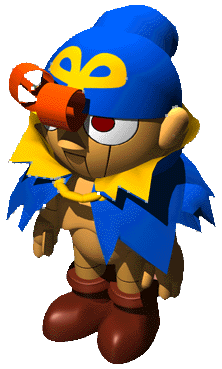
It’s also the theme song to Geno, a doll possessed by the spirit of one of the stars you’re out to rescue, who really creeped me out as a kid because I thought that orange thing on his hat was his nose for some reason.

VGM Entry 59: Street Fighter II and SNES domination


VGM Entry 59: Street Fighter II and SNES domination
(Thanks to Tish at FFShrine for the banner)

An enormous disparity had emerged between the Super Nintendo and competing platforms by the early to mid-90s. The Sega Genesis/Mega Drive, released two years sooner, still didn’t have much to offer, and the arcade was fading fast. The former simply couldn’t compete with the SNES’s ability to simulate real instrumentation, and the latter, I suspect, was no longer funded the way it used to be. This lends itself to a number of comparisons, but in consideration of the fact that my available time for writing these articles is rapidly coming to an end, let’s just jump straight to the point.

http://www.youtube.com/watch?v=gR38veZ3JrM

The Street Fighter II series is a massive and confusing string of titles through which Capcom managed to milk a great deal of money releasing minor updates and new characters over a short period of time. The original Street Fighter II came out for the arcade in 1991. This was followed (in the arcade) by Street Fighter II: Champion Edition (April 1992), Street Fighter II: Hyper Fighting (December 1992), Super Street Fighter II: The New Challengers (October 1993), and Super Street Fighter II Turbo (March 1994).

If that were all, it would be fairly easy to sort out, but each of these games was given a different title based on region and platform. Street Fighter II Turbo for the SNES, for instance, was a port of Street Fighter II: Hyper Fighting, not Super Street Fighter II Turbo. Street Fighter II: Special Champion Edition for the Sega Genesis/Mega Drive was not a port of Street Fighter II: Champion Edition, but rather of Hyper Fighting. The additions made in the original Champion Edition were carried over into most future versions of the game and ports, such that the original Sega Master System Street Fighter II (released in Brazil, where there was inexplicably still an SMS market, in 1997) was actually Street Fighter II: Champion Edition.

I would love to sort all this in a nice coherent list, but it would take me all day, and as I said, my time for writing these articles is starting to run short. So let’s just look at the version currently playing: Super Street Fighter II: The New Challengers. This one was released for the Super Nintendo in 1994 as simply Super Street Fighter II. Skip ahead to 5:12 and you’ll hear a delicious little oriental arrangement reminiscent of Miki Higashino’s Yie Ar Kung-Fu. (Again, time restricts me from actually finding the name of the song.)

Wikipedia credits Isao Abe and Syun Nishigaki with composing the Super Street Fighter II soundtrack. This is a little confusing as well, since Isao Abe and Yoko Shimomura get credited for the original Street Fighter II and a lot of the music is the same, but whoever wrote it, you’ve now heard the arcade version of the song, and I think we can all agree that at least in the 80s sound quality (not necessarily composition and arrangement) was substantially better in the arcade than on any home system.

http://www.youtube.com/watch?v=fkEQyIDdA-I

The same song appears in the SNES Super Street Fighter II song compilation at 4:29, and I don’t think I need to point out how it’s better. Here’s a game released for a 1990 system, and the quality of sound is decisively better than Capcom’s 1993 arcade release. Forget about state of the art technology in the arcade; I think at this point companies were cutting costs, and high-end sound systems had to go.

http://www.youtube.com/watch?v=Uo9bgGbK_lA

Here’s another case in point. Shining Force (Sega, 1992) was a tactical RPG released for the Sega Genesis/Mega Drive. Composed by Masahiko Yoshimura, it is one of the most highly regarded soundtracks on the system. Aside from a ton of spin-off titles, Shining Force as a series only saw three installments, and each of these featured a different composer. Motoaki Takenouchi, for all his talents, didn’t do such a hot job with Shining Force II (Sega, 1993), and the third was released on the Saturn, so we’ll just focus on the original.

Masahiko Yoshimura did a really outstanding job here with the limited resources available to him, especially when the gameplay situation called for intensity. The tracks beginning at 1:47 and 2:34 especially impress me in this regard. Yoshimura’s militant snare carries the day, and there’s also something interesting going on in company with the bass. The deep piano tones on this second track play tricks on my ears, projecting a piano vibration onto the bass when I listen to the song as a whole which clearly isn’t there when I focus on the bass specifically. Both at the start of the 1:47 track and mid-way into the next, around 3:19, he musically employs a tone that sounds more like a jumping sound effect in order to simulate an instrument sample that probably wasn’t available on the system, and it works. You can catch some more of this in the track that kicks off at 7:23.

Packed with catchy songs creatively arranged to artificially simulate a higher degree of orchestration than the system allowed, Shining Force was a great success.

But what it took a lot of creativity to pull off on the Genesis the SNES made easy. Jun Ishikawa and Hirokazu Ando (both of Kirby series fame) composed Arcana (HAL Laboratory, 1992) the same year Shining Force came out, and the improvement in sound quality was staggering. RPGs to a large extent defined the SNES. I have no statistics to back this up, but I have to imagine more popular games outside of Japan fell into the RPG/adventure/tactics spectrum on the SNES than on any other system, to such an extent that NOA even incorporated an “Epic Center” column into Nintendo Power for two years (March 1995-November 1996).

An end date of late 1996 roughly coincides with the North American launch of the Nintendo 64, when Nintendo Power subscribers began to feel the effects of the cartridge gaming fallout. RPGs were big games, calling for big capacity, and the Playstation rapidly became developers’ new system of choice.

But this was 1992, and even little known, quickly forgotten titles like Arcana were blowing Sega and arcade gaming out of the water.

VGM Entry 41: Game Boy


VGM Entry 41: Game Boy
(Thanks to Tish at FFShrine for the banner)

I nearly forgot to address the Game Boy. Released in April 1989, by the end of 1990 it was already pushing 100 titles. Perhaps production was easy and inexpensive, I don’t know, but this was a system that shot off at lightning speed. In consideration of all of the great music chiptune artists are making on the Game Boy today, I made a diligent effort to listen to a good 80 or so of these early titles. I figured there had to be a ton of hidden gems out there, but there really weren’t.

It’s actually really surprising how completely ho-hum the vast, vast majority of early Game Boy soundtracks were. Even those you might expect to be leading the pack, Castlevania: The Adventure (Konami, 1989, Dracula Densetsu in Japan) and Super Mario Land (Nintendo, 1989) for instance, offered next to nothing worth noting. Those which did peak my interest were often quite obscure. Fist of the North Star: 10 Big Brawls for the King of Universe (Electro Brain Corp., 1990) for instance has no identifiable composer. I searched long and hard to no avail.

This game supposedly stunk, and perhaps the music was not held in very high regard because of this. I thought it was a pretty solid effort. The Game Boy’s bass tones are very full and encompasing, capable of giving a song a great deal of depth. Very few musicians actually put this to use, but whoever composed Fist of the North Star had an ear for it. The way the extended bass notes compliment the melody reminds me a lot of Ryuji Sasai’s approach on my favorite Game Boy soundtrack, which we’ll be getting to here in another year.

The title track to Battle Bull (SETA, 1990), composed by Takayuki Suzuki, strikes me for its ability to pack in such a big sound. It is stylistically exactly the sort of thing I set out to find. It’s a shame there seems to be only one song here, because Suzuki turns out to be one of the few Game Boy composers who really understood how to make the most of the system. In retrospect after looking a few years ahead, this is easily one of the best Game Boy songs I have ever heard.

http://www.youtube.com/watch?v=qg48s-cZYK0

Square’s SaGa series became a nearly annual event following the first instalment, Makai Toushi SaGa, released for the Game Boy in December 1989. The first three were known in North America as the Final Fantasy Legend series–a title chosen in the hopes that familiarity would boost sales. I know the strategy worked for me. But the series did share at least one thing in common with Final Fantasy, at least initially. Nobuo Uematsu was commissioned to compose it. Despite what you might read, I am fairly confident that he composed Final Fantasy Legend in its entirety. At least, the liner notes displayed by vgmdb.net claim this. Final Fantasy Legend II, released the following December, was a joint effort, with Kenji Ito tackling about half of the tracks.

I am only going to present the original Final Fantasy Legend here out of consideration of space, but the sequel is about equal in quality and worth checking out. Nobuo Uematsu did an excellent job of carrying over his style onto the Game Boy, and a few tracks, like the introduction and the victory fanfare, would become series staples. The only noteworthy RPG series for the Game Boy to the best of my knowledge, the Final Fantasy Legends boasted a much larger song selection than most other Game Boy games at the time, and the consistant high quality really put to shame most of the competition.

Nobuo Uematsu and Kenji Ito really definitively proved that the dearth of good Game Boy music was a consequence of negligent composers, not system restraints. Uematsu was as new to the Game Boy as anyone else when he composed his first work for it, and, as you can plainly hear, that was a simple enough challenge to overcome. Much like the first three Final Fantasy soundtracks, the music of the first two SaGas did not so much conform to the system as force the system to conform as much as possible to a multi-platform vision of what an RPG ought to sound like. The music of Final Fantasy Legend you are hearing here certainly bears a distinctly Game Boy sound in so far as it was impossible not to, but the music neither capitalizes on the systems strengths nor succumbs to its difficulties. It really just sounds like Uematsu doing his thing in the early years.

Gargoyle’s Quest (Capcom, 1990) was pretty amazing. It was created by Harumi Fujita, the original arcade composer of Bionic Commando, and Yoko Shimomura, a new name to the business who you’ll be hearing plenty more of in the future. It is also a part of the Ghosts’n Goblins series, which you’ve heard pleanty of already.

Gargoyle’s Quest does everything right. The decision to abandon percussion altogether did wonders for enhancing the semi-classical melodies. The songs are consistantly well-written, and the melodies are often permitted to run wild, with no stagnation and no breaks in the actual presence of sound. The Game Boy had by far the most beautiful tones of the chippier-sounding systems–that is, pre-SNES/Genesis/Amiga–and they always seem to ring out to their fullest in states of perpetual transition. I don’t know, maybe I’m superimposing what worked best for Gargoyle’s Quest onto what worked best for the Game Boy in general, but it seems like this is the sort of system where you can never have too many notes.

But if that’s stretching matters, I would at least say that the Game Boy is a system on which boldness almost always profits. It’s a shame that Tim Follin didn’t, to the best of my knowledge, write any Game Boy music. But anyway, Gargoyle’s Quest, one of the best soundtracks the system would ever know, was certainly not lacking in it. I might never be able to really put my finger on the features that so strongly attract me to this system, but you’re hearing a lot of them right now. You can hear the soundtrack in its entirety here, once again compliments of explod2A03.

Funny that, for all I just said, my favorite Game Boy soundtrack of this 1989-1990 period is soft and simple Yakuman (Nintendo, 1989), a mahjong game composed by Hirokazu Tanaka and only released in Japan. A frequently occurring figure in my articles, Tanaka’s game audio history goes all the way back to monotone bleeps in the 1970s. His role as a major composer would rapidly fade after 1990, but he was partly responsible for such esteemed works as Metroid, Mother, Earthbound, Dr. Mario, and the Nintendo ports of Tetris. He also composed Super Mario Land for the Game Boy, which I find quite dull. Go figure.

Well, that wraps up my thoughts on the first two years of the Game Boy. Honorable mention goes to Maru’s Mission (Jaleco, 1990, composer again unknown) and Burai Fighter Deluxe (Taxan, 1990/1991), composed by Nobuyuki Shioda. And really I was a bit harsh on Castlevania: The Adventure. I don’t care for it, but it’s not bad.