“You see, stranger, I am a sheep man.” — James Farley (Ed Porter)
On the frontier, a range war has broken out between the cattlemen and the sheepherders. When rancher Seth Darnell is murdered, the blame is put on the sheepherders. When the Cheyenne Kid (Reb Russell) rides up on the small camp of the sheepherders and hears their problems, he decides to investigate on his own by getting a job at the Darnell ranch. Soon, Cheyenne is discovering the truth and also being pursued by both Darnell’s daughter (Victoria Vinton) and the daughter (Tina Menard) of the leader of the sheepherders.
Reb Russell was a former college football star who had a minor B-western career in the 30s. Supposedly, he didn’t really much care for Hollywood and he retired from acting in 1935, the same year that The Cheyenne Tornado came out. Russell went on to find a lot of success as a rancher himself.
The Cheyenne Tornado is a typical B-western. It’s short. There’s a lot shots of men riding on horses. There’s a little gunplay and a mystery that anyone should be able to solve. The acting is bad all the way around with even star Reb Russell failing to make much of an impression. It probably did not matter to the film’s target audience in 1935. They were there for the old west action and the movie does deliver that.
This line, which has been recycled in so many western parodies, is actually used seriously in The Drifter, a forgotten western from the pre-code era. The line is delivered by Montana (Russell Hopton) and he’s speaking to a mysterious character known only as The Drifter (William Farnum).
The Drifter is a French-Canadian who has spent decades searching for his lost-lost brother but who is now ready to go into town, get work as a logger, and hopefully find a woman to marry. Along with a mysterious man who is named Whitey and who is played by Charles Sellon, The Drifter is hired to work for local lumber magnate, John McNary (Noah Beery). The Drifter impresses everyone with his good hearted ways and he falls in love with McNary’s daughter, Bonnie (Phyllis Barrington). Unfortunately, Phyllis is already dating Paul LaTour (Bruce Warren), who is her father’s main business rival. But before The Drifter can concentrate on winning Phyllis away from LaTour and also solving the mystery of his own missing family, he has to deal with the most dangerous man in town, Montana. As Montana puts it, the town’s not big enough for both him and The Drifter.
The Drifter‘s story is potentially interesting but the low-budget, the shoddy production values, and a slow pace all conspire to do the film in. This was one of the countless western programmers that was produced in the early 30s. Like many of the other poverty row productions of the era, it starred an actor who had been huge during the silent era but who struggled to find work during the early years of the sound era. William Farnum started as a stage actor and as a protegee to Edwin Booth, who was largely considered to be America’s finest stage actor even if he was forever tainted by being the brother of presidential assassin John Wilkes Booth. Farnum’s very theatrical style of acting made him perfect for both Broadway and for the silent film era, a time when actors had to use big movements and dramatic facial expressions in order to convey their emotions. When the sound era came along, Farnum’s style was suddenly no longer in vogue and, unfortunately, it took him a while to adjust to working with sound. Even in a sound film like The Drifter where he had dialogue, Farnum gives the type of overly theatrical performance that was more common during the silent era. What’s interesting is that Farnum’s performance actually works for the character of The Drifter, who is meant to be an outsider who struggles to communicate with other people. Despite some implausible twists at the end, the rest of The Drifter isn’t as interesting.
Farnum eventually did adjust to the sound era and he became a respected character actor, playing many captains and many judges. In 1953, when he died at the age of 76, Hollywood turned out to pay their respects. Cecil B. DeMille and Paramount Picture co-founder Jesse B. Lasky served as pallbearers.
Back in the 1930s, the American film industry regulated itself with the Motion Picture Production Code. The production code stated that, in films, crimes would always be punished, profanity would not be heard, bodies would remain clothed, and drug abuse would not be portrayed. The only way to get around these rules was to make sure that the film was “educational” and that it pretended to condemn the behavior shown on-screen. This was the birth of what would eventually become grindhouse cinema.
It’s always interesting to watch these early grindhouse films because, even with the inclusion of such forbidden elements as nudity, violence, and drugs, they all still seem oddly innocent. Yes, there’s always a scene or two of the lead actress undressed but the camera rarely lingers as if it’s aware that it’s somehow breaking the rules. Whenever one of these films dealt with drug addiction or white slavery, the depictions were often so heavy-handed and silly that it was obvious that nobody involved with the film had any first-hand knowledge of what they were showing. The end results were often undeniably fun.
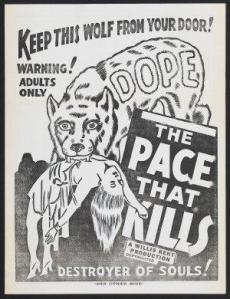
I watched one of these films last night, 1935’s The Cocaine Fiends (also known as The Pace that Kills, which is a much better title). The Cocaine Fiends starts with a waitress named Jane (Lois January) who meets and falls in love with a mysterious fellow named Nick the Pusher (Noel Madison). For most people, I would think that Nick the Pusher’s name would be a dead give away to what he does for a living but Jane is from the country and, by this film’s logic, this makes her an idiot. Anyway, Jane goes to the city with Nick. Whenever Jane starts to get a headache, Nick gives her some headache powder. Jane snorts the powder and her headache goes away. Soon, she’s calling herself Lil and sleeping with strangers to get money so that Nick will keep giving her headache powder. Soon Jane/Lil discovers that she hasn’t been doing lines of headache powder at all! Nope, that white powder is cocaine!
(Now, I know you’re probably laughing at Jane but I have to be honest and admit that last year, I was at work when I got a terrible migraine. This woman who works in the same building as me took sympathy on me and gave me a little packet of white powder. I quickly got out my credit card and a dollar bill and cut myself a line. “Wait, what are you doing!?” she said as I held the tightly rolled dollar bill up to my nostril. “I’m going to do a line,” I said. “Oh no, honey,” she said, sweetly, “you don’t snort B.C. Headache Powder.” True story.)
Anyway, Jane’s brother, Eddie (Dean Benton), comes to the city looking for his sister and gets a job working as a carhop. At his job, he befriends Fanny (Sheila Bromley) who, seriously, is one of the greatest film characters ever. Seriously, I had a huge girlcrush on Fanny by the end of this film. Not only is she hot and independent but she also hides cocaine underneath her garter and says stuff like, “Tonight, I’m going to take you on a sleigh ride with some snowbirds.” Eddie has a crush on Fanny too and they end up hanging out at sordid nightclubs together. Unfortunately, Fanny also gets Eddie hooked on cocaine and soon, they both get fired. Eddie forgets about finding his sister while Fanny turns to prostitution to support her habit.
Meanwhile, Fanny’s friend Dorothy (Lois Lindsay) doesn’t use cocaine but she still ends up getting kidnapped by Nick anyway. Apparently, Dorothy’s father is rich. While Eddie spends his time at an opium den (a surprisingly effective sequence), Dorothy’s boyfriend Dan (Charles Delaney) recruits Lil (remember her?) to help him rescue Dorothy and hopefully reveal the secret identity of the shadowy figure in charge of the city’s dope trade…
Did I mention all of this happens in 61 minutes? Seriously, the Cocaine Fiends is one busy film. Now, to be honest, all of this plot doesn’t leave much room for anything resembling introspection or nuance but perhaps that’s appropriate for a film about cocaine. I do have to admit that the Cocaine Fiends isn’t as much fun as some other exploitation films from the roadshow era. Unlike a lot of those films, Cocaine Fiends actually does have at least a tenuous connection to reality in that, when abused, cocaine actually is a dangerous drug that can contribute to people doing some pretty dangerous things. Still, for those searching for sordid melodrama and committed overacting, they’ll find it a surplus of it here.
That said, like the best grindhouse films, the Cocaine Fiends occasionally offers up a moment or two of true insight. For me, what made this film more than just a camp oddity was its sympathetic portrayal of women trapped in a cold, male-dominated underground where being female means being a commodity. What sets The Cocaine Fiends apart from other films of that era (not to mention most films made today) was the fact that it didn’t attempt to present their tragic fate as some sort of karmic punishment or divine retribution for straying from what society deemed the proper feminine path. Most films continue to insist that women “ask for it.” Whatever other faults The Cocaine Fiends may have, it knows better than to think anyone asks to be violated, abused, and exploited.
To be honest, the main reason I occasionally watch a film like The Cocaine Fiends is because I’m a just a history nerd at heart. Watching a film like The Cocaine Fiends, made outside of the idealized worldview of the Hollywood Establishment, is probably about as close as I’m going to get to using a time machine to go back to the 30s and experience the culture firsthand. I love how Eddie, when Fanny offers to let him stay at her apartment, automatically responds with, “But we’re not married.” And then there’s the sequence in the “dangerous” night club which, as far as decorations, music, and proper attire are concerned, reminded me of my senior prom. It’s also where Eddie freaks out upon getting a bill for $9.97. Luckily, Fanny is there to loan him enough money to pay it.
Anyway, for those who have an hour to kill, here’s 1935’s The Cocaine Fiends…
 “You see, stranger, I am a sheep man.” — James Farley (Ed Porter)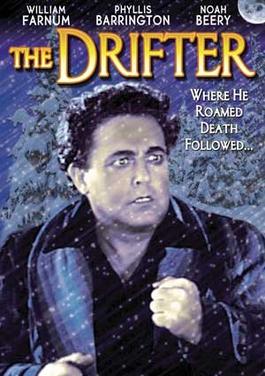
 Through the Shattered Lens