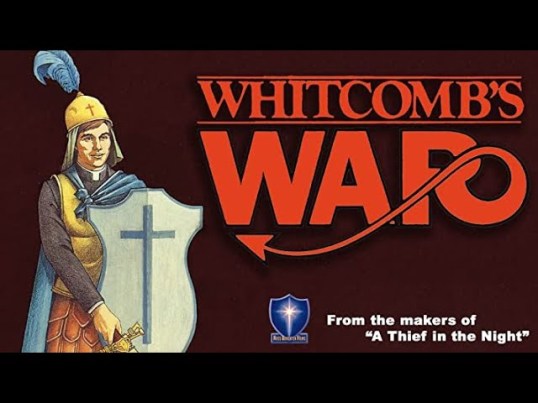
This 1980 film takes place in the town of Hurrah, Iowa. One of the opening scenes features Pastor David Whitcomb driving up to Hurrah and stepping out of his car to take a look at the city limits sign. Hurrah has a population of a little over 3,000. Apparently, almost all of them belong to the same church and everyone works for the same factory.
Unfortunately, the owner of the factor is not a member of the church. In fact, onery old Phil Esteen (say the same quickly) is determined to shut the church down by scheduling everyone to work on Sundays. As a result, hardly anyone is able to attend any of Pastor Whitcomb’s sermons. The pastor finds himself preaching to a church that is full of children whose parents are working at Esteen’s factory. When people complain about Esteen’s tactics, Esteen threatens to move his company to the nearby town of Riverton, which apparently has a river. Phil Esteeen loves to talk about that river.
Whitcomb is upset to discover that people in his church hate Esteen and view him as being unredeemable. Whitcomb says that’s not a good attitude. A huge reason why people have that attitude is because there’s a group of demons living in the church basement. (They may be demons but essentially, they just look like a bunch of community theater actors wearing red shirts.) They’ve been tasked with making the pastor’s life difficult. The demons have a bulky personal computer that they use to type up their evil plans and which they occasionally turn to for advice. The computer itself is treated as being a sort of exotic oddity. One gets the feeling that 1980 audiences were expected to look at the computer and think, “What type of twisted creature would actually travel with one of those things!?”
When the women of the church lead a protest against Esteen’s business practices, it just makes Esteen all the more determined to keep people working on Sundays. Pastor Whitcomb realizes he’s going to have to try something different to reach Esteen and convince him to change his ways. Can he do it?
(Personally, I think the whole problem could have been solved by the employees forming a union or all quitting at the same time or maybe the church holding more than one service during the day. My point is that there seemed to be many potential solutions that no one in this film ever considered….)
This was one of director Russell Doughten’s do-it-yourself regional productions. He directed and self-distributed several of these films in the 70s and 80s. Seen today, this films are grainy time capsules of the distant past. Doughten’s didn’t exactly make films that featured nuanced discussions of theological issues. He was frequently a heavy-handed filmmaker, working in a genre that was specifically designed to be magnify those self-righteous impulses. At the same time, there’s something undeniably charming about just how cheap most of his Iowa-shot films looked and just how enthusiastically they were acted by their largely amateur casts. (And yes, the term to remember is “enthusiastically” as opposed to “convincingly.”) Much as with Ed Wood, Doughten’s appeal is less about his films and more about his refusal to let a lack of funds or a lack of talent stand in the way of bringing his vision to the screen. A film like Whitcomb’s War has a ton of technical flaws but seen today, it’s definitely a time capsule of the era in which it was made. Watching it means taking a trip to the past, to an era when computers were still exotic and even the Devil had to use a landline phone to communicate with people.
Incidentally, I did a google search and apparently, the town of Hurrah, Iowa no longer exists. Maybe everyone moved closer to the river after all.
 Through the Shattered Lens