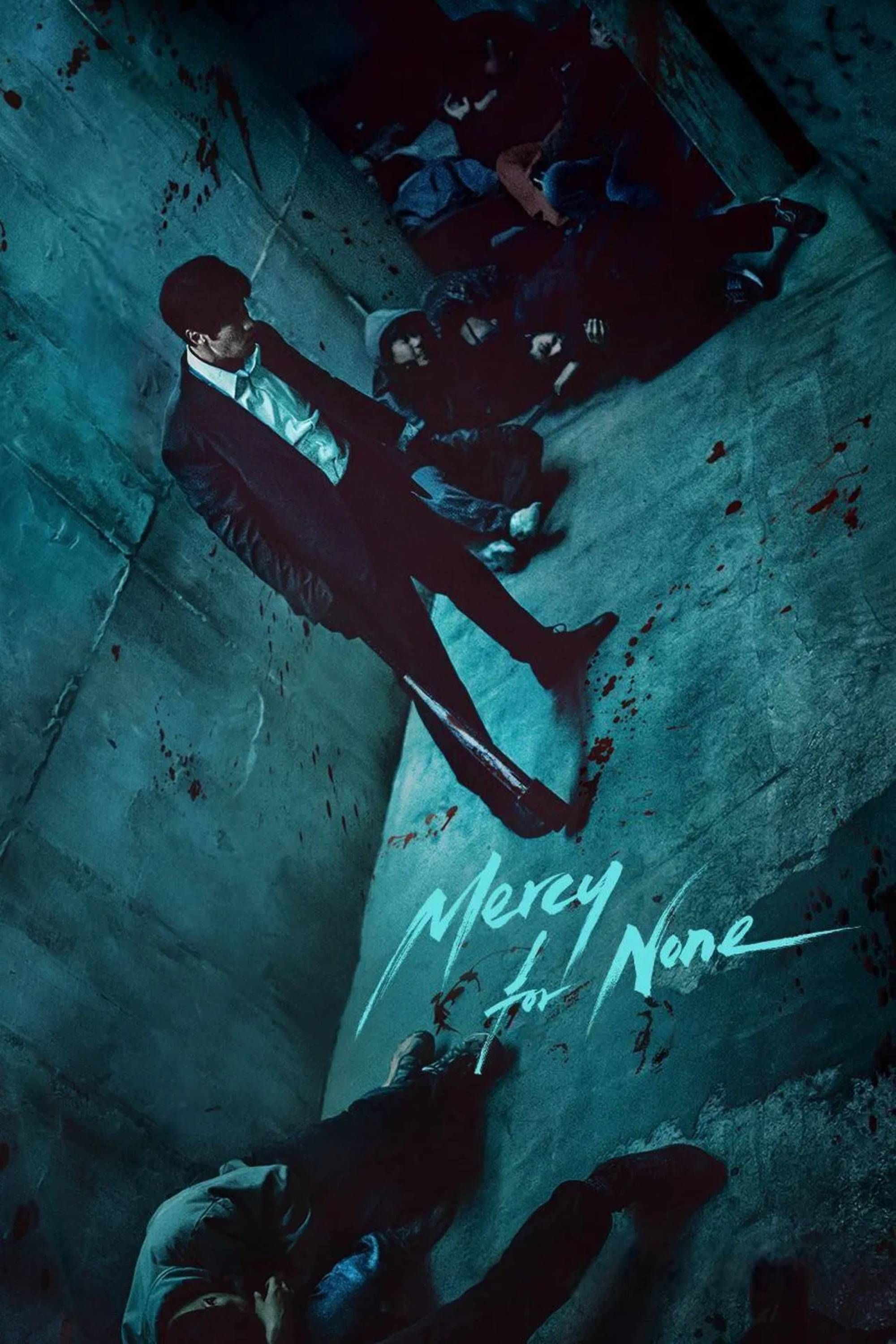
“The deal was clear—his life for mine. You broke it.” — Nam Gi-jun
Mercy for None is a gritty, intense Korean action drama that drops you into the shadowy underbelly of Seoul’s criminal world, where revenge is less a personal choice and more a brutal currency everyone ends up paying. Adapted from the webtoon Plaza Wars: Mercy for None by Oh Se-hyung and Kim Geun-tae, the series runs a lean seven episodes at roughly 40–45 minutes each, making it a compact but powerful binge. It follows Nam Gi-jun, a former gang enforcer who once carved out a bloody reputation for himself before literally cutting himself out of the life—he slices his own Achilles tendon to walk away after a disastrous job. Years later, when his younger brother Gi-seok, now a rising figure in the underworld, is murdered in what looks like a calculated move in a larger power struggle, Gi-jun is dragged back into the orbit he tried so hard to escape. What begins as a simple quest for payback slowly mutates into a full-blown gang war between rival factions, where old debts, broken promises, and rotten institutions all collide.
The show’s webtoon roots are easy to feel in its storytelling style and visual sensibility. Plaza Wars: Mercy for None was known for its grim noir tone, sharp sense of place, and explosive outbursts of violence, and the drama leans into that DNA rather than sanding it down. The adaptation keeps the basic spine of the story—an aging, wounded enforcer returning to a city carved up by criminal empires—and translates the panels’ rough, kinetic energy into tight, live-action set-pieces. So Ji-sub’s casting as Nam Gi-jun is spot-on: he looks and moves like someone who has survived more fights than he cares to remember, and his presence gives the character that blend of weariness and danger that fans of the source material wanted to see. The direction and writing embrace the original’s grimy, unforgiving atmosphere, focusing on high-stakes confrontations and the emotional cost of violence rather than trying to make the material more broadly “feel-good” or conventional.
At the center of everything is Gi-jun’s arc, and that’s where the series finds its emotional weight. He isn’t written as a slick, wisecracking antihero; he’s a man who carries his history in his body and on his face. When he’s living in hiding, you can feel the way his past still sits on his shoulders, and once he learns how his brother died, the shift in him is less about explosive rage and more about grim resolve. The limp from his old injury, the way he braces himself before every fight, and the quiet moments where he weighs what he’s about to do all help make him feel like a person first and a genre archetype second. That keeps the show from collapsing into pure revenge fantasy, even when Gi-jun tears through rooms full of armed men; there’s a sense that every win costs him something.
The supporting cast gives the drama a lot of texture, especially the older gangsters who make up the city’s criminal backbone. These men are written as survivors who’ve spent decades navigating backroom deals, territory disputes, and shifting alliances; they don’t just feel like generic “boss” figures but people with their own codes and grudges. Their scenes have a heavy, lived-in tension, even when nobody is throwing a punch. By contrast, some of the younger characters—the hotheaded heirs and ambitious underlings—can feel more sketched in. They bring energy and chaos, but their motivations and personalities aren’t always explored as deeply as they could be, which sometimes makes their big turning points land a little softer. The show also makes the deliberate choice to center almost entirely on men, with women mostly absent or on the fringes. That tight focus suits the idea of a closed, hyper-masculine underworld, but it does limit the emotional and thematic range.
Where Mercy for None really swings for the fences is in its action. The fights are brutal, messy, and grounded, full of close-quarters grappling, improvised weapons, and bodies hitting concrete hard. There’s a clear sense of geography in most of the set-pieces: you can tell where everyone is in a hallway brawl or a parking garage ambush, and the camera usually holds long enough to showcase the choreography without turning everything into a blur. Gi-jun’s physical limitations are baked into the way he moves; he fights like someone who knows his body can betray him at any second, relying on experience, ruthlessness, and timing more than sheer athleticism. As the series goes on, though, it does start to push him closer to the edge of believability, with him surviving punishment that would realistically stop anyone else. Whether that bothers you will depend on how much you’re willing to accept heightened genre logic in exchange for cathartic, over-the-top showdowns.
Stylistically, the series leans into a very specific mood: lots of night shots, harsh lighting, and cramped locations that make the city feel like a maze of traps and dead ends. Bars, offices, stairwells, garages, and back alleys all start to feel like different battlegrounds in the same endless war. When the show occasionally cuts to quieter, more open environments—like scenes from Gi-jun’s life in seclusion—they almost feel like they belong to a different world. That contrast reinforces just how suffocating his return to Seoul is. The music tends to underscore rather than dominate, and while it may not be the kind of score you walk away humming, it adds an extra layer of tension to confrontations and a sense of heaviness to the aftermath of each fight.
Structurally, Mercy for None benefits from being short and focused. With only seven episodes, there isn’t much room for filler, so the story keeps moving—information is revealed, allegiances shift, and every episode pushes Gi-jun further into conflict. There’s no attempt to pad things out with a romance subplot or quirky comic relief, which makes the series feel more like a long crime film than a traditional drama season. At the same time, the show occasionally leans on familiar rhythms: Gi-jun confronts a new layer of the conspiracy, storms another stronghold, leaves a trail of bodies, and moves on. A bit more variation in the types of obstacles he faces or the perspectives we follow might have made the middle stretch feel less repetitive. Still, the relatively tight run helps prevent that repetition from becoming a serious drag.
On a thematic level, the drama keeps circling back to ideas of debt, loyalty, and the illusion of getting out clean. Gi-jun once believed that sacrificing part of himself physically would allow him to walk away from the life he lived and protect the people he cared about. The story systematically tears that belief apart. The bosses he helped rise are still entangled in their old patterns, the institutions that are supposed to enforce justice are compromised, and his brother’s death becomes proof that the system he once upheld ultimately consumes everyone in its reach. The ending doesn’t offer easy comfort: the people who engineered the power struggle pay a price, but what’s left behind is not some hopeful new order, just ruins. Gi-jun’s revenge lands, but it doesn’t look or feel like a victory.
As a whole package, Mercy for None works very well as a stripped-down, no-frills revenge saga with a strong sense of character and place. Its strengths lie in So Ji-sub’s committed performance, the weighty, bruising action, and the way it translates its webtoon source into something that feels cinematic rather than purely episodic. Its weaknesses—limited female representation, some underdeveloped younger characters, and occasional repetition in structure and escalation—keep it from feeling completely fresh, but they don’t undermine what the show is clearly trying to be. It isn’t out to reinvent the gangster genre; it’s out to inhabit it fully, with a distinctly Korean noir flavor and a protagonist who feels like he’s been carved out of regret and rage.
If you’re looking for a character-driven revenge thriller that leans into dark atmosphere, grounded yet stylized violence, and the slow unraveling of a criminal ecosystem, Mercy for None is absolutely worth the time. If you’re hoping for a broader ensemble piece with varied perspectives, rich female characters, or a more hopeful worldview, this will probably feel too narrow and bleak. As a webtoon adaptation and a compact action drama, though, it stands out as a confident, hard-edged entry that knows exactly what it wants to do and largely pulls it off.
 Through the Shattered Lens