Horror on the Lens: The Avenging Conscience (dir by D.W. Griffith)


Hi there and welcome to October!  This is our favorite time of the year here at the Shattered Lens because October is our annual horrorthon!  For the past several years (seriously, we’ve been doing this for a while), we have celebrated every October by reviewing and showing some of our favorite horror movies, shows, books, and music.  That’s a tradition that I’m looking forward to helping to continue this year.

This year, we’re getting things started with a movie that has been called “the first American horror film.”  In 1914, D.W. Griffith released The Avenging Conscience, a melodrama that was based on Edgar Allan Poe’s The Tell-Tale Heart and Annabel Lee.  In this film, The Nephew (Henry B. Walthall) falls in love with the Sweetheart (Blanche Sweet).  However, the Uncle (Spottiswoode Aiken) is opposed to the relationship, mostly because the Sweetheart is a “common” woman.  Despite having been raised by the Uncle, the Nephew snaps and murders him.  The Nephew then finds himself tortured not just by his own guilt and fear but also by vivid hallucinations.  This is a film that invites us to come for the murder and stay for the reminder that “Thou Shalt Not Kill.”

Like a lot of the films of the silent era, it will require a bit of patience on the part of modern viewers.  It takes a while to get going but the surreal imagery and Henry B. Walthall’s increasingly unhinged performance make it worth sticking with.  If nothing else, the film’s historical significance makes it one worthy to be seen by all serious horror fans.

Enjoy!

The Sixth Annual Academy Awards: 1919


At the 1919 Academy Awards, Evelyn Preer makes history, Harry Houdini is rewarded for playing himself, and Bolshevism goes on trial!

Jedadiah Leland's avatarThrough the Shattered Lens Presents The Oscars

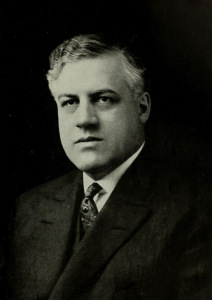
Attorney General A. Mitchell Palmer Attorney General A. Mitchell Palmer

In 1919, as the Spanish Flu continued to infect and kill millions, the world tried to recover from World War I.  After spending six months at the Paris Peace Conference, President Woodrow Wilson returned to the U.S. and launched an ultimately unsuccessful campaign to bring the United States into the newly formed League of Nations.  On September 25th, while barnstorming across the nation in support of the League, a physically exhausted Wilson collapsed and never truly recovered.  On October 2nd, a stroke left him partially paralyzed and blind in one eye.

Even before Wilson’s physical collapse, the U.S. population had reason to feel uncertain about the future.  On January 6th, the wildly popular Theodore Roosevelt died in his sleep.  Before his death, Roosevelt had been widely expected to run for President in 1920 and hopefully return the U.S. to the peace and prosperity…

View original post 1,108 more words

A Warning From The Past: The Road To Ruin


Good Morning!  It’s Thursday and we all know what that means.  The weekend is approaching and that means that all the usual temptations of the weekend are approaching as well.  These temptations include drinking, smoking, dancing, premarital sex, prostitution, and near incest.

These are the temptations that are dealt with in the 1934 film The Road To Ruin.

Do you have an hour to spare?

If so, consider watching this film (a personal favorite of mine) and learning from the mistakes of Ann Dixon…

Here’s a few interesting facts about The Road To Ruin:

  • The Road To Ruin is a prototypical example of the first independent films.  Films like this one dealt with “social problems.”  Typically, they would be about an “innocent” who would be led astray for 55 minutes before spending the last 10 minutes of the film either repenting or suffering the consequences of their actions. 
  • Since these films were shot outside of the Hollywood establishment, they were also “free” to show things that studio films wouldn’t even hint at.  By today’s standards they may seem “tame” but for the 1930s, they were considered to be quite scandalous.
  • This film is an almost shot-for-shot remake of a silent film that was also called The Road To Ruin.  The first Road to Ruin was the top-grossing film of 1928 and was directed by Norton Parker.  Helen Foster played the lead role in both versions of the film.
  • According to the opening credits of the 1934 Road to Ruin, the remake was directed by Melville Shyer and “Mrs. Wallace Reid.”  Mrs. Wallace Reid was actually Dorothy Davenport, a former silent film starlet.  After her husband — the actor Wallace Reid — died of a drug overdose in 1923, Davenport directed several “social problem” films as Mrs. Wallace Reid.
  • Despite the fact that this film is, technically, quite primitive, I love it for several reasons.  The historian side of me loves that the film basically serves as a time capsule, preserving the society and the attitudes that produced it. 
  • The film lover in me loves just how melodramatic this film is.  Seriously, I love how smoking cigarettes and sneaking a drink always serve to pave the road to Hell in films like this one.  It’s interesting to contrast a film like this with modern-day anti-drug propaganda. 
  • Finally, as a lover of exploitation films both new and old, I love how this film shows off everything that it’s claiming to condemn.