Film Review: Barabbas (dir by Richard Fleischer)


Who was Barabbas?

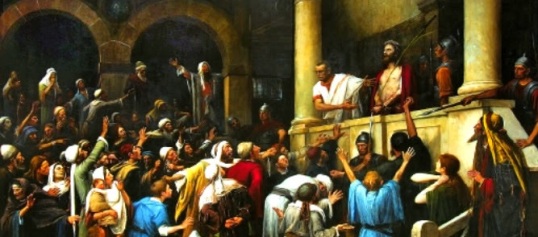
The simple answer to that is that Barabbas was the prisoner who, according to the Gospels, Pontius Pilate released during Passover.  As the story goes, Pilate gave the people the choice.  He could either release Barabbas or Jesus.  For what crime was Barabbas being held?  The Gospel of Matthew merely says that Barabbas was a “notorious prisoner.”  Mark and Luke both write that he was involved in a recent riot and that he was a murderer.  The Gospel of John refers to him as being a bandit, which may have been another term for revolutionary.  Regardless of what crime he had committed, the people overwhelmingly called for Barabbas to be released and for Jesus to be crucified.  What happened to Barabbas after he was set free is not recorded but has been the subject of a good deal of speculation over the centuries.

(Of course, there are some scholars who believe that the Barabbas story was simply an invention of later writers, designed to shift the responsibility for the crucifixion away from the Romans.  There’s also some who say that Jesus and Barabbas were actually the same person and that the inclusion of the Barabbas story was meant to indicate that Jesus was actually a revolutionary who was working to free Judea from Roman role.  I imagine Dan Brown will eventually base a novel on this theory, so look forward to hearing your grandma debating the historicity of Barabbas at some point in the future.)

Back to the original question, who was Barabbas?

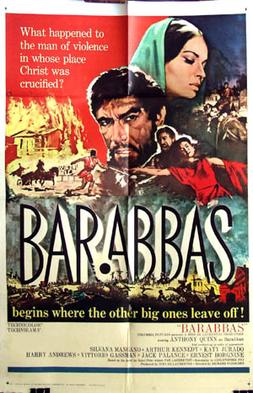
According to the 1961 film of the same name, Barabbas was Anthony Quinn.

Based on a novel by the Nobel Prize-winning Swedish author, Pär Lagerkvist, Barabbas opens with Pilate (Anthony Kennedy) making his infamous offer.  Barabbas or Jesus?  Perhaps the only person more shocked than Pilate by the people’s decision is Barabbas himself.  A brutish and violent man, Barabbas is looking forward to returning to his old life but, as he leaves the prison, he finds himself fascinated by the sight of Jesus stoically carrying the cross, heading to the fate that Barabbas was spared.  Later, Barabbas witnesses the Crucifixion and is shaken when, upon Jesus’s death, the sky turns black.

(Director Richard Fleischer shot the Crucifixion during an actual solar eclipse, so that the sky actually did turn black during filming.  It’s a stunning scene.)

For the rest of his life, Barabbas is haunted by both his narrow escape from death and his subsequent notoriety.  When Barabbas tries to reunite with his former lover, Rachel (Silvana Mangano), he discovers that not only does she now want nothing to do with him but that she has also become a follower of Jesus.  (Later, in a surprisingly graphic scene, Rachel is stoned to death.)  Barabbas becomes convinced that he cannot die and he becomes increasingly reckless in his behavior.  Over the next few decades, he finds himself sold into slavery and forced to spend 20 years working in the harsh sulfur mines of Sicily.  He befriends a Christian named Sahak (Vittorio Gassman) and, with him, is trained to be a gladiator by the sadistic Torvald (Jack Palance).  Eventually, Barabbas finds himself rejected by both the Romans and the Christians while Rome burns all around him.

Barabbas is a film that really took me by surprise.  I’ve seen a lot of Biblical and Roman films from the 50s and 60s and I was expecting that Barabbas would be another sumptuously produced but slow-paced epic, one that would inevitably feature stiff dialogue and overly reverential performances.  I mean, don’t me wrong.  I happen to love spectacle and therefore, I enjoy watching most of those old historical and religious epics.  But still, for modern audiences, these films can often seem rather … well, hokey.

But Barabbas was totally different from what I was expecting.  As wonderfully played by Anthony Quinn, Barabbas wanders through most of the film in a state of haunted confusion.  Even at the end of the film, after he’s met St. Peter (Harry Andrews), Barabbas doesn’t seem to fully understand what he believes or how he’s become one of the most notorious men in Rome.  Quinn plays Barabbas almost like a wild animal, one that has been cornered and trapped by his own infamy.  The more Barabbas struggles against his fate, the more trapped he becomes.  Barabbas may be a brute but, the film suggests, even a brute can find some sort of redemption.  Quinn gets good support from the entire supporting cast.  Jack Palance is perfectly evil as Torvald while Vittorio Gassman, Silvana Mangano, and Ernest Borgnine bring some needed nuance to characters who, in lesser hands, could have just been cardboard believers.

Barabbas is a surprisingly dark film.  When Rachel is stoned, the camera doesn’t flinch from showing just how cruel an execution that was.  Nor does the camera flinch from the violent brutality of the gladiatorial games.  When Barabbas is sold into slavery, the sulfur mines of Sicily are depicted in Hellish detail and practically the only thing that saves Barabbas from spending the rest of his life being smothered under a cloud of sulfur is a giggly Roman woman who decides to buy Barabbas so that he can serve as a good luck charm.  The scenes of Barabbas’s skill of a gladiator are contrasted with the bloodthirsty crowd demanding and cheering death.  Even when Barabbas joins the Christians in the Roman catacombs, he discovers that they want nothing to do with him, suggesting that they believe in forgiveness for everyone but him.  The spectacle of Rome is displayed but so is the terror of what lies underneath the city’s ornate surface.  If Barabbas is occasionally a ruthless or unsentimental character, one need only look at the world he lives in to understand why.

With the exception of a few slow scenes at the start of the film, director Richard Fleischer does a good job of keeping the action moving.  It’s a long film but it never becomes a boring one.  In the end, thanks to Quinn’s performance and the film’s unflinching portrayal of life in ancient Rome, Barabbas is a biblical epic for people who usually don’t like biblical epics.
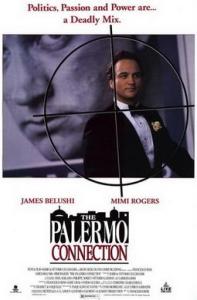
 

A Movie A Day #80: The Palermo Connection (1990, directed by Francesco Rosi)


Carmine Bonavia (James Belushi) is an idealistic New York City councilman who wants to be mayor.  Despite an easily understood slogan — “Make A Difference!” — his reform campaign is running behind in the polls.  Having nothing to lose, Carmine announces that he supports the legalization of drugs.  By taking out the profit motive, the Sicilian Mafia will no longer have any incentive to sell drugs in the inner city.  Carmine shoots to top of the polls.  Now leading by 11%, Carmine marries his campaign manager (Mimi Rogers) and returns to his ancestral home of Sicily for a combination honeymoon and fact-finding tour.  The Mafia, realizing that Carmine is serious about legalizing drugs, conspires to frame him for the murder of a flower boy.  If that doesn’t work, they are willing to resort to other, more permanent, methods to prevent Carmine from ever becoming mayor.

The Palermo Connection is an unfairly overlooked film from Francesco Rosi, an Italian director who specialized in political controversy.  Though The Palermo Connection was sold as a thriller, Rosi was more interested in showing how organized crime, big business, government corruption, the war on drugs, and the poverty of the inner cities are all intricately connected.  When Carmine arrives in Palermo, Rosi contrasts the outer beauty of Sicily with the desperate lives of the junkies living there.  The pace may be too slow for action movie fans but Rosi gives the audience much to think about.  This is probably the last film you would ever expect to star James Belushi but he gives a strong and committed performance as Carmine.

The Palermo Connection, which was co-written by Gore Vidal, is a good film that predates The Wire in its examination of how greed, drugs, poverty, and racism all come together to victimize the most marginalized members of society.

A Movie A Day #7: Sharky’s Machine (1981, directed by Burt Reynolds)


220px-sharkys_machine_ver3After a drug bust goes wrong, Atlanta police detective Tom Sharky (Burt Reynolds, who also directed) is transferred from narcotics to the vice squad, the least desirable assignment in the Atlanta police department.  Despite all of his honors and commendations, Sharky finds himself reduced to busting hookers with Papa (Brian Keith) and Arch (Bernie Casey).  But then Sharky discovers evidence of a prostitution ring being run by Victor D’Anton (Vittorio Gassman), one that services the wealthiest and most powerful men in Georgia.

Working with Papa, Arch, and a burned-out bugging expert named Nosh (Richard Libertini), Sharky begins a surveillance of Domino (Rachel Ward), one of Victor’s girls.  As the days turns into weeks, Sharky falls in love with Domino, who doesn’t even know that she’s being watched.  Sharky also discovers that Domino is sleeping with Hotckins (Earl Holliman), who is about to be elected governor of Georgia.  At the same time, a heroin-addicted assassin named Billy Score (Henry Silva) is assassinating anyone who could reveal Victor’s crimes.

There are two great sequences in Sharky’s Machine.  One is the opening credits scene, in which a bearded Burt Reynolds walks through the roughest parts of Atlanta while Randy Crawford sings Street Life.  This scene lets everyone know from the start that this is not another Burt Reynolds good ol’ boy comedy.  The other is a cat-and-mouse chase through an Atlanta skyscraper, as Sharky and his partners try to track down Billy Score, who is so doped up on painkillers that he barely flinches whenever he’s shot.  Billy Score is one of the most frightening movie villains of all time, seemingly indestructible and capable of moving like a ghost.

henry-silvaWith the exception of maybe Deliverance, Sharky’s Machine is Burt Reynolds’s darkest movie.  There are moments of humor and appearances by the usual members of the Burt Reynolds stock company, like John Fiedler and Charles Durning.  But overall, this is one dark movie.   Likable characters die.  Sharky cries and loses two fingers when they are graphically chopped off by the bad guys.  A woman’s face is literally blown off.  Even when Sharky starts to talk about his childhood, a sentimental moment the occurred in almost every Burt Reynolds film, Domino tells him that she doesn’t care.

In other words, this ain’t The Cannonball Run.

Burt Reynolds’s first cut of Sharky’s Machine reportedly ran for 140 minutes.  Twenty minutes were cut before it was released into theaters and, as a result, Sharky’s Machine sometimes seems to be rough around the edges.  (One important supporting character is killed off-screen and if you don’t pay close attention to the dialogue, you might never know what happened to him.)  Still, this violent film noir, which Reynolds once called “Dirty Harry in Atlanta,” is one of Burt’s best.

sharky-machine

Cleaning Out The DVR Yet Again #15: Quintet (dir by Robert Altman)


(Lisa recently discovered that she only has about 8 hours of space left on her DVR!  It turns out that she’s been recording movies from July and she just hasn’t gotten around to watching and reviewing them yet.  So, once again, Lisa is cleaning out her DVR!  She is going to try to watch and review 52 movies by Wednesday, November 30th!  Will she make it?  Keep checking the site to find out!)

quintet

The 1979 post-apocalyptic film Quintet aired on FXM on November 15th.  I recorded it because this film is often cited as being one of director Robert Altman’s worst but I’ve also read some very passionate defenses of Quintet.  Since I’ve enjoyed several of Altman’s films (Nashville, Gosford Park, Short Cuts, The Company, The Player, The Long Goodbye, and many more), I wanted to experience Quintet for myself.

I mean, seriously — a postapocalyptic sci-fi film from Robert Altman!?  That would have to be at least interesting, right?

Anyway, I watched Quintet and to be honest, I wasn’t really sure what the Hell was going on for most of the film.  Things made a bit more sense after I did a little bit of research and I discovered that Quintet was 1) inspired by a fragment of a dream that Altman had and 2) went into production despite not having a completed script.

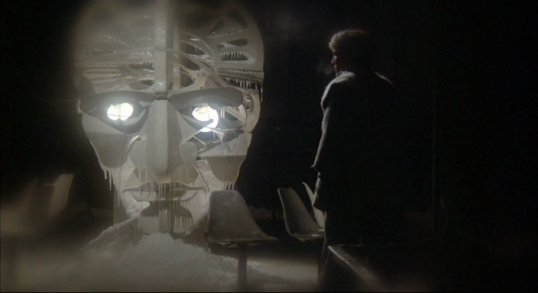
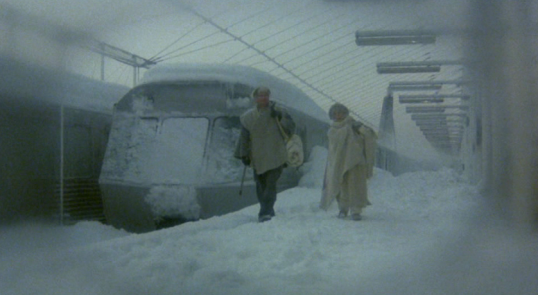
Quintet opens with a breath-taking shot of a frozen landscape.  There’s been a new ice age.  The entire Earth is frozen.  There’s only a few hundred humans left and their number is rapidly dwindling.  Some, like Essex (Paul Newman) and Vivia (Brigitte Fossey) spend their days hiking across the tundra and hunting seals.  Others — like practically everyone else in the entire freaking film — spend their times in ramshackle villages, pursuing what little pleasure they can find while waiting to die.

In this new frozen world, the most popular activity — outside of getting drunk — is playing a board game called Quintet.  I have no idea how Quintet is played, though the film is full of scenes of people playing it.  From what we do see, it really doesn’t look like that fun of a game but I guess you can’t be picky when you’re waiting to freeze to death.  I mean, honestly, if the world’s ending, I’d rather play a board game than charades.

Anyway, in one of the frozen towns, a group of people are having a Quintet tournament, with the rule being that, once you’re eliminated in the board game, you are also killed in real life.  (And again, this is where it would have been helpful for the film to take just a few minutes to clarify just how exactly Quintet is played.)  One of the Quintet players is killed by a bomb, which unfortunately blows up Viva as well.  Seeking revenge (or, at least, I’m guessing that was his motivation because Paul Newman didn’t exactly give the most communicative performance of his career in Quintet), Essex assumes a fake identity and enters the tournament.

Soon, he’s running around the frozen landscape, killing people.  He knows that the final player standing will receive a prize of some sort but he doesn’t know what the prize is.  How deep!  Or something.

Dammit, I really wanted to defend Quintet.  I really did.  Whenever I see a movie that has gotten almost universally negative reviews, my natural instinct is to try to find something good about it.  And I will say this: visually, Quintet is fascinating.  A lot of care was put into creating this frozen world and it’s interesting to note how every location is decorated by elaborate ice sculptors.  The ice may be destroying civilization but it can’t squelch humanity’s natural creativity.

Unfortunately, Quintet  may be well-designed but it’s also a painfully slow film.  Just because the film takes place on a glacier, that doesn’t mean that it needs to move like one.  The slow pace is not helped by the fact that many of the characters have a tendency to suddenly start delivering these faux profound philosophical monologues, the majority of which are about as deep as the typical Tumblr post.

Quintet stars Paul Newman, who was both an iconic movie star and a legitimately great actor.  He spends most of Quintet alternating between looking confused and looking stoic.  That said, it’s always interesting to watch an actor like Paul Newman slog his way through an artistic misfire like WUSA or Quintet.  Let’s give Paul Newman some credit: he delivered his lines with a straight face. Just as Essex knew he was trapped on a glacier, Paul Newman understood that was trapped in Quintet.  Both did what they had to do to survive.

Robert Altman was a great director but Quintet is not a great film.

It happens.

quintettrain