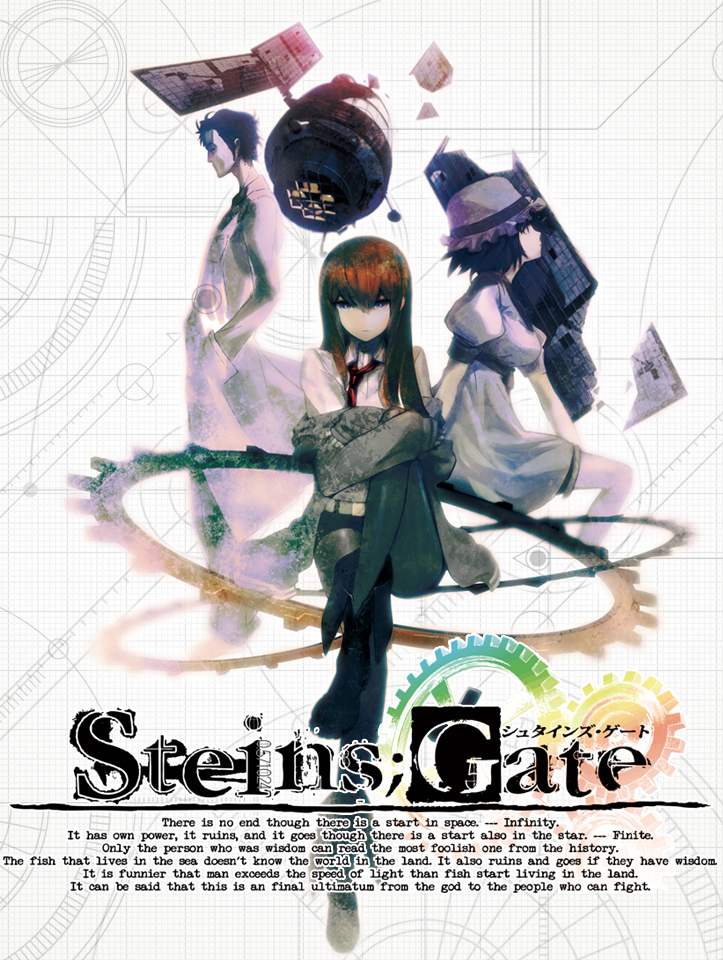
Visual Novel Review: Steins;Gate


Steins;Gate

Steins;Gate is a Japanese visual novel created by collaboration of two developer companies Nitroplus and 5pb. for multiple platforms. Even though it doesn’t have any official releases in English a fanmade translation patch for it exists allowing to play it even if you don’t know Japanese.

stgcap1

Steins;Gate’s genre mostly could be classified as hard science fiction which already makes it stand out among most of the others sci fi stories that could be found in anime, manga or visual novels. You aren’t going to find there giant robots, superpowers, aliens, supernatural creatures, talking animals or transforming magical girls. The setting of Steins;Gate nearly completely abides known laws of physics with one exception that is the discovery of a phenomenon leading to possibility of time travel. The theme of time travel is the key focus of the story of this VN and many aspects of time travelling covered in others works dealing with it such as Butterfly Effect are being touched upon as the story progresses.
stgcap2

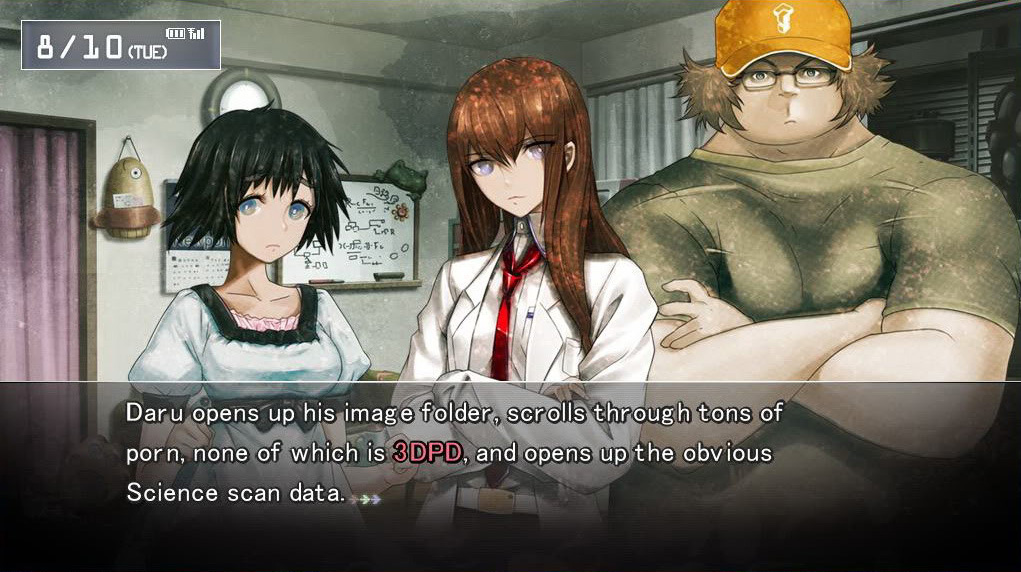
The story of Steins;Gate is set in Akihabara district of Tokyo and revolves around members of “Future Gadgets Laboratory” created by protagonist of the story Okabe Rintarou. The start of the story is rather slow and it takes a while until the events take turn into more dramatic and thrilling half of the story. This might turn off some people from the VN personally I enjoyed the first half of it as much as the second one. Akihabara is known not only for its electronics stores but as the heartland of otaku culture as well so it’s no wonder that many characters of the story to various extent belong to it as well. As the result most of activities in early parts of the story which starts from accidental discovery of strange side effect in the latest creation of the lab (a remote controlled microwave oven) revolve around either scientific or otaku related topics. Those two topics blend in together very nicely with science part building up a rather plausible base for time principle while otaku part mostly serving to fleshen up main characters. Together with its second half which brings many engaging moments, sudden twists and suspenseful drama Steins;Gate has very well written and masterfully planned story.
stgcap3

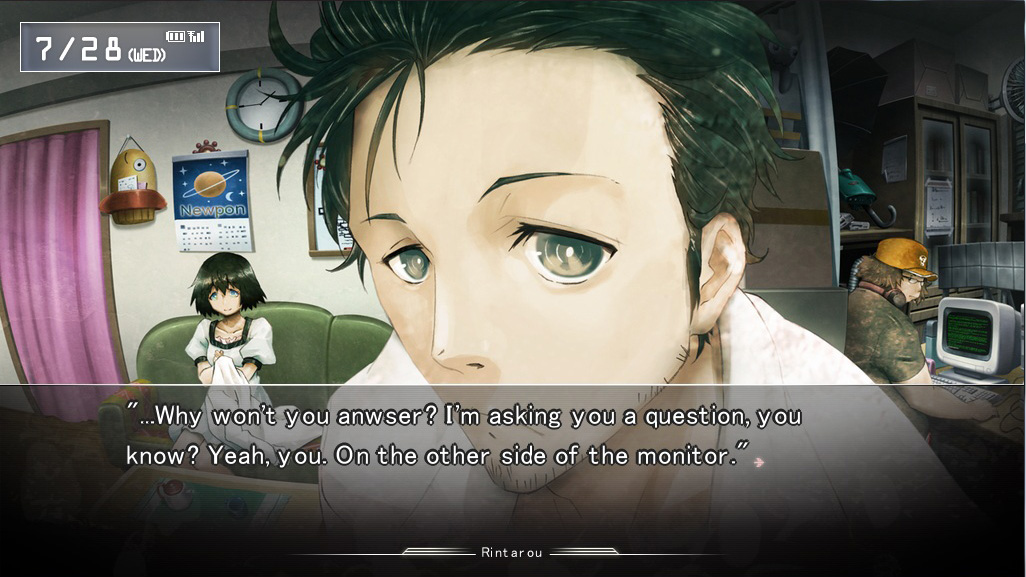
Characters means a lot for a visual novel and even in cases when the story isn’t that great or too cliche a lovable cast could became saving grace for it. And already possessing good story Steins;Gate adds excellent cast of characters to boot. I must admit that I end up either disliking or not caring about more than 90% of protagonists in visual novels. In most cases they end up being narrowed down to either to nice guy with no personality archetype or nihilistic jackass archetype. Steins;Gate is a rare exception to that boasting one of the most memorable protagonists that I saw. Okabe Rintarou is a chuunibyou. To those who don’t know chuunibyou is a slang term that roughly could be translated as second year of middle school (8th grade) syndrome. It refers to a certain behavior pattern that sometimes develops in age which most often corresponds to the 8th grade of school hence the name. Making up dark past background, pretending to have hidden superpowers, engaging in activities that they think makes them look “cool” and adult like those are the main qualities that identify chuunibyou. Usually it soon passes as they keep growing up but in some cases they remain being chuunibyou and Okabe Rintarou is hardcore example of that. Calling himself mad scientist Hououin Kyouma, claiming to be pursued by some kind of secret organization, suddenly engaging into monologue conversations with imaginary correspondent on his cell phone and having strange and pompous speech manner all of this makes him really stand out. Naturally he isn’t able to maintain his mad scientists persona all the time and his true personality occasionally shows up and when faced with adamant unwillingness to communicate with it or in dire situations it completely cracks up. Such “dual” personality makes him really interesting and fun character to follow after.

stgcap4

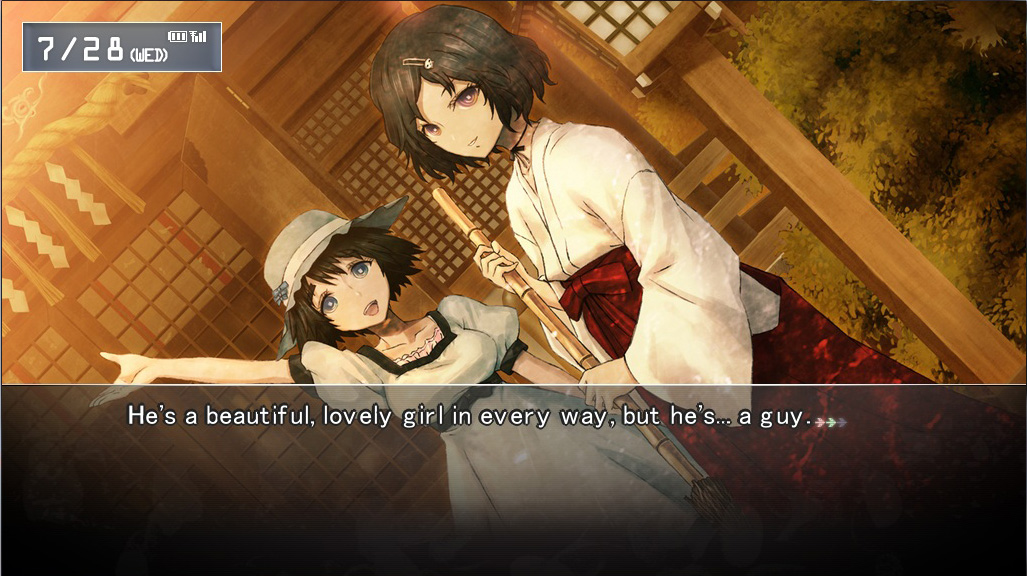
The others main characters although not as much flashy still hardly could be called ordinary and each of them possess one or more quirks that makes them to stand out. Besides Rintarou the others founding members of Future Gadgets Lab are his airheaded cosplay loving childhood friend Shiina Mayuri and hardcore otaku and skilled hacker Hashida Itaru. Neuroscience prodidgy with tsundere personality Makise Kurisu joins the lab soon thus completing initial cast of main characters. Several more characters joins them as the story progresses and each of them gets a bunch of development. Overall there are 6 endings in this VN, 5 of them corresponding to 5 different heroines and one true end.
stgcap5

The art of Steins;Gate is done by huke, an artist possessing a highly distinctive drawing style who became known from his work on Black Rock Shooter. To be honest I didn’t like his style at first since normally I prefer more traditional character designs. But as I kept playing it was growing on me more and more blending perfectly with characters and overall mood of the VN. As the result I ended up loving it so much that even ordered huke’s artbook of Steins;Gate. The music of the VN is above average. PC version of Steins;Gate has two OP themes sung by Itou Kanako: Skyclad Observer that plays early on and A.R. that plays later when the story reaches its culmination. Both of those songs are superb and fit perfectly with overall mood of the VN. Unfortunately BGM soundtrack isn’t that great although it isn’t really bad either. It has only only one memorable melody Gate of Steiner which in various arrangements plays in many moments of the story. The others tracks blend nicely with situations where they are playing but really forgettable otherwise. On other hand voice acting in Steins;Gate is excellent. Many highly profilic seiyu were chosen to voice characters of this VN and they did great job in delivering characters voiced by them.

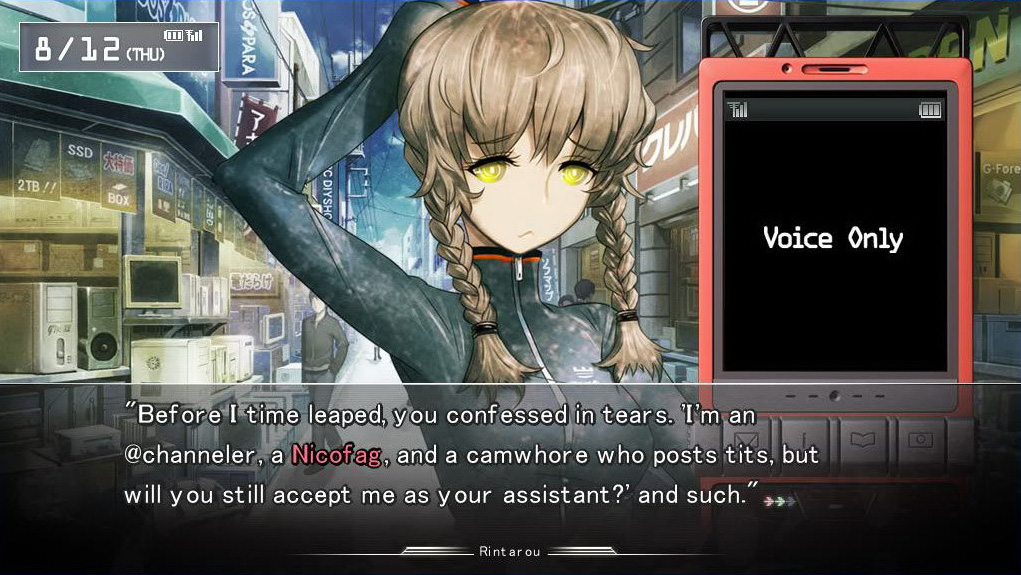
From technical standpoint the main difference of Steins;Gate possess from the others visual novels with branching plot is that it doesnt have any dialogue choices. Instead you have to use Okabe’s cell phone in order to respond or ignore calls and text messages. An interesting decision although I wouldn’t call particularly great since it could be rather confusing early on. Another uncommon feature is fairly big tips section explaining meanings of various scientific, otaku or internet slang term which are in abundance encountered during the course of the story.
stgcap6

In conclusion I must say that I was starting Steins;Gate with big share of skepticism to all praises that it was receiving since previous works from its producers left me with an impression that their VNs doesn’t fit my tastes much but as I kept progressing through the story it grew up on me into being one of the most enjoyable visual novel reads that I ever had. Still I wouldn’t recommend it to just about anyone. While touching various aspects of otaku culture the character abundantly use 2channel (called @channel in the VN) lingo and memes in translation partially replaced by their 4chan counterparts and it certainly might alienate some people not accustomed to that.

VGM Entry 56: Snatcher (part 1)


VGM Entry 56: Snatcher (part 1)
(Thanks to Tish at FFShrine for the banner)

At this point I think it’s safe to talk about Snatcher. Snatcher has quite a long history. Konami first released it on the PC-8801 in November 1988, following this up with an MSX2 port the following month. In 1992 it found its way to the PC-Engine, and in 1994 it got its first English translation via the Sega Mega-CD. It would go on to appear on the Playstation in February 1996 and the Sega Saturn in March before all was said and done.

Snatcher was a cyberpunk visual novel, which isn’t the sort of thing North American and European gamers are particularly familiar with. It also featured some graphic violence, partial nudity, and cultural references, which didn’t jive well with North America’s outrageous censorship and copyright laws. All of these factors contributed to the long delay of an English port, and it’s quite remarkable that Konami ended up making one at all. The market was not in fact ready for it, and Jeremy Blaustein, who oversaw the localization, admitted that the game “only sold a couple thousand units”. He provided the legitimate argument that this resulted from Konami’s decision to release a game on the rapidly tanking Sega CD, not any shortcomings of the game itself. Snatcher remained popular in Japan however, and by the sixth and final release in March 1996 it also boasted six different variations on the main soundtrack.

What’s great for our purposes is that liquidpolicenaut on youtube already did all the legwork for comparing them. In some cases, such as “Decadence Beat (Joy Division)”, the original PC-8801 and MSX2 versions survive every port on into the Sega Saturn, but more often the songs get replaced for the Sega CD or Playstation and retain their new forms the rest of the way.

It’s by no means immediately obvious which take on this song is best. As songs by themselves, displaced from any game, the MSX2 version stands out the most to me, but the comments by actual fans of the game seem to denounce the MSX2 version as out of touch with the atmosphere of the scene. “Joy Division” (censored to “Plato’s Cavern” for the US Sega CD port) was Snatcher‘s general store chain. As a cyberpunk game, it naturally ought to be a little bit sleazy, but since I never played it personally I can’t say just how far that should go. The Sega CD version sounds like a porn shop, and the PSX version sounds like the score to what the Sega CD store is selling. The Sega Saturn take, despite being practically identical to the PSX take in construction, comes off quite tasteful due to better quality instrument samples. The potential complaint, of course, is that it’s too tasteful to be wholly appropriate.

If the PC-8801 take is a bit too funky and the PC-Engine a bit too weird, I’m left with the MSX2 take. It has a very technological feel to it. This is music for the sort of store I’d go to to buy my cybernetic crack injection kits for sure. The visual helps it out too; the store clerk looks a lot more seedy and a lot less evil on the MSX2 and PC-8801 than in the other takes, and the emphasis on grey (the PC-8801 has a brown floor) makes the whole place seem a little metalic–a little more futuristic. Oh the MSX2 take wins for me hands-down. But I’m listening to this with nothing but a song, a single image, and a general idea of cyberpunk to go on. I never played the game. Maybe the MSX2’s atmosphere, while consistent in audio and imagery, is totally out of place in it. One of the great benefits of Snatcher and liquidpolicenaut’s comparison videos is to bring these finer aesthetic considerations to mind.

I mentioned that “Joy Division” was renamed “Plato’s Cavern” on the Sega CD. It’s one of many censorship issues that forced minor changes in detail as new ports were made. The left-hand mask on the wall behind the store clerk on the MSX2 and PC-8801 was Predator, and it vanishes starting with the PC Engine. Amazing what petty things billionaires will file lawsuits over…

The censorship on “Pursuer Part 4 (Endless Pursue)” is a little more obvious. (Supposedly the dog was twitching, still alive on the original versions, and this was removed before they took out the image altogether.) Musically, this is another instance where the same song was maintained for all six versions of the game. Here the differences aren’t nearly as extreme, either. Again the Playstation take comes off the worst to my ears, and this time the Saturn’s improved sound does not sufficiently redeem it–at least if this is meant to be the fairly tense, down to the wire scene that the track title and early versions imply.

I can’t think of any context in which the PSX and Saturn versions might sound appropriate to be quite honest. The PSX take kicks off like some progy jazz piece that completely fails to acknowledge any sort of distress, or anything remotely unsettling (we’re still staring at a dog with its guts spilled out mind you, even if it’s censored). The bass drum beat is made no less obnoxious in the Saturn version by actually sounding like a bass drum, and its pace is totally out of touch with the melody. No, the PSX and Saturn versions are bad–no getting around that.

If you go back to the MSX2 take, you’ll find that it’s far more imaginative anyway. Variations in the intensity of the drum beats give it a dimension lacking in the last two versions. The higher-pitched notes behind the main melody in the PC-8801 introduction carry the song much more effectively than their MSX2 equivalent, emphasizing the pace of events, and the variations in percussion intensity are retained, but the main melody is just a bit too clean. The MSX2 take has a more hollow, raspy sound. I suppose I would characterize the MSX2 and PC Engine versions as prioritizing an element of danger, while urgency dominates the PC-8801 and Sega CD takes.

I could go on like this for every track, but I fancy it’s already gotten old. Tomorrow I’ll tackle who exactly wrote it all.

Scenes I Love: Clannad After Story


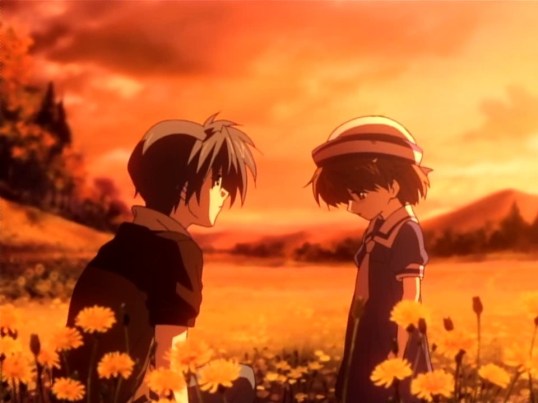
After people see this scene they will think I’m either crazy or a glutton for heartache for loving this scene. It’s hard to disagree with that statement. There’s a reason why I love this scene from the anime series Clannad After Story and it has less to do with the tone of the scene, but a major reason why anime is not just for kids or about boobs, tentacle rape and all the other things adults in the Western media dismiss the art form for.

This scene from Clannad After Story happens between the series’ main lead in Tomoya who has now come to the realization that he must now make amends to the daughter he left behind to be cared for by his wife’s family. It’s a powerful scene that has brought many to tears from young teen girls to grown-ass men who probably bawled more than the former. One doesn’t even have to have seen the previous season to this anime or any episodes leading up to this scene. The moment itself has enough of a backstory that one cannot help but get caught up in the moment. It’s also a scene that does a great job of emphasizing that bond between parent and child even when the former hasn’t lived up to their responsibilities.

I think if more people watched anime like Clannad After Story their opinions of anime would change for the better and see it in a new and positive light.

Anime You Should Be Watching: Higurashi no Naku Koro ni


Believe it or not, originally I was brought on to be the anime guy. Granted, I haven’t always been the most active of people, but that’s my natural laziness taking over. But with the season being what it is, and me having drank enough, allow me to enlighten everyone about one of the finer horror anime out there, Higurashi no Naku Koro ni.

Previously Arleigh had posted up another yandere classic, School Days. The Higurashi visual novel predates said visual novel by three years. The big difference is that while School Days was a fairly well funded project (with many, many bugs in it!) and Higurashi was basically a doujinshi project.

Let me explain doujinshi for a very little bit. A lot of people make the mistake that doujinshi instantly equals porn comics. Now, if you attend Comiket, which is the single largest doujinshi convention in Japan, you could be excused for thinking that it’s all about comics, and more importantly, comics that solely deal in erotic content. However, doujinshi basically just means “self published”. Again, not a literal translation. You want literal? Fine. The literal translation is “same person periodical publication”. Basically this can be taken to mean a project taken on by someone without the financial backing of the mainstream media. This could mean either comics, games, or even anime. Yes, the more common genre are the comics, but there is a fairly decent market for self published games. Higurashi falls under the blanket of the self published games. From a visual standpoint, they were very raw. In fact, there’s a very good reason why it gets criticized for having bun hands.

Compare that to the anime character art, and the difference is quite obvious.

But if you can get past the rough character designs,  (keep in mind that the true meat of the game comes from the story, not the graphics) then you’re in for a very good story with many a twist and turn along the way.

One thing I must say, based on the experiences I’ve had with people is that you should probably watch the anime first. Perhaps I’ve just been subjected to extremely rabid fans, but too many of them have an irrational hatred of the anime. I’ll accept that there is a chance the complaints are valid, because I have not personally played the visual novel (you play them, not read them. Trust me on this) but having seen all of the anime, even if the transition is not perfect, it’s still a fun watch that will keep you guessing right up until the answer arcs are shown.

Each arc starts out in a very light hearted manner, but make no mistake, this is a horror series at its core.  The fact that such cute girls are at the center of it all makes it seem all the more horrific, especially with the actions that are taken throughout the various arcs.  While it’s very difficult for anime to effectively show gore without getting to the ridiculous buckets of blood level, Higurashi manages to be very effective in its depictions of it, and some scenes are actually a bit shocking to see.

The thing is, you have to watch both seasons of the show, Higurashi no Naku Koro ni, and Higurashi no Naku Koro ni Kai, to get the true ending and find out the reason for all the happenings in the town of Hinamizawa during June of 1983, but it is well worth the time spent, and shows that anime can successfully pull off the horror genre.

Anime You Should Be Watching: School Days


For our latest Anime of the Day I have chosen the very controversial title School Days which aired from July through to September of 2007.

The series was adapted by anime studio TNK from the visual novel and eroge of the same title published by the company Overflow. School Days was your typical “harem” visual novel eroge where the main protagonist (most of the time male though there’s a few where it’s reversed and it’s a female) becomes involved with several of the female characters in the game. The goal of these eroge was to try and navigate through the many relationships between the protagonists and the many female characters around him (usualy in a sexual nature) and get the perfect ending which always ends up being the so-called “good ending”.

With School Days the main protagonist is one Makoto Ito who starts off as being a mild-mannered and polite high school student. This doesn’t last long as he become embroiled with the many female classmates he’s known for years and those he recently met. To say that the character of Makoto becomes addicted to having sex with his female classmates would be an understatement.

While there are several female characters in School Days who become involved with Makoto in one way or another it’s the duo of Kotonoha Katsura and Sekai Saionji who become rivals for Makoto’s affection. Just like the visual novel the anime series was adapted from (the visual novel was also adapted as a manga series) the complex and increasingly malicious attitudes by some of the leads in the series would lead to more than one tragedy for all involved. This is a series which starts off as a light-hearted harem title but as the series progresses towards its climactic finale it somehow takes a huge turn into the darkside that by the time it does make that turn the viewer has become so invested in the characters and the story that it becomes a major shock to the system.

School Days has become controversial since its release due to a real-life killing where a young high school girl kills her father with an axe which some thought as being too similar in tone to a sequence in the series. The controversy from such a real-life event caused the tv station broadcasting the series to replace almost half the running time of the final episode with an image of a nice boat and classical music playing in the background. This became such a major internet meme that saying “Nice Boat” has become the comment of choice when discussing controversial scenes and plot developments of any series that’d be ripe for studio censorship.

The series in all its form also emphasizes the character stereotype of yandere. School Days definitely has its major share of yandere characters and the many different endings to the visual novel shows how some of the yandere characters in the story deal with the callous way Makoto has dealt when dealing with their affections towards him. It gets bloody, violent and more than just a tad crazy-insane.

School Days is definitely one of the more seriously twisted anime offerings out there which doesn’t involved hentai in its description whatsoever. It’s a series that if it was a live-action series would be similar in tone and scope to many of filmmaker Ken Park’s films which deal with teenage highschool relationships, sex and the consequence which can come from it.