Cleaning Out The DVR, Again #37: All This And Heaven Too (dir by Anatole Litvak)


(Lisa is currently in the process of trying to clean out her DVR by watching and reviewing all 40 of the movies that she recorded from the start of March to the end of June.  She’s trying to get it all done by the end of July 11th!  Will she make it!?  Keep visiting the site to find out!)
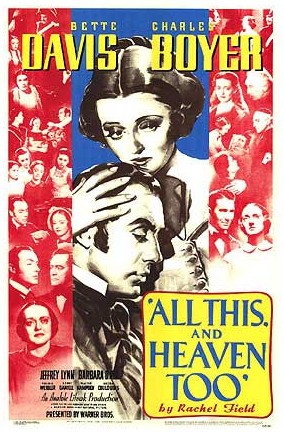
All_this_heaven_movieposter

The 37th film on my DVR was the 1940 film, All This, And Heaven Too.  It originally aired on June 21st on TCM.

All This, and Heaven Too is one of the many melodramatic historical romances in which Bette Davis appeared in the late 30s and early 40s.  These films usually featured Bette as a strong-willed woman who was often condemned for not conforming to the rules of society.  Typically, she would end up falling in love with a man who society said she could not have.  Bette almost always seemed to end up alone, which I guess was the way women who thought for themselves were punished back then.

In this one, Bette plays Henriette Deluzy, a French woman who ends up in America in the 1850s.  When she shows up to start teaching at a private, all-girls school, her students immediately start gossiping about her.  It seems that Henriette was at the center of some sort of European scandal and everyone is speculating about what happened.  Finally, at the start of class, Henriette tells her students that she’s going to tell them the true story of what happened back in France.

It turns out that Henriette was a governess.  She took care of the four children of the Duc de Praslin (Charles Boyer) and his wife, the Duchesse (Barbara O’Neil).  The Duchesse was mentally unstable and soon came to suspect that her husband had fallen in love with Henriette.  Though she may have been insane, it turned out that the Duchesse was correct.  When the Duchesse fired Henriette and then lied to her husband about it, the Duc flew into a rage and murdered his wife.

Under the laws of the time, the Duc could only be judged by his fellow noblemen.  He was told that if he simply confessed and said that Henriette was the one who drove him to commit the murder, he would be set free.  (As opposed to the characters that Bette Davis played in The Letter and The Little Foxes, Henriette was totally innocent.)  Would the Duc confess and allow Henriette to be blamed or would he deny his love for her and sacrifice his life as a result?

All This, And Heaven Too is a rather slow movie and it’s hard not to be disappointed that Henriette is such a boring character.  She’s so innocent and victimized that the role almost seems like a waste of Bette Davis’s talents.  A big production that featured lavish (though black-and-white) recreations of 19th Century France, All This, And Heaven Too was probably a big deal for contemporary audiences and, if you’re a Bette Davis or Charles Boyer completist, you might enjoy it.  But otherwise, it’s really nothing special.

All This, And Heaven Too was among the 10 films nominated for Best Picture of 1940.  However, it lost to Rebecca.
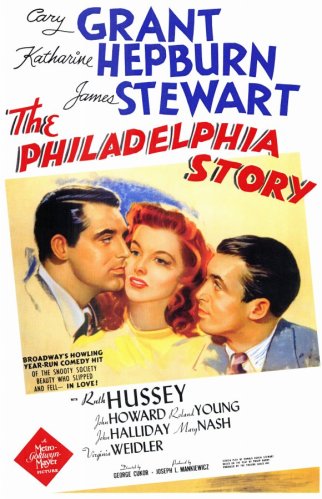
Lisa Reviews The Oscar Nominees: The Philadelphia Story (dir by George Cukor)


The-Philadelphia-Story-(1940)

There are a few reasons why The Philadelphia Story was one of those films that I had been meaning to watch for a while.  For one thing, The Philadelphia Story was nominated for best picture of 1940 (it lost to Alfred Hitchcock’s Rebecca) and my ultimate goal is to see and review every single film ever nominated for best picture.  The other reason is that Jimmy Stewart won an Oscar for his performance in The Philadelphia Story and anyone who doesn’t love Jimmy Stewart has obviously never seen Anatomy of a Murder (not to mention It’s a Wonderful Life!).

Well, The Philadelphia Story was on TCM last night and I finally got to see it and what can I say?  I absolutely loved it.  For a 74 year-old, black-and-white comedy, The Philadelphia Story is still a lot of fun.

The Philadelphia Story tells the story of Tracy Lord (Katharine Hepburn), a wealthy socialite who is engaged to marry George Kitteridge (John Howard), a self-described “man of the people,” who is widely respect for both his strong moral character and the fact that — unlike most of Tracy’s friends — he made his fortune as opposed to inheriting it.

It would be tempting to reach into the bag of simplistic blogging clichés and call the Lords a 1940s version of Khardashians but I’m not going to do that because the Lords have a lot more wit and class.  My favorite member of Tracy’s family was Dinah (Virginia Wiedler), her teenage sister who is sarcastic, cheerfully cynical, and has no problem demanding to be the center of attention.  My sister Erin claims that the reason I liked Dinah is because I saw a lot of myself in the character and that’s probably true.  However, I have to say that the great thing about both Tracy and Dinah is that they were both wittier, classier, and better dressers than all of the Khardashians and Jenners combined.

Anyway, the evil editor of Spy Magazine, Sidney Kidd (Henry Daniell), wants to get pictures of Tracy’s very exclusive and very private wedding so he sends two of his reporters in under cover.  Mike Connor (James Stewart) is a frustrated writer who hates having to lower himself to writing for a tabloid.  Photographer Liz (Ruth Hussey) is secretly in love with Mike.  Helping Mike and Liz pass themselves off as friends of the family is Tracy’s ex-husband, C.K. Dexter Haven (Cary Grant).

As quickly becomes obvious, Dexter is still in love with Tracy.  However, Tracy divorced Dexter because Dexter was an irresponsible alcoholic and, even though Dexter has changed his ways and she is still obviously attracted to him, Tracy is now engaged to the morally upright but boring and judgmental George.

However, Tracy is not just torn between George and Dexter.  She is attracted to Mike as well, to the extent that Tracy even takes the trouble to read some of Mike’s short stories.  For only the second time in her life, Tracy gets drunk and goes for a midnight swim with Mike.  This, of course, leads to the best scene in The Philadelphia Story: Jimmy Stewart singing Somewhere Over The Rainbow.

Seriously, the scene made my entire night.

The Philadelphia Story is based on a play and the film itself is rather stagey in that way that films from the 40s often appear to be to modern viewers.  But, once you get used to the fact that the movie was made in 1940 and not 2014, it’s a real delight.  The dialogue is funny and it’s delivered by one of the best casts ever.  Playing a role that was specifically written for her, Katherine Hepburn is brilliant as the strong-willed but unapologetically romantic Tracy and Cary Grant is just as charming as you would expect Cary Grant to be.  Best of all, you’ve got Jimmy Stewart singing Somewhere Over the Rainbow and seriously, how can you not love that?