The Film’s of 2024: God’s Not Dead: In God We Trust (dir by Vance Null)


It can be easy to forget just what a big splash God’s Not Dead made when it was released back in 2014.  Today, it’s taken for granted that every year, at least one faith-based movie will be released to terrible reviews and then “shock” everyone by opening up strong at the box office.  However, in 2014, God’s Not Dead was the film that started the whole trend, along with sparking the ongoing debate about whether or not Hollywood has the slightest idea what most Americans want to see.

That’s not to say, of course, that God’s Not Dead was a good film.  It’s not.  It’s a ludicrously simplistic and smug film that, over the course of its overly long run time, promotes the idea that the only reason atheists exist is because they’re either bitter, evil, or both.  (For the record, if a professor truly threatened to fail a paying student solely because of his religious beliefs, the end result would probably be a lawsuit.)  The idea that someone could sincerely disagree with the film’s heroes or even believe differently than them without having an ulterior motive is not one that is entertained in the God’s Not Dead universe.  Indeed, perhaps the most interesting thing about the God’s Not Dead films is that they are just as heavy-handed and often just as condescending as the secular films being churned out by the major studios.

God’s Not Dead has, to date, spawned four sequels.  The second was enjoyably campy and featured an earnest performance from Melissa Joan Hart.  The third, which is the the closest that the franchise has gotten to actually making a good film, was surprisingly even-handed, or at least as even-handed as a film in this franchise can be.  The fourth was way too talky but, because it came out during the COVID lockdowns, its condemnation of government overreach reflected the way that a lot of people were feeling at the time.  Somewhat inevitably, the fifth film finds Reverend David Hill (David A.R. White) running for Congress again the villain from the second film, dastardly atheist Peter Kane (Ray Wise).

The film opens with the death of an incumbent congressman.  His opponent, Peter Kane, tells the press that the congressman was a good man and then proceeds to gloat about his death in private.  Kane is an ultra-liberal atheist.  Usually, the villains in the God’s Not Dead universe have a dead relative to help explain why they’ve lost their faith but Kane is just evil.  (In God’s Not Dead 2, Kane specifically put Melissa Joan Hart on trial for expressing her Christian beliefs and then chortles, “We are going to prove God is dead!”)  With Kane on the verge of being elected to Congress by default, Rep. Daryl Smith (Isaiah Washington) suggests that David Hill, who went viral for denouncing Congress in the fourth film, should be the party’s new nominee.

After some hesitation, Hill agrees.  However, he drives his campaign manager, Lottie Joy (Samaire Armstrong), crazy by basing his campaign on his religious beliefs.  Of course, if you didn’t want a candidate to talk about his religious beliefs in a campaign, why would you nominate a pastor whose fame is totally based on those beliefs?  Add to that, Hill is running for a Congressional seat in Arkansas.  I have family in Arkansas.  Growing up, I occasionally lived in Arkansas.  Sure, there are liberals in Arkansas and there are atheists in Arkansas.  But none of them are going to get elected to Congress anytime soon.  Arkansas is probably one of the few states where Hill’s faith-based campaign wouldn’t be considered controversial.

(That Mike Huckabee has a cameo as himself should be all the reminder that viewers need that Arkansas is not at all hesitant about electing pastors to higher office.)

It’s heavy-handed and cartoonish, which is probably to be expected.  Unfortunately, it’s also rather boring, with not even Ray Wise’s villainy providing much entertainment value.  Outside of arguing that atheists are evil and that separation of church and state is just a catch phrase, the film argues that money is a divisive force in politics and that politicians shouldn’t be bought.  Wow, really!?  It’s a film about politics that has little fresh insight to offer.  David Hill goes from being a media-savvy pastor to being an innocent naïf who is shocked to discover that politics is a dirty business.  God’s Not Dead: In God We Trust makes Billy Jack Goes To Washington seem like a hard-hitting portrayal of American politics.

I will give this franchise some credit for maintaining a surprising sense of continuity.  As I mentioned earlier, Ray Wise returns as the character that he played in the second film.  Paul Kwo is back as Hill’s associate pastor.  Dean Cain returns as the amoral businessman from the first film.  You have to imagine that Kevin Sorbo is kicking himself for allowing his smug professor character to die in the first film.  What’s funny is that the college student who kicked off the franchise by refusing to sign a piece of paper declaring God to be dead has pretty much vanished from the films.  Whatever happened to that kid?

In the end, we all know where this is going.  The next film will undoubtedly feature David Hill running for president.  2028 is right around the corner.
The Films of 2021: God’s Not Dead: We The People (dir by Vance Null)


Here’s the story so far:

In 2014, a film called God’s Not Dead was released.  Produced by PureFlix Entertainment, it was a big, messy, and often confusing movie about a college student who challenged the claim of an atheist professor that God never existed.  While the student was debating the professor, countless other characters were wandering around campus and having their own faith-related dramas.  The main theme of God’s Not Dead appeared to be that only bitterness could explain disbelief and that everyone on the planet secretly wants to be a Christian.  It was not a particularly good movie but it was a surprise hit at the box office.  After spending years being ridiculed in nearly every mainstream film ever released, hardcore evangelicals finally had a movie that ridiculed the other side.

In 2016, God’s Not Dead 2 came out.  God’s Not Dead 2 was so heavy-handed that it actually managed to make the original film appear balanced and fair.  As opposed to the previous film, God’s Not Dead 2 was overtly political, telling the story of a teacher who is put on trial for encouraging a student to pray.  Again, it wasn’t a very good film but it did have two things going for it: a sincere lead performance from Melissa Joan Hart and an amazingly over-the-top villainous turn from Ray Wise as the prosecutor.  Most prosecutors would be smart enough to just argue that the teacher’s actions violated the law and perhaps offer a deal so that they wouldn’t have to waste their time with a lengthy trial.  Instead, Wise’s prosecutor practically cackles that he’s going to prove to the jury that “God is dead.”  Not surprisingly, the jury responded with “That’s a little above our paygrade.”

After all of that, 2018’s God’s Not Dead: A Light In The Darkness was a surprisingly low-key affair.  Largely eschewing the overt political content of the previous installment, the third God’s Not Dead film returned the story to campus and followed the efforts of Rev. David Hill (played by David A.R. White, the franchise’s producer) to keep his church from being closed down.  Of all the films, the third God’s Not Dead probably comes the closest to being a conventional film.  It even admits that not all atheists are evil and acknowledges that there is a legitimate constitutional argument to be made for not having a church on campus.  Because it didn’t feature any villains as memorable Ray Wise, A Light In The Darkness is also probably the most boring of all the films.  It also underwhelmed at the box office, a sign that the novelty of seeing a Christian film in a theater had worn off for even the film’s target audience.

And that brings us to God’s Not Dead: We The People, which had a three-day exclusive theatrical engagement in October of 2021.  As you can probably guess from the title, the fourth God’s Not Dead returns to the political themes of the second film.  Congress is thinking about infringing on the rights of parents to homeschool their children.  Rev. Hill and a group of parents (one whom is played by Antonio Sabato, Jr.) head to Washington D.C. so that they can testify in front of a Congressional hearing that’s being chaired by a smug liberal played by legitimate actor William Forsythe.  Isaiah Washington appears as a congressman who supports homeschooling and who thinks the education system needs to be reformed.  (“He’s that Congressman from Texas!” one character exclaims.)  Judge Jeanine Pirro plays a judge who is originally against homeschooling but who changes her mind after her daughter argues with her because, in the world of God’s Not Dead, not a single atheist or skeptic has any sort of firmly held conviction that can’t be overturned by an argument that would be more appropriate for a community college Intro to Philosophy class.  The film ends with the reverend giving an impassioned speech while Forsythe glowers and Washington stares on in beatific appreciation.

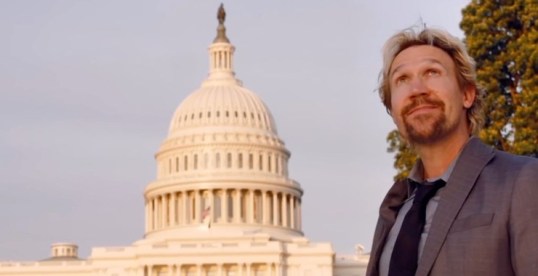
As you can probably guess, God’s Not Dead: We The People is total and complete propaganda, full of strawman arguments and moralizing.  Speaking as someone who is not a fan of the government or its tendency to try to interfere in people’s lives, even I watched the film and thought, “Okay, this is just a little too heavy-handed for me.”  Director Vance Null takes a vaguely Oliver Stone-style approach to the film, editing in random shots of American flags and patriotic monuments while the film’s characters discuss how the founding fathers felt about religion.  To be honest, when it comes to how its presented, the film’s propaganda is not that different from the type of propaganda that regularly appears in more mainstream films.  The film’s flashy editing and one-sided view of the world isn’t that much different from Adam McKay’s post-Big Short filmography.  Ending the film with a passionate speech that leaves all of the main character’s opponents with nothing to say in response may be a cliché but it’s a cliché that Aaron Sorkin knows well.  All of the cameos from the characters who appeared in the previous film may feel a bit random but it’s not that much different from when Marvel used to sneak Robert Downey, Jr. into every film they made.  If nothing else, the people behind the God’s Not Dead franchise have learned the first rule of business: watch what the successful do and copy them.

All of that aside, God’s Not Dead: We The People is not a particularly interesting film.  The editing may be flashy but the pace is still slow and the final hour of the film is basically just people testifying in front of a congressional committee.  The film is less concerned with converting the skeptical and more about rallying the faithful to vote in 2022.  That’s always been my main problem with the propaganda films of both the left and the right.  It’s always less about making a case and more about vanquishing any shred of doubt from those who already largely agree with the film’s message.  Ideological purity tests do not make for enlightening or memorable entertainment.