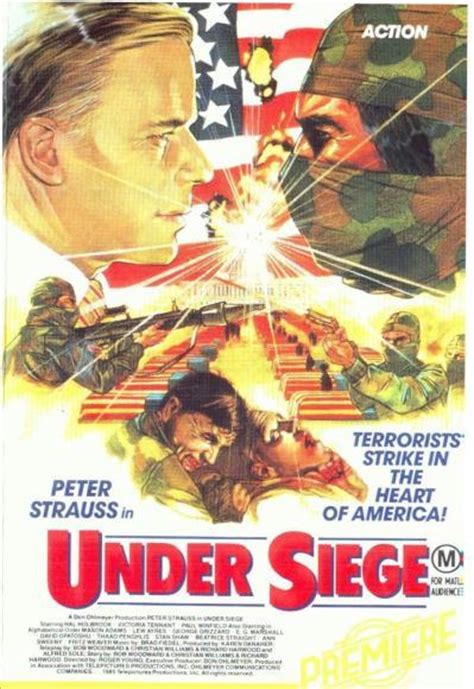
Under Siege (1986, directed by Roger Young)


Let’s say that you are the governor of Arkansas and, once again, your state is running out of money and will soon not be able to afford to pay its bills.  What do you do?

That was the problem facing Governor Bill Clinton in 1986.  His solution was to allow a big Hollywood production to come down to Little Rock and film someone throwing explosive devices at the state capitol.  The capitol building at Little Rock looks like a smaller version of the capitol building in Washington D.C.  The producers of Under Siege needed to shoot a scene where terrorists attempt to blow up Congress.  Even though the state capitol wasn’t actually blown up in the film, the dome did end up with extensive burn marks that were visible for years afterwards.  Many people in Arkansas were not amused that they had to allow a film crew to set their capitol on fire just to pay the bills.  Still, if Bill Clinton hadn’t agreed to blow up the state capitol building, Arkansas could have gone bankrupt and then he probably would have lost his reelection bid in 1986.  If Bill Clinton wasn’t reelected, he never would have been elected to the presidency in 1992, Hillary Clinton would never have been elected to the Senate in 2000 and, in 2016, the Democrats wouldn’t have been stuck with the only possible nominee who could have actually lost to Donald Trump.  When you look at it that way, Under Siege is one of the most significant films ever made.

As for the film, it’s a 3-hour, made-for-TV movie about what happens when Islamic extremism hits home.  Notorious terrorist Abu Ladeen (Thaao Penghlis) has managed to sneak into the United States and is hiding out in Detroit.  He directs a series of attacks on beloved American institutions.  Not only is the Capitol Building bombed but a mall is also attacked.  While President Maxwell Monroe (Hal Holbrook, who was born to play presidents) tries to keep America from falling apart, his hawkish advisers tell him that now is the time to launch a strike against Iran, despite Iran claiming to have nothing to do with the attacks.  Only the director of the FBI, John Garry (Peter Strauss), and the Secretary of Defense, Andrew Simon (Paul Winfield), argue that the president should exercise caution.  Garry is convinced that the attacks are the result of homegrown, domestic extremism and not an international conspiracy.  Garry is a very hands-on FBI director.  He’s the type of FBI director who will chase a terrorist down a street in Washington D.C.  Let’s see James Comey do that shit.

Under Siege probably seemed outlandish in 1986 but it seems prophetic today.  The film’s depiction of both terrorism and the government’s shady response to it turned out to be accurate.  That doesn’t mean that it’s a very good movie.  It was co-written by Bob Woodward of Watergate and Washington Post fame, so of course John Garry is righteous beyond belief and the solution to all of America’s problem begin with contacting a newspaper editor and blowing the whistle.  America may be under siege but a strongly-worded editorial is here to save the day.

Under Siege used to regularly show up on late night television and the DVD was popular overseas.  (In France, it was called Au Revoir, America.)  Not surprisingly, after 9-11, it vanished from circulation.  If you can find a copy, watch it and ask yourself, “Would I blow up my state capitol just to pay the bills?”

Quickie Review: Olympus Has Fallen (dir. by Antoine Fuqua)


OlympusHasFallen

“The most protected building on Earth has fallen.”

Die Hard has become it’s very own subgenre of action films since it was first released in 1988. It was a simple enough story that combined the “one against many” type of story with the “siege tale”. It was a perfect combination that has since been copied, imitated, but truly never duplicated to the highest level of success the original film had upon release. There’s been a few films that added their own unique take on this action film template. There was “Die Hard on a boat” with the underappreciated Under Siege. Then we have Air Force One which was “Die Hard on a plane”. The latest action film to try and put a new spin on the Willias-McTiernan classic is Antoine Fuqua’s latest film, Olympus Has Fallen.

The film pretty much takes what worked with the three films before it that’s been mentioned above and combines them to make a film. We have a lone, highly skilled operative in the form of Secret Service Agent Mike Banning in the role that made Bruce Willis famous and, for a time, resuscitated Steven Seagal’s career. Then we have the Presidential angle but instead of Air Force One it’s the White House this time around. The plot of the film is simple enough that even a person not well-versed in film could follow it. A group of dedicated and highly-trained North Korean terrorists do a surprise attack on the White House as the President of the United States and his South Korean counterpart try to find a way to defuse a situation that’s been growing in the DMZ between the two Koreas. It’s now up to Agent Banning, on his own, to try and stop whatever plans the terrorists have brewing with the President as hostage while also dealing with an inept group of higher-ups trying to deal with it far from the action.

Olympus Has Fallen doesn’t break new ground with the way it’s story unfolds and it’s characters develop. The film was pretty much beat-for-beat and scene for scene lifted from the three other films mentioned above. The characters may be different and the circumstances they find themselves in somewhat different, but the screenwriters played everything safe except the action sequences part of the film. It’s these action scenes which brings Olympus Has Fallen to a new level of violent artistry that the previously mentioned films never reached.

To say that this film was violent would be an understatement. Where other films of this type a certain cartoonish tone to it’s violence this time around Fuqua goes for a much more serious and, at times, disturbingly difficult to watch level of violence to make the film stand out from the rest of it’s kind. The assault on the White House itself and the surrounding area has less a look of a fun action film and more of a war film. People die in droves and it doesn’t matter whether they’re Secret Service, police, terrorists or innocent civilians. All were fair game in this film.

Even the action once we get to Banning playing the Willis role looked more brutal than what Willis and even Seagal ever got to do. Gerard Butler may not have had the charisma and wit of Willis in the same role, but he convincingly played his role as more Jack Bauer than Officer McClane. Butler as Banning was all business and efficiency while Willis as McClane was more the witty, smartass who just keeps finding himself in the wrong place at the wrong time.

Olympus Has Fallen won’t be hailed as one of the best films of 2013. It won’t even be talked about as one of the top action films this year, but despite the story being a derivative of every Die Hard and it’s clones before it the film does succeed in being a very enjoyable piece of popcorn flick. It was full of tension and big action setpieces (though the CG effects looked very cheap at times) that Fuqua has gradually become known for. The characters in the film were just a step above being one-dimensional and the story itself becomes less eye-rolling and more worrisome considering the real tensions coming out of the Korean Peninsula at this very moment.

One thing I’m sure of is that of the two “Die Hard-in-the-White-House” films this year (there’s the bigger-budgeted White House Down later this summer from Roland Emmerich) I have a feeling that Olympus Has Fallen might be the more fun. It’s probably going to be the more violent of the two and that’s an assumption I’m willing to make without even seeing how Emmerich’s film turns out.