April True Crime: Our Guys by Bernard Lefkowitz and Our Guys (dir by Guy Ferland)


If there’s any true crime book that I recommend without hesitation, it’s Our Guys by Bernard Lefkowitz.

First published in 1997, Our Guys deals with a terrible crime that occurred in the leafy suburban community of Glen Ridge, New Jersey.  In 1989, it was an affluent community that loved its high school football team and where conformity and financial success were the most valued qualities the someone could have.  On March 1st, a 17 year-old girl was invited to a house party where, after she was convinced to head down to the basement, she was raped with a broomstick and a baseball bat by several members of the football team.  The girl was intellectually disabled and was later determined to have an IQ of 64.  Her name has never been revealed to the public.  In his book, Lefkowitz assigned her the pseudonym of Leslie Faber.

The crime was terrible.  So was the aftermath.  When one of the witnesses went to a teacher with what he saw happen in the basement, the town responded by rallying around the accused.  Initially, Leslie was accused of lying.  Then, as it became clear that something actually had happened in that basement, Leslie was accused of bringing it on herself.  Leslie, who was desperate to have friends and who was later determined to be psychologically incapable of saying “no” or even understanding what consent meant, was cast as a wanton seductress who led the members of the football team astray.  A girl who went to school with Leslie even tape recorded a conversation with Leslie in which Leslie was manipulated into saying that she had made the entire thing up.  It also undoubtedly didn’t help that some of the accused boys had fathers who were on Glen Ridge’s police force.

It’s a book that will leave you outraged.  Lefkowitz not only examined the crime itself but also the culture of the town and its general attitude that “boys will be boys.”  Despite the fact that they had a losing record and the fact that one of them was infamous for exposing himself every chance that he got, the football team was viewed as being made up as winners.  They were allowed to party every weekend with their parties becoming so legendary that they bragged about them in their yearbook quotes.  With a group of supportive girlfriends doing their homework for them, the football team was free to do whatever they wanted and, by the time they were seniors, they were infamous for being voyeurs.  While one football player would have sex, all the others would hide in a closet and watch.  When one of the football players stole $600 from one of his classmates, his father paid back the money and no one was ever punished.  In a town that valued material success above all else and viewed being different as a sign of weakness, Leslie and her family were treated as being outcasts.  In the end, three of the football players were sentenced to prison.  One was sentenced to probation.  A few others accepted plea deals and had their arrests expunged from the record.  Years later, one of the guys who was in the basement but not charged would murder his wife while home on leave from the military.
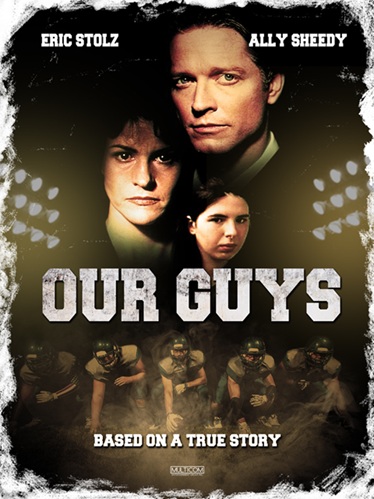
In 1999, Our Guys was adapted into a made-for-television movie.  Featuring Heather Matarazzo as Leslie, Ally Sheedy as the detective who investigated her rape, Eric Stoltz as the lawyer who prosecuted the case, and Lochlyn Munro as a cop who starts out on the side of the football team before realizing the truth, Our Guys simplifies the story a bit.  While the book focused on Glen Ridge and the culture of celebrating winners no matter what, the film focuses on Sheedy as the detective and her disgust with the suburbs in general.  Unfortunately, by not focusing on the culture of the town, the film presents the rape as being the bad actions of a group of dumb jocks as opposed to an expression of Glen Ridge’s contempt for anyone who was viewed as being on the outside.  What Lefkowitz showed through a precise examination of the town and its citizens, the film quickly dispenses by having Stoltz and Sheedy make a few pithy comments about how much the town loves it football team.  The story will still leave you outraged and Heather Matarazzo gives a heart-breaking performance as Leslie.  But, for those wanting the full story of  not only what happened in Glen Ridge but also how it happened, the book is the place to find it.
Film Review: Boot Camp (dir by Christian Duguay)


Occasionally, if you’re lucky, you come across a film that so totally and completely conforms to your own worldview that you’re forced to wonder if maybe you wrote the script and then somehow forgot about it.

That was certainly the case, for me, when I recently watched 2008’s Boot Camp, a teen melodrama with an anti-authoritarian subtext.  Check out the trailer:

http://www.youtube.com/watch?v=WLzdRTKgFrc

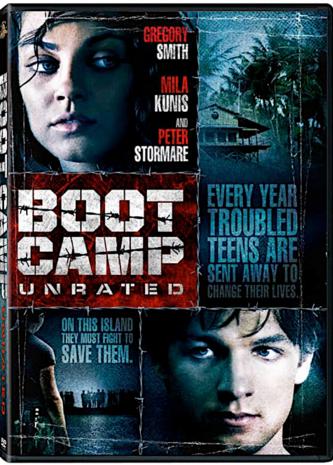
In Boot Camp, Mila Kunis plays Sophie.  Sophie is rich and, in the eyes of her parents, out of control.  She talks back.  She sneaks out of the house.  She hangs out at all the wrong clubs and with all the wrong people.  You know the story.  We’ve all seen the talk shows.  Sophie’s parents are convinced that the only way that they can get Sophie under control is to exile her to what the film calls a “tough love boot camp.”

The boot camp is located on an island, just a few miles away from a luxurious resort.  From the minute Sophie arrives, she is told that escape is impossible and she can only leave after the facility’s founder, Dr. Arthur Hall (Peter Stomare), says that she can.  Some people have been at the camp for years, waiting for Dr. Hall to announce that they’re rehabilitated.

The rest of the film follows Sophie and several other inmates as they try to survive boot camp without surrendering their free will.  It’s not easy.  Though he is more than happy to take their money, Dr. Hall resents the parents and his program is mostly designed to brainwash the inmates into thinking of him as being their new father figure.  The camp is staffed with brutes, sadists, and rapists.  When one inmate drowns, the staff tries to cover up his death.  Eventually, like the inhabitants of the Island of Dr. Moreau, Sophie and the other inmates have no choice but to rise up in rebellion against their masters.

“Tough love boot camps” are a real thing.  They used to be hugely popular with daytime talk show audiences and I know that Dr. Phil still has a ranch to which he sends “out of control” teens.  (I put “out of control” in quotes because, often times, it seems that “out of control” is code for “thinking for yourself.”)  The idea is that rebellious teenagers are sent to the camp, where they get yelled at until they agree to stop being so rebellious.  Over the years, there’s been a lot of debate over whether boot camps actually work.  If I had been sent to a boot camp, I think I would have just lied about my feelings and put on a repentant good girl act just to get the yelling to stop.  I’d be perfectly humble and contrite for three months and then, as soon as I got out of the camp, I’d go back to sneaking out of the house, skipping school, shoplifting, doing drugs, and whatever else got me sent to the camp in the first place.  From what I’ve seen of the whole boot camp experience, it seems to be more about brainwashing than anything else.  What’s the point of having well-behaved children if they can’t think for themselves?

But, then again, boot camps have never really been about  helping the teenagers sent to them.  Instead, they’ve always been about making lousy parents feel better about themselves.  Parents who have spent the last 14 years totally fucking up their children get to pat themselves on the back because they sent their kids to boot camp.  Other adults, bitter over having lost their youth, get to say, “It’s time to teach those ungrateful children to respect authority.”  As for the people who run the boot camps, it’s less about the inmates and more about power and money.

That’s certainly the message of Boot Camp.  In fact, I was taken by surprise to discover just how much Boot Camp conformed to my own thinking on … well, on just about everything.  Make no mistake, Boot Camp is a flawed film.  There’s nothing subtle about Christian Duguay’s direction and, with the exception of Mila Kunis, none of the performances are as memorable as you might hope that they would be.  Peter Stomare is way too obvious in his villainy, giving a performance that belongs in the Overacting Hall Of Fame.  (You’ll find Stomare’s Dr. Hall in the villain wing, right next to Christoph Waltz in SPECTRE.)

But, even with all that in mind, it was impossible for me not to get excited when Sophie and her fellow out-of-control teens finally made their move against their tormentors.  The final third of Boot Camp turns into a celebration of disobedience and rebellion and it was impossible for me not to be thrilled by it.  Considering the increasingly Orwellian nature of American culture, we need more movies that celebrate revolution and individual freedom.  At a time when we’re being told that we “have to do this” or “have to do that,” Boot Camp says, “Nobody has to do anything, beyond what they choose.”

It’s an important message and one that people need to start heeding.