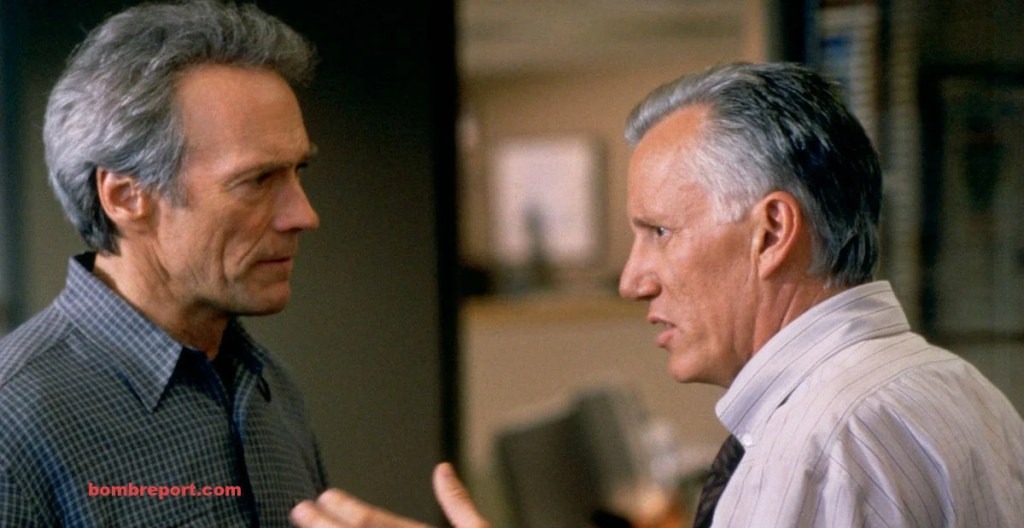
Here at The Shattered Lens, we’re celebrating Clint Eastwood’s birthday on May 31st. I decided to revisit his 1999 film, TRUE CRIME.
Clint Eastwood directs and stars as ace journalist, Steve Everett, who also happens to be a bad friend, a terrible dad, and an even worse husband. Literally the only thing that he’s got going for him is his “nose,” his ability to sniff out a story where no one else can. Even that has begun to fail him, mostly due to his recents bouts with alcoholism, which he seems to somewhat have a handle on at the time of this story. When a young, beautiful colleague tragically passes away in an auto accident, Steve is given her previous assignment to cover the execution of convicted murderer Frank Beechum (Isaiah Washington). Not the kind to write a human interest “puff piece” like the Oakland Tribune is wanting, Everett begins digging into the past and pretty soon that nose of his starts telling him that Beechum is a victim of circumstantial evidence. Despite his editor Bob Findley’s (Denis Leary) objections, he’s able to convince his newspaper boss Alan Mann (James Woods) to let him dig deeper into the story. As he tries to juggle his myriad personal problems with his growing belief in Beechum’s innocence, Everett is also facing a clock that is ticking down to the midnight execution. Will he be able to find the crucial piece of evidence that will set Beechum free?
TRUE CRIME appears to be somewhat of a forgotten Clint Eastwood film. I saw it at the theater when it came out in 1999, but it was not financially successful, only bringing in $16 Million at the box office. Regardless of that, I still love the film. It’s certainly not perfect. It’s probably too long, Beechum is probably too angelic after being “born again,” and the resolution may be a little unrealistic, but I still enjoyed every second of it. One of the coolest things about Clint Eastwood is his willingness to play such flawed men on screen, yet we still love him. He’s great in this film! Anyone who’s read much of my work knows that my love of actor James Woods goes back to being in junior high and renting his movies BEST SELLER and COP. It’s such a treat seeing the legendary pair on screen together even if Woods’ role is sort of a glorified cameo. Woods is hilarious in his limited screen time. My last shout out is to Isaiah Washington as the innocent man who’s about to be put to death. After all these years and appeals, he’s accepted his fate, but the scene where he tells Everett his story and Everett tells him that he believes he’s innocent is so powerful. Add to that Washington’s scenes with his wife and daughter, and I was very much emotionally invested in this film. Washington’s performance was key to the film working, and he’s great!
Overall, TRUE CRIME is a film that takes its sweet time, but it ultimately tells a tense, engrossing story that ratchets up the tension to 10 prior to its last second resolution. I consider it very underrated and highly recommend it. I’ve included the trailer below:
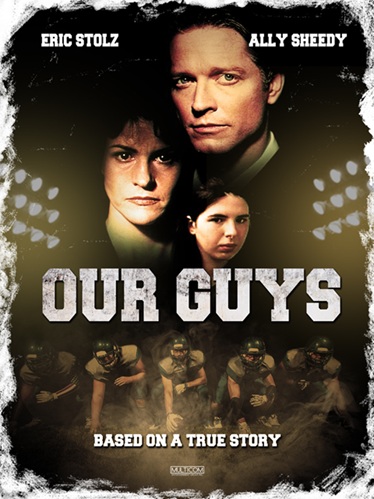
If there’s any true crime book that I recommend without hesitation, it’s Our Guys by Bernard Lefkowitz.
First published in 1997, Our Guys deals with a terrible crime that occurred in the leafy suburban community of Glen Ridge, New Jersey. In 1989, it was an affluent community that loved its high school football team and where conformity and financial success were the most valued qualities the someone could have. On March 1st, a 17 year-old girl was invited to a house party where, after she was convinced to head down to the basement, she was raped with a broomstick and a baseball bat by several members of the football team. The girl was intellectually disabled and was later determined to have an IQ of 64. Her name has never been revealed to the public. In his book, Lefkowitz assigned her the pseudonym of Leslie Faber.
The crime was terrible. So was the aftermath. When one of the witnesses went to a teacher with what he saw happen in the basement, the town responded by rallying around the accused. Initially, Leslie was accused of lying. Then, as it became clear that something actually had happened in that basement, Leslie was accused of bringing it on herself. Leslie, who was desperate to have friends and who was later determined to be psychologically incapable of saying “no” or even understanding what consent meant, was cast as a wanton seductress who led the members of the football team astray. A girl who went to school with Leslie even tape recorded a conversation with Leslie in which Leslie was manipulated into saying that she had made the entire thing up. It also undoubtedly didn’t help that some of the accused boys had fathers who were on Glen Ridge’s police force.
It’s a book that will leave you outraged. Lefkowitz not only examined the crime itself but also the culture of the town and its general attitude that “boys will be boys.” Despite the fact that they had a losing record and the fact that one of them was infamous for exposing himself every chance that he got, the football team was viewed as being made up as winners. They were allowed to party every weekend with their parties becoming so legendary that they bragged about them in their yearbook quotes. With a group of supportive girlfriends doing their homework for them, the football team was free to do whatever they wanted and, by the time they were seniors, they were infamous for being voyeurs. While one football player would have sex, all the others would hide in a closet and watch. When one of the football players stole $600 from one of his classmates, his father paid back the money and no one was ever punished. In a town that valued material success above all else and viewed being different as a sign of weakness, Leslie and her family were treated as being outcasts. In the end, three of the football players were sentenced to prison. One was sentenced to probation. A few others accepted plea deals and had their arrests expunged from the record. Years later, one of the guys who was in the basement but not charged would murder his wife while home on leave from the military.
In 1999, Our Guys was adapted into a made-for-television movie. Featuring Heather Matarazzo as Leslie, Ally Sheedy as the detective who investigated her rape, Eric Stoltz as the lawyer who prosecuted the case, and Lochlyn Munro as a cop who starts out on the side of the football team before realizing the truth, Our Guys simplifies the story a bit. While the book focused on Glen Ridge and the culture of celebrating winners no matter what, the film focuses on Sheedy as the detective and her disgust with the suburbs in general. Unfortunately, by not focusing on the culture of the town, the film presents the rape as being the bad actions of a group of dumb jocks as opposed to an expression of Glen Ridge’s contempt for anyone who was viewed as being on the outside. What Lefkowitz showed through a precise examination of the town and its citizens, the film quickly dispenses by having Stoltz and Sheedy make a few pithy comments about how much the town loves it football team. The story will still leave you outraged and Heather Matarazzo gives a heart-breaking performance as Leslie. But, for those wanting the full story of not only what happened in Glen Ridge but also how it happened, the book is the place to find it.
On a hot August morning in 1892, the brutal double murder of Andrew Borden and his second wife Abby in the New England mill town of Fall River, Massachusetts shocked the nation. Andrew’s 32-year-old spinster daughter Lizzie Borden was accused of the ghastly crimes and brought to trial. The sensational headline-producing trial lasted thirteen days, and she was acquitted by a jury of her peers. To this day, the killings remain unsolved, with speculation still running rampant among true crime buffs. Did Lizzie Borden really hack her father and stepmother to death?
(Lisa recently discovered that she only has about 8 hours of space left on her DVR! It turns out that she’s been recording movies from July and she just hasn’t gotten around to watching and reviewing them yet. So, once again, Lisa is cleaning out her DVR! She is going to try to watch and review 52 movies by the end of Tuesday, December 6th! Will she make it? Keep checking the site to find out!)
On November 5th, Lifetime aired a film about the murder of six year-old JonBenet Ramsey, Who Killed JonBenet? They followed this film with a documentary called JonBenet’s Mother: Victim or Killer? I did not watch the films when they originally aired, largely because, much like Girl In The Boxand Cleveland Abduction, the subject matter sounded way too disturbing to me. Instead, I just recorded them and, for a few weeks, both programs sat unwatched on my DVR.
Until earlier today, that is!
I watched both of them and then I quickly deleted both of them as well. And now I’m going to write a few words about them. In fact, I’m going to try to devote as little time as possible to these films.
Normally, I’m the first one to defend Lifetime and their movies. If you’re a regular reader of this site, you know how much I love Lifetime movies. I love them for the exact same reason that most people claim to disdain them. It’s rare that I ever see a Lifetime film that I can’t enjoy or, at the very least, defend.
But, seriously, Who Killed JonBenet? was such a misfire that I barely know where to begin. In many ways, it’s a typical true crime film. Suspects are identified. Detectives find themselves caring about the case … TOO MUCH! It ends on a note of surface ambiguity that’s deceptive because the film all but comes out and accuses Patsy Ramsey of murdering her daughter.
That thing that sets Who Killed JonBenet? apart is that the film is narrated by JonBenet Ramsey, who is apparently speaking to use beyond the grave. JonBenet tells us that she’ll always be six. And she tells us that one of the detectives is a nice lady. And it’s such an icky technique that it pretty much makes the entire film nearly unwatchable. Every time that we hear that cloying little voiceover, we’re reminded of two things: 1) this film is based on the real life rape and murder of a six year-old and 2) this movie was made specifically to exploit that event. In the end, you feel guilty for watching the damn movie in the first place.
Seeing as how Who Killed JonBenet? basically accuses Patsy Ramsey of murder, it’s interesting that it was immediately followed up by JonBenet’s Mother: Victim or Killer? JonBenet’s Mother explores Patsy’s life and pretty much comes to the conclusion that, while Patsy may have been a bit odd, she did not kill her daughter. If anything, the documentary shows that Patsy was largely the victim of a vicious media.
Like, to name just one example, Who Killed JonBenet?
Anyway, let us never speak of these two movies again. When I think of a Lifetime movie, I’d much rather think of Confessions of Go Go Girl.
I’ll admit right now that I’m a true crime junkie. Maybe it’s because I work for a lawyer or maybe I’m just morbid-minded but, for whatever reason, I am fascinated by this stuff. And while we all love to watch a good mystery and see if we can solve it before everyone else, it’s the mysteries without a solution that hold a special grip on my imagination. That’s why I was really looking forward to seeing the film All Good Things. Directed by Andrew Jarecki and starring Ryan Gosling, All Good Things is based on not one true crime case but three! (And two of those crimes remain unsolved to this day.)
All Good Things is based on the life of Andrew Durst, who was born into a wealthy New York family just to eventually find himself accused — at one time or another — of two murders and actually put on trial for a third. Oh, and did I mention that in-between being accused of killing people, Durst also found the time to drop out of high New York society and, despite being a very wealthy man, wandering around the country like a homeless transient? And, would you also believe that when Durst eventually ended up moving down to Galveston, Texas, he apparently also became a transvestite? And once Durst was in Galveston, he ended up living in a run-down boarding house with another transient who Durst eventually ended up decapitating? Of course, all of this happened long after the mysterious disappearance of his first wife and the execution-style shooting his best friend (who also happened to be the daughter of a Las Vegas mob boss). Durst, it should be noted, has only been put on trial once and, in that case, was acquitted. (For a better account of the various unproven allegations against Robert Durst, click here.)
Yes, Robert Durst is a man who has found himself at the middle of several very intriguing mysteries and All Good Things pretty much sticks to the facts of the case, recreating all the scenes that we Durst watchers are familiar with while leaving the ultimate question of Durst’s guilt or innocence ambiguous. For legal reasons, the names are changed but that’s about it. The film even begins with a title card telling us that the film is based on the Durst case even if Ryan Gosling is technically playing a character named David Marks. We watch as David meets and romances sweet but lower class Katie (Kirsten Dunst) despite the disapproval of his wealthy father. (David’s father is a real estate mogul who owes his fortunes to the peep shows and grindhouses on 42nd Street.) Once David and Katie have married, we watch the marriage turn into a nightmare as David grows increasingly abusive and Katie starts to abuse drugs. We meet all the familiar characters that we know about from reading about the case, especially David’s devoted friend Deborah (Lilly Rabe). We see the way that Deborah fanatically defends David after Katie mysteriously vanishes and eventually, we see David in Galveston, a blank-faced recluse who has lost the ability (if he ever had it) to exist in reality. Yes, it’s an interesting story but does the film do it justice?
Frustratingly, the answer is yes and no.
There’s a great movie to be found in the life of Robert Durst and unfortunately, director Andew Jarecki doesn’t find that great movie with All Good Things. Despite telling a fictionalized version of a true story, Jarecki still approaches the material as if he’s making another documentary. By simply concentrating on the public record of the Durst case (and, for the most part, declining to engage in any poetic license while telling the story), he keeps his distance from the characters and their world and, as a result, you watch fascinated because the story is so bizarre but not because you have any emotional investment in anything happening onscreen. Like a good documentarian, Jarecki concentrates on providing the evidence and leaving the ultimate verdict to the audience. If this film was a documentary about Robert Durst, this would be commendable. However, All Good Things is a movie about a vaguely sinister guy named David Marks who remains a cipher throughout the entire film.
However, this is not the fault of the cast who manage to redeem this movie with several carefully conceived character turns. In a frustrating and vague role, Ryan Gosling gives a far better performance than anyone would really have the right to expect. He plays the role with a vague sense of blank desperation, creating a portrait of a man who wants to fit in with reality but just doesn’t know how to do it. When we first meet see David wandering around 42nd street and struggling to maintain a facade of normalcy, it’s hard not to feel sorry for him. He looks like a lot child and your natural reaction is to want to protect him and help him find his place in the world. Add that vulnerability to the fact that he looks like Ryan Gosling and you can believe that Kirsten Dunst’s character would find him attractive and would eventually marry him, despite his quirks. Its only once David is married (and, in theory, no longer has to worry about losing Dunst) that he starts to show his true face. Any woman who has ever been in an abusive relationship will know the type of person that David Marks is. As played by Gosling, he becomes every boyfriend or husband who has ever transformed into a different person once we’ve made the mistake of falling in love with him. He’s every man we’ve ever been happy to have out of our life even as we wondered if we were to blame for whatever went wrong. Gosling’s strongest moments come when David simply stares at his own reflection, the look on his face indicating that he’s just as confused by himself as we are. Kirsten Dunst is sympathetic as his wife and there’s excellent character turns from Frank Langella, Philip Baker Hall, Diane Venora, and Lilly Rabe.
So, what I recommend All Good Things? I would. It makes for a good introduction to the Durst case and, if nothing else, it’s worth seeing for Gosling’s performance. The definitive version of Durst’s case hasn’t been told yet but All Good Things is, at the very least, a start.
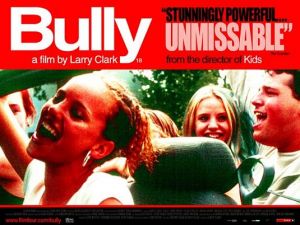
Bullying has been in the news a lot lately. The fact that some people are bullies is hardly a new development, it’s just that now people are actually paying attention to the possible consequences of cruelty. Tragically, it appears it takes people killing themselves for the rest of the world to consider that “Hey, maybe concentrated, socially accepted sadism isn’t a harmless thing.” With so many people finally admitting what they had to have known was true all along, now seems like a good time to reconsider Larry Clark’s controversial and much-maligned 2001 film, Bully.
I can still remember the night, five years ago, that I first saw Bully. I was at a party with a group of friends. Nine of us ended up in a random bedroom, drinking, smoking, and going through all the closets and dressers. I might add, we found some very interesting things while searching. Anyway, someone eventually turned on the TV and there was Bully, playing on one of the movie stations. Since we knew Bully was supposed to be a very explicit, very controversial movie, we left the TV playing and hung out in a stranger’s bedroom for two more hours. There was, obviously, a lot going on in that room and I have to admit that I only paid attention to bits and pieces of the movie. But what I saw stuck with me enough that the next chance I got, I bought the movie on DVD so I could actually devote my full attention to it. In the years since, Bully is not a film that I revisit frequently because, to be honest, it’s the type of movie that makes you take a shower after watching it. It’s also an unusually powerful and disturbing film that sticks with you for a long time after it ends. It’s not a film that I would recommend anyone watch a hundred times. But it’s definitely worth viewing at least once (or maybe even four times if you’re like me).
The bully of the title is 20 year-old Bobby Kent (played by Nick Stahl). Bobby’s “best friend” is passive, blank-faced Marty Puccio (Brad Renfro). Despite being physically stronger, Marty allows himself to be totally dominated by Bobby. Marty accepts Bobby’s constant insults and physical abuse with the meek acceptance of a battered spouse. Bobby, who is on the verge of starting college and presumably making a life for himself that high school dropout Marty could never dream of, even forces Marty to moonlight as a male stripper and to take part in making cheap, gay-themed porn videos. (Bobby insists that he’s not gay himself and, like most guys in denial, goes out of his way to act as much like an insensitive asshole as possible as if to scream to the world, “I’m straight!” despite all the evidence to the contrary.)
As the film begins, Ali (Bijou Philips) and her friend Lisa Marie Connelly (Rachel Miner) step into sandwich shop where both Bobby and Marty work. (Bobby, of course, is the boss.) Apparently, they are appropriately impressed by the sight of Bobby slamming Marty’s head against a refrigerator because soon, all four of them are going out on a double date. While Ali’s content to just give Bobby a blow job, the far more insecure Lisa decides that Marty is the love of her life and starts a relationship with him that the ever-passive Marty simple accepts. However, what Lisa has failed to take into account, is that Marty is already in a relationship and Bobby isn’t ready to just let go. Bobby expresses this by walking in on Marty and Lisa while they’re having sex, beating Marty up, and then (unlike everything else in this movie, this is never explicitly shown) raping Lisa. After this, Lisa discovers that she’s pregnant but she doesn’t know if the baby’s father is the man she claims to love or the man who raped her.
(One thing that surprised me, that night I first watched Bully out of the corner of my eye while me and my friends searched through a stranger’s lingerie, was just how little sympathy most of my friends had for Lisa. While I wasn’t surprised that the majority of guys in the room seemed to feel that Lisa was somehow to blame for disrupting all that precious male bonding, it was the reaction of some of the other girls that truly caught my off guard. While none of them went as far as to say that Lisa deserved to be raped by Bobby, quite a few of them took the attitude that she either brought it on herself or she was lying. Unlike the boys, these girls also felt the need to make several snide remarks about Rachel Miner’s physical appearance. At the time, their attitude really bothered me and I have to admit that I wasn’t as close to any of them afterward.)
(Of course, we Lisa Maries have to stick together…)
Despite having raped his girlfriend, Bobby still considers himself to be Marty’s best friend and Marty — again like an addicted spouse — proves himself to be incapable to simply cut off all ties with Bobby even as the abuse gets worse and Bobby grows increasingly unstable. In one of the film’s more controversial scenes, Bobby and Ali are about to have sex when Bobby decides that the only thing the scene is missing is a gay porn video playing in the background. Ali finds the idea to be disgusting and insinuates that Bobby must be gay. Bobby responds by raping Ali.
Finally, Lisa tells Marty and Ali that they have little choice but to murder Bobby. While this starts out as a somewhat innocent suggestion of the “I wish he was dead,” kind, Lisa soon begins to insist that Bobby must die. Ali recruits her friend Heather (Kelli Garner) and an ex-boyfriend named Donny (a truly scary Michael Pitt) into the conspiracy. (Heather and Donny both agree that Bobby must die though neither one has ever met him.) Lisa, meanwhile, brings in her cousin, video-game geek Derek. Finally, and most fatefully, they decide to get some pointers from the neighborhood hitman (Leo Fitzpatrick).
That’s right. The neighborhood hitman. He’s actually a pretty familiar figure in the suburbs. He’s the 17 year-old white boy who tries to stare out at the world with hateful eyes. He brags to you about how he’s a member of a gang. He tries to rap and speaks in dialogue lifted from Grand Theft Auto. In short, he’s the guy that everyone laughs at whenever he’s not around. His lies should be obvious to anyone with a brain which is exactly why Lisa, Marty, and Ali all assume that he’s an actual hitman. The Hitman agrees to direct their murder and help them kill a person who (like almost everyone else now involved in the conspiracy) he has never actually met.
It all climaxes in one of the most disturbingly graphic and harrowing murder scenes I’ve ever seen, one that manages to snap the audience back into reality after the (needed) comic relief of Fitzpatrick’s absurd wannabe gangster. As he’s repeatedly attacked by this group of made up of bumbling strangers and his “best” friend, Bobby proves himself to be not quite as powerful a figure as everyone had assumed. Instead, he’s revealed as a pathetic, frightened teenager who begs Marty to forgive him (for “whatever I did”) even as Marty savagely stabs him to death.
Unlike the standard rape-revenge flick (and have no doubt, that’s what Bully essentially is), the film’s climatic act of violence doesn’t provide any sort of satisfaction or wish-fulfillment empowerment. Instead, it just sets up the chain of events that leads to the film’s inevitable and disturbing conclusion.
When it first came out, Bully was controversial because of its explicit sex and violence. As a director, Clark employs his customary documentary approach while, at the same time, allowing his camera to frequently linger over the frequently naked bodies of his cast. More than one reviewer has referred to Clark as “a dirty old man” while reviewing this film. (More on that in a minute.) What those critics often seem to fail to notice is that, as explicit as the movie is, some of the most powerful and disturbing elements (like Bobby’s repressed homosexuality) are never explicitly stated.
After seeing this movie a few more times, the thing that gets me is that — in the end — the film’s nominal villains — Bobby and Lisa — are also the only two compelling characters in the entire movie. While all the other characters are essentially passive, Bobby and Lisa are the only ones actually capable of instigating any type of action. As such, they become — almost by default — the heroes of the movie. On repeat viewings, it’s apparent that Bobby and Lisa are really two sides of the same coin. The film’s title could refer to either one of them. They are both insecure, unhappy with who they are, and both of them seem to find a personal redemption by dominating Marty. One of the great ironies of the film is that Bobby and Lisa are essentially fighting a war for the soul of a guy who is eventually revealed to be empty inside. For his part, Marty simply shifts his “forbidden” relationship with Bobby over to Lisa, a relationship that is just as exploitive and destructive as his friendship with Bobby but which is also more socially acceptable because it’s so heterosexual in nature that he’s even knocked up his girlfriend. When Marty finally does kill Bobby, he’s not only killing a bully but he’s attempting to kill of his own doubts about his sexual identity. It’s his way of letting the world know that he’s a “real” man. As for the other characters — Ali, Donny, Heather, and even the swaggering hitman — they are all defined by their utter shallowness. While its clear that none of them are murderous on their own, it also becomes clear that none of them have enough of an individual identity to resist the Bobbys and Lisas of the world.
Despite playing shallow characters, nobody in the cast gives a shallow performance. Down to the smallest role, the actors are all believable in their roles. Whether it’s Michael Pitt’s blank-faced aggression or Leo Fitzpatrick’s comedic swagger, all of the actors inhabit these characters and give performances that are disturbingly authentic. The late Brad Renfro gave one of his best performances as Marty, just hinting at the anger boiling below the abused surface. However, the film belongs to Miner and Stahl. Stahl displays a sordid charm that makes his character likable if never sympathetic while Miner manages to do something even more difficult. She makes Lisa into a character who is sympathetic yet never quite likable. When Bully first came out, critics spent so much time fixating on the fact that Miner’s frequently naked on the film that they forgot to mention that she also proves herself to be an excellent actress.
As I stated, Bully is not a universally beloved film. Most of the reviews out there are negative with a few of the more self-righteous critics accusing the film of being “pornographic” as if the whole thing was filled with close-up money shots of Brad Renfro ejaculating on Rachel Miner’s ass. Strangely enough, you can find hundreds of critics complaining that Clark filmed full frontal nudity but next to none complaining that Clark filmed a brutal and realistic murder scene.
The two most frequent criticisms of Bully are that 1) it plays fast and loose with the true story that it’s based on and 2) that the film is exploitive.
Both criticisms are valid but the first one is the only one that would really bother me. I have to admit that I don’t really know much about the real life murder of Bobby Kent. I just know the version presented in this movie and in the Jim Schultze book that the movie was based on. Of course, everyone arrested and convicted for Kent’s murder has been quick to claim that the movie makes them look more guilty than they actually are. That’s to be expected. However, the main difference between the film and the reality — for me — was that, in reality, victim Bobby Kent did not look a thing like Nick Stahl. Whereas Stahl is clearly no physical match for any of the characters in the film (and hence, it’s easier to feel sorry for him when everyone attacks him at once), pictures of the real-life Bobby Kent reveal an intimidating, muscular, young man who few people would probably ever chose to mess with. Stahl’s Bobby is a bully because everyone else in the film is too passive to stand up to him. The real Bobby could probably get away with being a bully because he literally looked like he could rip another man’s arm off.
The other criticism is that this movie — with its combination of tits and blood — is essentially just an “exploitation” film. Well, it is. But as I’ve explained elsewhere, just because a film is exploitive, that doesn’t mean that it’s not a good movie. Art and exploitation, more often than not, are clandestine lovers and not bitter enemies. Yes, all of the characters — male and female — do spend a good deal of time showing off their bodies but then again, what else would these otherwise empty characters do? Their surface appearance is really all they have. Yes, the camera does linger over all the exposed flesh but then again, so do most people. If anything, critics attempted to punish Clark for openly acknowledging that majority of his audience is waiting to either see Bijou Phillips’ twat or Nick Stahl’s dick. Yes, Bully is exploitation but it’s exploitation in the best grindhouse tradition. It’s a film that’s honest specifically because it is so sordid and exploitive.
When all is said and done, Bully is the epitome of a movie that is too sordid to ever be corrupted.












 Through the Shattered Lens