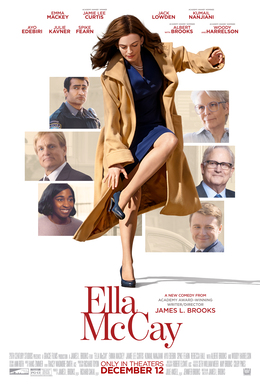
Catching Up With The Films Of 2025: Ella McCay (dir by James L. Brooks)


The Winter Olympics have begun and, waking up this morning, I did what any American celebrating the 250th birthday of her country would do.  I watched curling.  I watched as Team USA defeated Team Switzerland.  I enjoyed not only watching America notch up a victory but I also enjoyed the contrast between the super-intense, super-shriekey Swiss team and the relatively mellow American team.  Watching the Americans laugh and joke while the Swiss couple yelled at each other left me feeling very patriotic and hopeful.

In fact, it left me in such a good mood that I decided it was finally time to watch Ella McCay.

It’s easy to forget now what a big deal it was when the trailer for Ella McCay was first released in August of 2025.  It was the trailer for James L. Brooks’s first film in 15 years, a political comedy for adults.  It was full of familiar faces and it looked absolutely awful.  Seriously, the trailer was so unappealing that I became rather fascinated by it.  Even the worst films can usually scrounge together enough good material to at least come up with a passable trailer.  Watching the trailer for Ella McCay, I could only wonder who was responsible for putting it together.  Who thought it was a good idea to lead off with that lengthy Woody Harrelson scene?  Who thought the wedding scene didn’t look weird?  Who didn’t take the time to do something about Spike Fearn’s hair?

There were some who said that Ella McCay shouldn’t be judged based solely on its trailer.  They pointed out that director James L. Brooks directed three films that were nominated for Best Picture, two of which were actually good.  They pointed out that Ella, her brother, and her husband were all played by British actors who had appeared on niche television shows.  Soon, there was a mini-civil war being fought on twitter between those who dismissed Ella McCay based on the trailer and those who promised that they would love the film once it was released.

Then, on December 12, the film was released, the reviews were uniformly terrible, and it tanked at the box office.  It took the film a little less than two months to go from the theater to streaming online.

Having now watched Ella McCay, I can say that …. well, yeah, it’s pretty bad.

It’s not necessarily bad for the reasons that I thought it would be.  Watching the trailer, I thought the film’s downfall would be the performances of Woody Harrelson and Jamie Lee Curtis.  Both of them looked to be acting up a storm.  Having now seen the film, I can say that both of them actually do probably about as good a job as could be expected to do with the material that they were given.  Neither one is particularly memorable but they’re not terrible either.  For that matter, Albert Brooks is amusing as Ella’s boss and mentor, Governor Bill.

Instead, the main problem with the film is that Ella McCay is not a particularly interesting or even likable character, not matter how much the film’s narrator insists otherwise.  A policy wonk from a broken home who, at the age of 34, has become lieutenant governor of some nameless state up north, Ella is boring, humorless, and ultimately more than a little annoying.  She’s the girl in elementary school who always told on the kids who talked while the teacher was out of the room.  She’s your high school classmate who got all judgey if you wore a short skirt.  She’s your self-absorbed college roommate who always had to remind you that, no matter what you were going through, her father was a philanderer and her mom was dead.  She’s the colleague who voluntarily does all the work on your group project without being asked and then complains that no one helped her.  She’s the person who insists that she can change the world but who is still so emotionally stunted and immature that, at 34, she needs her aunt to teach her primal scream therapy.  Emma Mackey gives a disjointed performance as Ella, speaking with bland intensity whenever Ella is being serious and then overacting whenever Ella has to be flustered.

As bad as Mackey was, though, she was nowhere near as bad Spike Fearn, who plays Ella’s agoraphobic younger brother, Casey.  For some reason, Casey gets a huge subplot that doesn’t really seem to go anywhere.  We’re told that Casey hasn’t left his apartment in over a year and we repeatedly see that Casey struggles to communicate with people.  The film treats most of this as being a joke and Spike Fearn gives such a twitchy performance that Casey comes across as being far more creepy than he probably should.  We’re meant to cheer when Casey reconnects with his ex but I wasn’t silently yelling at her to run as far aways as possible.  We spend so much time with Casey that it’s hard not to wonder if maybe the filmmakers themselves realized that Ella wasn’t very interesting but Casey is hardly an appealing alternative.

There’s a lot about Ella McCay that doesn’t work.  Just the fact that the film features what appears to be hastily written narration from Ella’s secretary (Julie Kavner) would seem to reveal that someone understood that the film’s mix of tones and incidents really didn’t gel.  (Having Kavner actually say, “Hi, I’m the narrator,” is a touch that is more than a bit too cutesy.)  Ella’s husband (Jack Lowden) is such an obvious and odious villain that it was hard not to feel that Ella had to have been an idiot to marry him in the first place.  There’s a weird plotline involving Ella’s state troopers trying to get overtime.  Ella gets involved in one of the most jejune scandals of all time and the film ends with on a note that leaves you wondering how the 80-something Brooks can be so naive about politics.

But really, the main problem with the film is that it never convinces me that I should want Ella McCay to be governor.  To quote Karen Black in Nashville, she can’t even comb her hair.
 

The Films of 2025: Steve (dir by Tim Mielants)


Cillian Murphy plays the title character in this rather downbeat British film.

Though Steve has a properly depressing British flat in a properly depressing British town, he still spends the majority of his time at the reform school that he struggles to manage.  The students are rowdy and quick to fight but Steve insists that all of them can be reached if the teachers just try hard enough.  Steve has taken a particular interest in a student called Shy (Jay Lycurgo).  Shy alternates between moments of genuine insight and empathy and moments of pure rage.  He’s practically begging for someone to take the risk to get close to him but, at the same time, he instinctively pushes people away.

Steve takes place over one 24-hour period.  We first meet Shy while he’s getting high in a nearby field.  Later, he takes a call from his mother and she promptly informs him that he’s no longer allowed to be a part of her life.  As for Steve, he has to deal with not only a documentary crew but also the news that the building housing his school has been sold and that the school that he’s dedicated his life to will now be shutting down.  Steve tries to hold back his temper, self-medicating his bad back with painkillers and alcohol.

Directed in a frenetic manner by Tim Mielants, Steve is a film that seems like it should be better than it actually is.  It’s a film dealing with an important subject.  Steve cares about his dysfunctional students but that’s not going to make much of a difference if his school gets shut down.  Shy is intelligent but also only a few steps away from self-destructing.  Cillian Murphy, who also produced the film, gives a committed performance.  And yet the film is never quite as affecting as it should be.

The film itself is extremely British, which is a polite way of saying that the nonstop cursing got boring after about five minutes and the harsh lighting seemed to be designed to make sure that we understood that everyone was very, very tired.  Visually, the hand-held camera work couldn’t disguise just how drab everything looked.  Beyond that, though, I have to admit that, as the film reached the 60 minute mark, I realized that I was just tired of Steve.  I was tired of his scraggly beard.  I was tired of his constant back pain.  I was tired of his stupid tennis ball.  I was tired of the pained expression on his face.  I was tired of his nonstop resentment and his complaining.  I was tired of his inability to fight back.  I was just sick to death of spending time with him.  Murphy commits himself to the roll but Steve is not a compelling character.  If anything, he’s a bit whiny.  Seriously, Steve, don’t just lie down on the floor and talk about how much you resent things.  Get out there and fight for your school, dude.

There are parts of the film that work but there are other parts that just fall totally flat.  The use of the documentary crew feels unnecessary and there’s not really any payoff to their presence.  A scene where a stuffy member of Parliament visits the school and talks about the importance of not allowing Britain to go communist is so poorly-executed that it almost feels like a parody of a Ken Loach film.  Even when Steve finally does let go of his emotions, it feels like a false note.

In the end, I’ll give Steve credit for trying to deal with a real issue.  The fact of the matter is that society — both in the UK and in the US — is far too quick to give up on those who have been deemed as delinquents.  That said, the film falls flat.  It’s a noble failure but failure nonetheless.

Music Video of the Day: Breakaway by Tracey Ullman (1983, dir. Dave Robinson)


When I was a kid, all I knew about Tracey Ullman was that she did a show called Tracey Takes On… I’m pretty sure I didn’t even know that she did a show prior to that called The Tracey Ullman Show. So all I knew was that she was a comedian famous for impersonations. I most certainly didn’t know she ever did music. Much to my surprise, this video recently showed up in my YouTube feed.

Apparently, she had short-lived music career in the early-to-mid-80s that sprung out of a encounter with the wife of the head of Stiff Records, Dave Robinson. This was the first single off her debut album.

Dave Robinson himself appears to have directed this appropriately 1960s-inspired video for Ullman’s cover of the 1964 song originally performed by Irma Thomas.

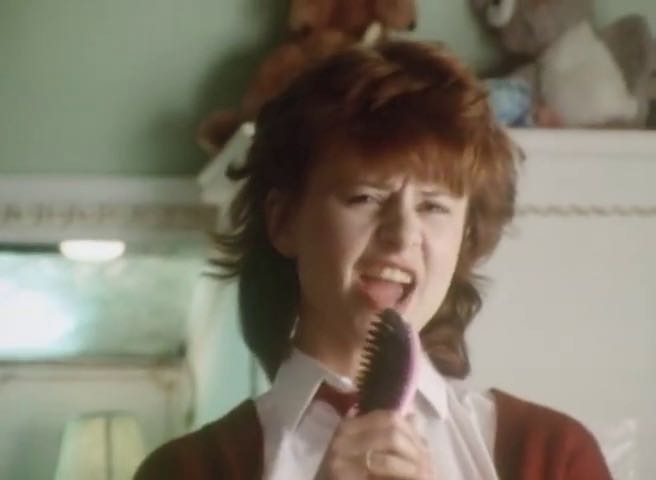
It’s quite cheap. It appears to be best remembered for Ullman singing into a brush.

A Nightmare On Elm Street Part 2: Freddy’s Revenge (1985, dir. Jack Sholder)

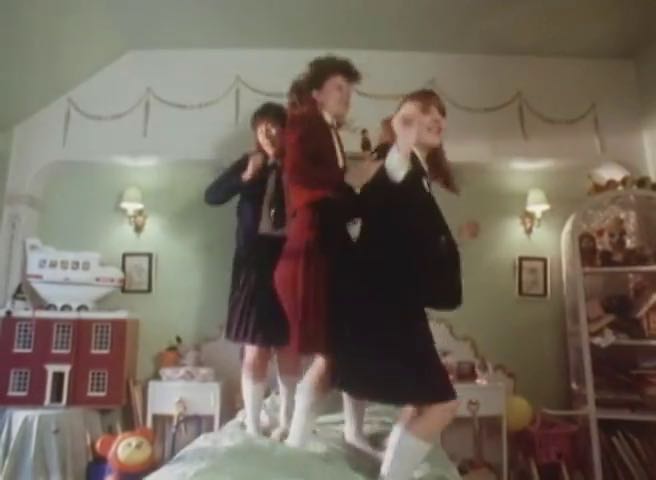
I want to know why there is a plane on top of the building (left) and what looks like a creepy clown head on the top shelf (right).

It’s still catchy, fun, and the editing does draw you in into the song, regardless of it having to use the white dimension several times.

From taking a quick glance at her next video for the song They Don’t Know, her videos got more impressive. But we can’t jump right to the video where we see the Rank Films gong-guy with a package, and Paul McCartney ending up with Ullman. We need to start with her first video.

Dave Robinson appears to have directed around 22 videos.

The video was produced by John Mills and prolific music video director Nigel Dick, who were also the art directors.

Enjoy!

Film Review: Into the Woods (dir by Rob Marshall)


I had such a mixed reaction to Into the Woods, the latest Rob Marshall-directed musical adaptation, that it’s hard to really know how to start my review, let alone how to conclude it.

So, I’ll start by answering the most important question that you probably have about this film.  I think sometimes that film snobs like me tend to forget that, for most people, it’s just a question of whether or not the film is worth the time, effort, and money that it will take to sit through it.  In other words, having seen Into the Woods, do I recommend it?

Yes, I do.  Well, kind of anyway.  As I said before, it’s complicated.  But, for the most part, I enjoyed Into the Woods.  The audience that I saw it with (and the theater was absolutely packed) seemed to really love the film and there was even a smattering of applause at the end of it.  Into the Woods is a crowd-pleaser.  It’s a well-made film.  It’s perfectly cast.  It’s full of funny moments.  The costumes are absolutely to die for.  (I’m totally in love with the gown that Anna Kendrick gets to wear to the ball.)  Meryl Streep will probably get an Oscar nomination.  Chris Pine deserves to be given a lot more awards consideration than he’s received.  It’s such a good film and yet…

And yet, I never loved Into the Woods like I thought I would.  I watched it and I kept thinking about how much I, of all people, should have loved this film.  I love musicals.  I love spectacle.  I love fairy tales.  I love revisionism.  I love satire.  I love handsome, charming men, like the one played by Chris Pine.  In a perfect world, Anna Kendrick would be my best friend and we’d spend all of our time going to wine tastings and watching Lifetime movies.  Into the Woods was full of everything that I should have loved and the final song actually brought tears to my mismatched eyes but I never quite came to love the film.  Something was just off.

Before I go any further, I should admit that my reaction may have been influenced by outside factors.  On the one hand, all of the Bowman girls are together right now for the holidays and I loved the fact that, as I watched Into the Woods, I was watching it with my sisters and all four of us were sharing in the experience.  Really, that’s the ideal way to watch something like Into The Woods.  This is the type of movie that was specifically made to be watched and appreciated by large groups, preferably made up of people who understand and appreciate the conventions of musical theater.

On the other hand, we had the most obnoxious woman ever sitting directly behind us.  She laughed through the entire film, regardless of whether anything funny was happening on screen or not.  (The film features a lot of comedy but it grows progressively darker with each passing minute.)  It wasn’t just that she wouldn’t stop laughing as much as it was that her laugh was so insincere.  You could tell that she was laughing because she wanted everyone to be impressed with the fact that she “got” the film.  But ultimately, all she did was get on everyone’s nerves with her inability to understand that we weren’t there to listen to her dry heave of a laugh.  We were there because we wanted to see Into the Woods.  The experience was not meant to be about her.  It was about the movie.

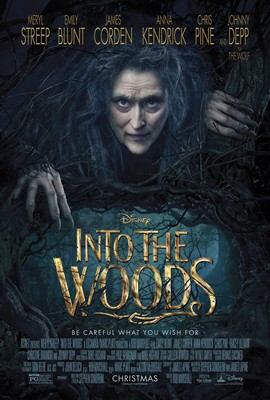
As for what the film is about, it’s an adaptation of the famous Stephen Sondheim musical in which the Baker (James Corben) and the Baker’s Wife (Emily Blunt) attempt to break the spell of a not-quite-evil-but-definitely-bad-tempered witch (Meryl Streep).  By bringing the witch several things (the majority of which can be found in the woods that sit right outside their village), they can lift the curse that has made it impossible for the Baker’s Wife to get pregnant.  Along the way, they run into everyone from the witch’s daughter, Rapunzel (MacKenzie Mauzy) to Jack the Giant Slayer (Daniel Huttlestone) to Cinderella (Anna Kendrick) to the Big Bad Wolf (Johnny Deep, playing up the sexual subtext of the story of Little Red Riding Hood) to not one but two charming princes (played by Chris Pine and Billy Magnussen)!  Into the Woods starts by poking gentle fun at the fairy tales of old and then gets darker and darker until, by the end of the film, only a few characters are left alive.

It’s a great idea and it’s gorgeously executed but yet the film itself never quite makes the transition from being good to being great.  Towards the end of the musical, the surviving characters sing about missing their loved ones and it brought tears to my eyes but that was one of the few moments when the film itself actually made an emotional connection.  Otherwise, I spent a lot of time feeling curiously detached from what was happening on screen.

Thinking about Into The Woods, it’s hard not to compare it to 2012’s version of Les Miserables.  In Les Miserables, all of the songs were recorded live on set.  And, for all the unfair criticism that Russell Crowe received for his singing, this brought a definite raw power and immediacy to the entire production.  What some of the actors may have lacked in conventional singing ability, they made up for with the sheer power of their performances.  In Into The Woods, the majority of the songs were pre-recorded.  Everyone sounds almost too perfect.  There’s none of the vitality or danger that came with Les Miserables or even Rob Marshall’s previous musical, Nine.

(As far as casting, direction, and almost everything else is concerned, Into The Woods is a hundred times better than Nine but it still never manages to produce a moment as vibrantly silly and memorable as Kate Hudson’s performance of Cinema Italiano.)

Into the Woods does have a uniformly excellent cast.  Everyone — even the much-criticized Johnny Depp — does a wonderful job with their role.  Meryl Streep has been getting all of the awards-consideration, largely because she’s Meryl Streep and, if she could get a nomination for giving that performance in August: Osage County, then she can probably get a nomination for anything.  (And don’t get me wrong — Meryl’s great and all but there’s still a part of me that would have loved to have seen what a less self-enamored performer — like Marion Cotillard or Helen Mirren — could have done with the role of the Witch.)  But, to me, the film’s best two performances really came from Anna Kendrick and Chris Pine.  Whether pausing to strike a heroic pose or casually trying to seduce a woman who he meets in the woods or explaining that he’s been raised to be charming and not sincere, Chris Pine is never less than outstanding.

So, to get back to the only question that really matters, did I like Into The Woods?  I did but I did not love it, which is unfortunate because I really wanted to love it.

However, overall, I recommend Into The Woods.

Just don’t watch it alone.

Or with anyone who has an annoying laugh.

Into_The_Woods_(film)