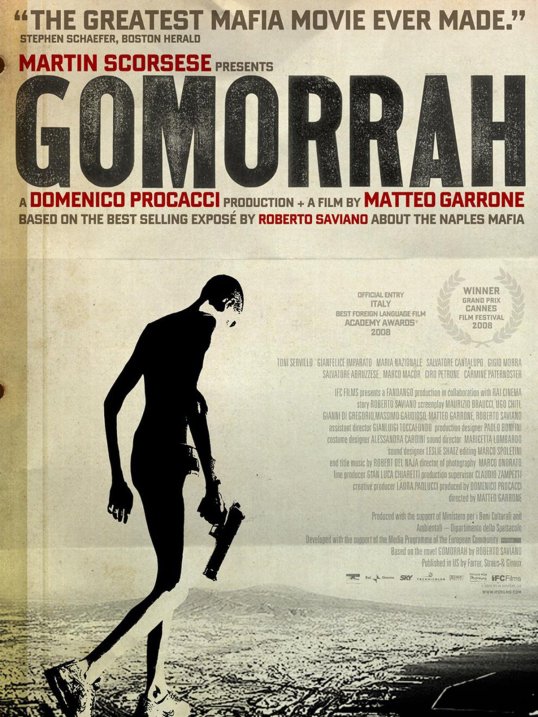
The International Lens: Gomorrah (dir by Matteo Garrone)


In the suburbs of Naples, a group of middle aged men are gunned down while relaxing at a tanning salon.  The 2008 Italian film, Gomorrah, opens with that shocking act of violence and, though we don’t ever learn much about the men who have just been killed or even why they were killed, we spend the next 137 minutes watching the ramifications of those murders.

The poorest neighborhoods of Naples have been plunged into violence as two rival clans of the Camorra go to war.  (The Camorra is like the Mafia but even more violent.)  We’re never quite sure who has gone to war with who or who is winning the war.  For the most part, we’re usually not even sure who is allied with who.  The details of the war are not as important as the people who are caught up in it.

For instance, there’s a 13 year-old boy named Toto (Salvatore Abruzzese) who desperately wants to join one the clan-affiliated gangs.  Toto has a job delivering groceries and, after he proves that he can be trusted by delivering a package of misplaced drugs to the gang, he allowed to join.  Of course, he also has to help his new friends murder one of the people to whom he delivers groceries.

And then there’s Don Ciro (Gianfelice Imparato), who looks like  quiet accountant but who has one of the most dangerous jobs around.  He’s the guy who has to deliver money to the families of all of the clan members who have been arrested or killed.  Having that money is dangerous, even for someone who doesn’t appear to have a violent bone in his body.  One thing that Gomorrah quickly establishes is that, when it comes to the Camorra, there is no honor.  Everything that we’ve been led to believe about organized crime having any sort of code is a lie.  Everyone is a target, even the ones who appear to just be timid bankers.

Pasquale (Salvatore Cantalupo)) is a tailor who takes a job training Chinese garment workers.  Because the Chinese workers are directly competing with the Camorra-owned factories, Pasquale soon discovers that his life is in danger.  He even has to hide in the trunk of a car so that he can be safely smuggled into work each night.  It’s a dangerous world but Pasquale’s story does conclude with one of the film’s best and most darkly humorous moments.

Franco (Toni Servillo) works in waste management, hauling away people’s garbage and then secretly dumping it where it won’t be discovered until long after it’s poisoned the soil.  Franco’s business may be funded by criminals and he may be destroying the Earth but Franco still very proud of himself.  He’s the type of hard worker who built Italy’s economy.  Without him, Italy would be dependent upon other countries for its survival.  Franco is the type of man who makes Italy and therefore Europe great.

And finally, there’s Marco (Marco Macor) and Ciro (Ciro Petrone), two teenage morons who love Scarface and who think that they’re destined to become master criminals just like Tony Montana.  Hoping to impress the clans, they commit a series of progressively violent crimes.  Even as the Camorra plots a violent retribution for the two of them, the two teens are too busy playing on the beach, stripping down to their underwear and firing off rifles, to understand.  It’s easy to dismiss these two as just being idiots who are in over their heads but what else is there for them?  They live in one of the poorest neighborhoods in all of Europe,  There are no economic opportunities.  There’s no chance for any sort of advancement.  They’re trapped, prisoners of both their birth and their circumstances.  They can either try to be gangsters or they can just be passive observers.  Either way, there’s a good chance they’ll get caught in the crossfire.  When the choice is between being a victim and victimizer, is it such a shock that the two of them would want to be the latter?

Gomorrah is a gritty crime film, shot in a documentary-style with a largely nonprofessional cast and featuring scenes of sudden and shocking violence.  Unlike most mafia movies (though the Camorra is not the same as the Mafia that we know here in the United States), Gomorrah is barely concerned with the mobsters.  Instead, its focus is on those who have to live around them, the indirect victims of their nonstop vendettas.  The film understands that its audience is probably full of people like Marco and Ciro, people who can quote Scarface but who have no understanding of the actual damage that has been done by organized crime.  Gomorrah sets out to correct the record and it does a pretty good job of it.

Gomorrah is a harrowing but effective film, one that shows how poverty breeds crime and crime, for the most part, just breeds more poverty.  To its credit, the film doesn’t offer up any easy solutions.  Instead, it just asks us to acknowledge the reality of what’s happening all around.
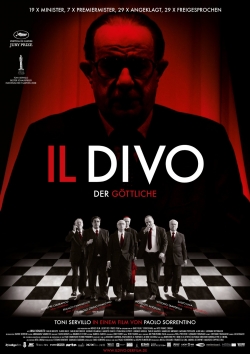
The International Lens: Il Divo (dir by Paolo Sorrentino)


Earlier tonight, as I watched the 2008 Italian film, Il Divo, it occurred to me that political corruption really is an international language.

The film is heavily stylized biopic of Giulio Andreotti.  Andreotti (who died five years after the release of this film) is nearly unknown figure in the United States but, in Italy, he spent several decades as a member of the country’s political elite.  He was a controversial figure, a man who served several terms as prime minister and was later appointed senator for life but who was also accused of being politically corrupt and affiliated with some of the worst elements of the Mafia.  People who threatened to investigate Andreotti or who could have contributed to his downfall had a habit of ending up dead.  No sooner has Il Divo begun then we’re treated to a lengthy montage of Andreotti’s associates getting killed in various ways.  Some are gunned down.  One is found hanging underneath a bridge.  One is in an exploding car.  The film also opens with a title card that informs us that, over the course of Andreotti’s long career, he was rumored to be one of the leading members of the P2, a masonic lodge that counted among its members some of the most powerful men in Italy.  P2 is one of those organizations that conspiracy theorists love to obsess upon.

Directed by Paolo Sorrentino, Il Divo is an Italian film that deals with the life of a prominent Italian political figure and, needless to say, it was made for an Italian audience.  For an American viewer like me, it was often impossible not to get confused as I tried to keep up with who was working with who and who had just been killed.  In short, this film was made to be viewed by people who already know who Guilo Andreotti was and who are familiar with the details of his long career.  It was not made for someone like me who is still struggling to wrap her mind around the fact that Italy has both a prime minister and a president.

But, in the end, it really didn’t matter if I occasionally struggled to follow every twist and turn of Andreotti’s career.  Il Divo may technically by a biopic of Giulio Andreotti but, on a larger scale, it’s about how power corrupts and the banality of evil.  Those are universal themes and you certainly do not have to be any particular nationality to be familiar with the fact that people who dedicate their lives to accumulating political power often turn out to be, at the very least, willing to cut some ethical corners.  I may not have always understood every detail of Il Divo‘s story but I did understand exactly what the film was ultimately about.

As played by Toni Servillo, Andreotti does not come across as being  particularly charismatic politician.  With his hunched back and his bat-like ears, Andreotti almost seems like a caricature of a corrupt leader.  In the film, one immediately sees that Andreotti hasn’t held onto his power because he’s particularly loved by the people.  Instead, he’s held onto power by being smarter than those who would try to defeat him.  No matter how determined his enemies may be, Andreotti is always just a little bit more ruthless.  Andreotti succeeds because he’s willing to do what he has to do to succeed and he’s willing to ally himself with people who have a stake in his continued success.  While the film never comes out and says that Andreotti was personally responsible for ordering the deaths of any of his enemies, it does suggest that he purposefully surrounded himself with men who would do anything to keep Andreotti in power, if just to protect their own fiefdoms of corruption.

There’s an early scene in Il Divo where Andreotti’s allies all arrives for a meeting with the prime minister.  Most of them are politicians.  One of them is a cardinal.  Another is simply identified as being a “businessman.”  They pull up in their expensive cars and then we watch as they walk across the screen in slow motion, arrogantly confident in the fact that they’re above any and all legal or ethical considerations.  They’re all wealthy men and they all seem to understand the importance of keeping Andreotti happy.  Carlo Buccirosso plays Paolo Cirino Pomicino, who was one of Andreotti’s chief allies.  Buccirosso plays Pomincino as being glibly hyperactive, a cheerfully corrupt ball of energy who seems to be having all of the fun that Andreotti denies himself.  Because Andreotti denies himself an interest in anything other than wielding and holding power, he is invulnerable to attack and prosecution but sometimes it’s hard not to wonder if he would have rather have been Pomincino, dancing at parties and sliding across tiled floors.

Indeed, Andreotti begins and ends Il Divo as an enigma.  How deeply involved is he in the murders occurring around him?  Is he ordering them or is he just turning a blind eye?  What makes Andeotti tick?  By the end of the film, his main motivation seems to be bitterness.  Death may be inevitable but he’s not going to go until everyone else goes first.  That is a motivation that many politicians across the world probably share.  Corruption is universal.