
Released in 1967 and directed by Giulio Questi, Django Kill is one of the essential spaghetti westerns.
The film opens with a man literally clawing his way out of a shallow grave. Played by Tomas Milian and known as the Stranger, the man is a Mexican outlaw who has been buried out in the middle of the desert. Two sympathetic Indians discover the Stranger and, while they nurse him back to health, he has several flashbacks that explain how he came to be buried alive.
The Stranger was a member of a gang of thieves who stole a cargo of gold. However, the Americans in the gang betrayed the Mexicans, gunning them down and fleeing with the gold. The Indians agree to help the Stranger find the rest of his gang on the condition that the Stranger tell them what it was like to be dead.
The Stranger’s former gang, meanwhile, has arrived at a desolate town known as Unhappy Place. From the minute that the gang first rides into town, we know that there’s something sinister about Unhappy Place. A naked child stands in the middle of the street while another is used as a footrest by one of the adults. A distraught woman watches them from behind a barred window. A lame hedgehog drags itself across the dusty street. As soon as the gang stops at the local saloon, the locals see the gold that they’re carrying and, in a shockingly brutal scene, the townspeople lynch the outlaws.
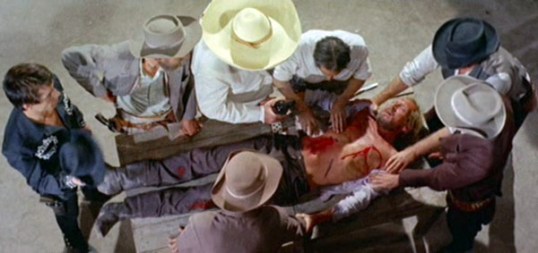
While this is going on, the Stranger rides into town. Spotting the last living outlaw, the Stranger proceeds to gun him down. In one of the film’s more infamous scenes, when the townspeople learn that the Stranger is using gold bullets, they proceed to literally rip the outlaw to pieces in an effort to retrieve the golden bullets.
With the outlaws dead, the townspeople claim the gold for themselves. The Stranger, who was apparently more interested in revenge than getting the gold, stays in town and watches as things get increasingly weird.
How weird?
Well, how about the fact that the Stranger ends up having a romance with a crazy woman who spends her days trapped behind a locked door?
Or how about the fact that the Stranger finds himself in the middle of a power struggle between the townspeople and the flamboyantly homosexual Zorro (played, in grandly villainous fashion, by Roberto Camardiel) who rides into town with a gang of cowboys who are all dressed in black outfits with white embroidery? In another one of the film’s infamous scenes, Zorro and his cowboys kidnap and gang rape the son of the town’s saloonkeeper.
(A young Ray Lovelock, who would go on to be one of the best actors to regularly work in Italian exploitation plays the son.)
Or how about the scene where Zorro plays with a bunch of Civil War figures while arguing with his pet parrot? When Zorro offers the parrot a drink, the parrot replies, “I want more!”
Or, how about the fact that the Stranger, at one point, has to deal with several vampire bats while literally hanging from a cross?
Graphically violent and full of bizarre and disturbing imagery, Django Kill is one of the strangest westerns ever made and that strangeness keeps the film interesting even when the story doesn’t make much sense. While Django Kill may not be the masterpiece that several claim it to (the film runs on a bit long and the dubbing of the English language version was absolutely terrible), it’s still one of the most compulsively watchable films that I’ve ever seen. Just when you think the film can’t get any stranger, it does.
Django Kill was filmed under the title of If You Live, Shoot! However, in a move typical of Italian cinema, the film was retitled to take advantage of the popularity of Sergio Corbucci’s Django. The implication, of course, is that Tomas Milian is playing the same character here that Franco Nero played in Corbucci’s film. Of course, nothing could be further from the truth. Even in the crudely dubbed English version of the film, Milian is never referred to by name. Instead, he’s simply known as the Stranger and, appropriately enough, the film feels more like a surreal take on Sergio Leone’s Dollar trilogy as opposed to being a part of the Django series.
That said, regardless of whether it’s a legitimate Django film or not, Django Kill …. If You Live, Shoot! is more than worth watching. In fact, it’s essential for anyone who loves Italian exploitation films.

 Through the Shattered Lens