MAN WITH A CAMERA (TV Series) – starring Charles Bronson – S1, E3: Profile of a Killer 


Mike Kovac (Charles Bronson) is working on a pictorial profile of a banker in a small town outside of New York City, when a man named Terry Killeen (Tom Pittman) robs the bank and kills the banker. Killeen sees Kovac’s camera and forces him to come along with them. Killeen wants to be famous so he has Kovac document his one man crime spree as he robs a bank every day for six straight days. Kovac takes pictures at each robbery and sends them to his friend and small town newspaper man, Jenkins (Russell Collins), to publish the stories. Jenkins figures out that Kovac is using the pictures to provide clues to where they are heading, mainly the Lone Pine Lodge. It seems the college girl that Killeen loves, Sara (Mayo Loiseaux) is at the Lodge and Killeen thinks she will reciprocate his feelings now that he’s a famous outlaw. With Killeen planning to kill Kovac once he’s taken a picture with him and Sara, will Jenkins be able to figure out the clues and make it to Lone Pine and save his friend before it’s too late?!

The most unique aspect of “Profile of a Killer” is the performance of Tom Pittman as the bank robber / murderer, Terry Killeen. He’s certainly over the top, but his cackling laugh as he murders, robs, and terrorizes everyone around him is somewhat unsettling. Sadly, Tom Pittman would die on October 31st, 1958, one week after this episode aired, in a car accident. I also liked the performance of Russell Collins as Kovac’s friend and newspaper man, Jenkins. Jenkins’ day job may be as a newspaper editor, but he makes it clear throughout the episode to the local sheriff’s deputy Gilligan (Wayne Heffley) that he’s planning on getting out of the office and saving Kovac by himself if he has to. That’s pretty much exactly what he does. The episode concludes with a rifle wielding Jenkins and Kovac working together to take on Killeen in a night time gunfight. It’s a fun scene, with Kovac’s flashbulbs and Jenkins’ deadeye shooting skills both coming in handy. And of course, there’s the continued excellence of Charles Bronson in the lead as Mike Kovac. In this episode he uses his brain more than his brawn. He didn’t get any real cool lines, and he didn’t get the opportunity to kick any butt. That’s always a missed opportunity with Bronson, but he still dominates the proceedings with his unique charisma and presence. 

“Profile of a Killer” doesn’t give Bronson any true badass moments, but it does create some memorable characters for his Mike Kovac to interact with, and I enjoyed that very much!
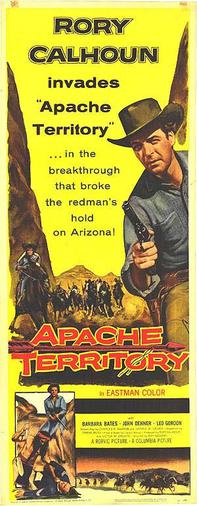
Apache Territory (1958, directed by Ray Nazarro)


In this B-western, Rory Calhoun plays Logan Cates, an old west drifter, while traveling through the desert, comes across a young woman named Junie Hatchett (Carolyn Craig).  Junie’s parents were settlers who were captured and killed by a group of Apaches.  Knowing that the Apaches will still be looking Junie, Logan takes her to a nearby canyon where there’s water and shelter.  Soon, other victims of the Apaches start to show up at the canyon.  With their supplies dwindling and the Apaches surrounding them, Logan has to keep everyone alive and lead them to safety.

Complicating matters is that one of the people who shows up at the canyon is Logan’s ex-girlfriend, Jennifer (Barbara Bates).  Jennifer is traveling with her new husband, the wealthy (and therefore cowardly) Grant Kimbrough (John Dehner).  Also seeking shelter at the canyon are a group of Calvary officers, a Pima Indian named Lugo (Frank DeKova), and a naive teenage cowboy named Lonnie (Tom Pittman).

Based on a novel by Louis L’Amour, Apache Territory is a pretty standard western.  Some of the battle scenes are surprisingly brutal — particularly when one of the Calvary officers gets hit by a flaming arrow — but otherwise, this is a typical B-western, the type of movie that would have been the second part of a double bill at a Saturday matinee.  Logan Cates is able to survive because, unlike Grant Kimbrough, he knows and respects the land and, unlike the Calvary officers, he respects his enemy.  He’s a typical western hero, though well-played by Rory Calhoun.

The main problem with the film is that, for a film about a group of people trapped in one location, it never achieves any sense of claustrophobia.  The size of the canyon seems to change from shot to shot.  The film’s finale involves a well-realized dust storm but it still never reaches the type of action-packed conclusion that most western fans will be hoping for.  It ends with a whimper instead of a bang.  It feels more like an extended episode of Gunsmoke or The Virginian than a feature film.

This one will be best appreciated by undemanding fans of the genre.

Back to School #5: High School Big Shot (dir by Joel Rapp)


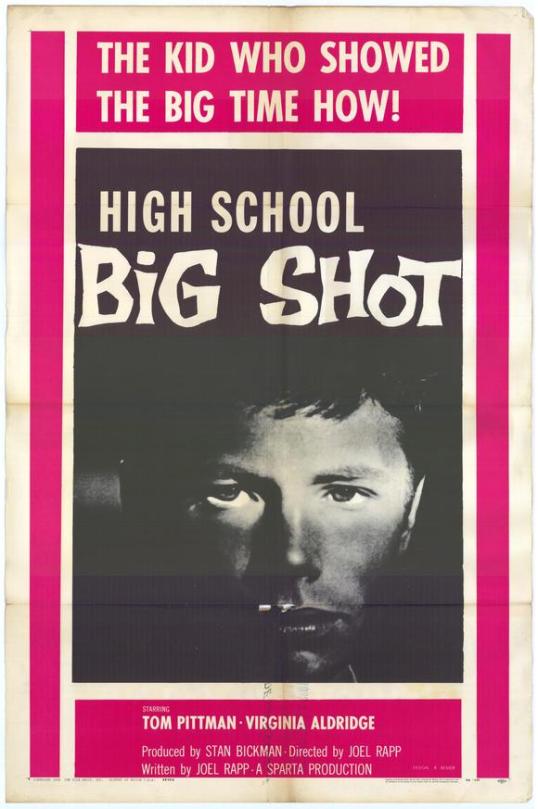
high-school-big-shot-movie-poster-1959-1020228183

We continue our trip back to school with the 1959 teenage heist film, High School Big Shot!

Oh my God, this movie is so dark.  Rebel Without A Cause and Blackboard Jungle weren’t exactly optimistic portraits of the youth of America but none of them could ever hope to be as cynical and bleak as High School Big Shot.  This film, which I guess could best be described as being a high school noir, tells the story of poor, socially awkward high school student Marv (Tom Pittman).  Marv is a genius and, while he’s not popular at school, he does seem to have a wonderful future ahead of him.  He’s recently applied for a scholarship and his English teacher has agreed to write him a letter of recommendation because, as he puts it, Marv is “different from all the others.”

And Marv needs that scholarship because his father is an alcoholic who can’t hold down a job.  Marv’s relationship with his father is perhaps best epitomized by an early scene where he asks Marv to loan him some money because he has a date.  Marv has a date too but he still loans his dad the money.  Cut to the next scene and Marv is telling his date that he can’t really afford to take her anywhere but he can get her a Coke if she wants one.

Seriously — dark.

Marv’s life starts to look up when Betty (Virginia Aldridge) suddenly takes an interest in him and even agrees to go out with him.  However, as Betty explains to her loutish boyfriend Vince, the only reason that she’s going out with Marv is so she can trick him into writing her English term paper for her.  Marv, of course, agrees to do just that and then asks Betty if she wants to get married after they graduate from high school.

Again, dark.  Dark and awkward.

When the English teacher figures out that Marv wrote Betty’s term paper, Marv loses his scholarship and it looks like he’s now destined to spend the rest of his life working down at the docks.  However, Marv discovers that his seedy boss has recently received a million dollars in drug money.  Looking to both buy Betty’s love and help out his suicidal father, Marv comes up with an elaborate scheme to steal the money.  However, Betty and Vince have plans of their own…

Needless to say, it all leads to a violent climax that leaves nearly every character in the film dead.

And all because poor Marv wanted to impress Betty.

Like I said, dark.

And yet, the film itself is so dark that it becomes oddly fascinating.  You watch because you’re genuinely curious about how much darker Marv’s life can get.  It also helps that Tom Pittman gives a sympathetic performance as Marv (even if he does appear to be a bit too old to be playing a high school student) and Virginia Aldridge makes for a great femme fatale.  If this film were made today, it would probably be directed by David Fincher and it would star Anton Yelchin and Jennifer Lawrence.

And it would be great!

But until that happens, you can watch the original below!

http://www.youtube.com/watch?v=5K_Y3tEPlSY