Welcome to Retro Television Reviews, a feature where we review some of our favorite and least favorite shows of the past! On Saturdays, I will be reviewing 3 By Cheever, which ran on PBS in 1979. The entire show can be purchased on Prime and found on YouTube.
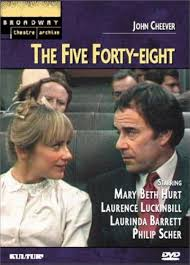
This week, we finish up 3 By Cheever with an adaption of one of his best-known short stories.
Episode 1.3 “The Five Forty-Eight”
(Dir by James Ivory, originally aired on James Ivory)
Laurence Luckinbill stars as Blake, a business executive who rides the train into the city for work and then back to the suburbs when it’s time to return to his perfect home. One day, as Blake heads to his train, he comes to be aware that he’s being followed by his former secretary, Miss Dent (Mary Beth Hurt). Blake is concerned because Miss Dent made quite a scene when she was fired from her job a little while ago. Of course, a part of the reason why she was so upset was because Blake had earlier seduced her, something that he has a habit of doing when it comes to his secretaries. On the train, surrounded by neighbors (including one that Blake can’t stand because of his long hair), Blake finds himself sitting next to Miss Dent. She explains that she has a gun in her purse. As the train heads for its destination, Blake’s confident facade crumbles and he is soon as humiliated by his former secretary as she was by him. And yet, this being a Cheever story, one wonders if Blake is even capable of realizing why any of this is happening to him.
The final episode of 3 By Cheever was an adaptation of one of John Cheever’s best short stories. As directed by James Ivory, this adaptation can feel a bit overdrawn. The short story, for instance, opens with Blake on an elevator, already preparing to head home on the train. Ivory’s adaptation opens with Blake at the start of his day and we see a lot of things — like Blake’s antagonistic relationship with his long-haired neighbor — that Cheever simply mentioned. It takes a while for Miss Dent to finally sit down next to Blake and Ivory doesn’t do much to build up any sort of suspense while we’re waiting.
On the plus side, the film reveals Ivory’s skill when it comes to working with actors as both Luckinbill and Mary Beth Hurt give excellent performances. Luckinbill goes from being oily and overconfident to being a neurotic mess by the end of the show while Hurt does the opposite, going from being meek to commanding. Both the original short story and Ivory’s adaptation succeed in making you wonder what the future could possibly hold for either one of the two characters. They both seem to reach a point of no return and it’s hard to imagine Blake going back to his suburban home and his train rides and his motel hook-ups but, then again, this is a Cheever story so the implication is that he does just that, untouched by the fact that he nearly lost his life due to his own behavior. As for Miss Dent, she reclaims her self-respect by going to an extreme.
This was the last episode of 3 By Cheever. This was an interesting series of adaptations, even if Cheever’s prose does seem to work best on the page than literally translated to film. Next week, a new series will being in this spot.
 Through the Shattered Lens