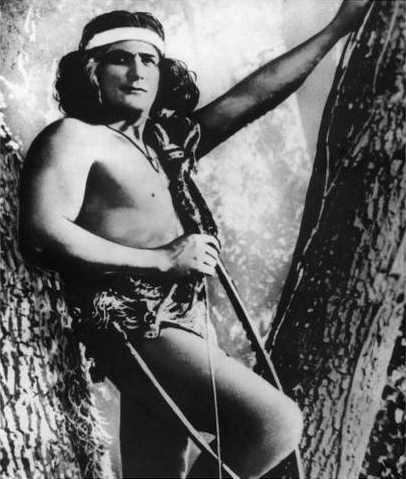
Silent Film Review: Tarzan of the Apes (dir by Scott Sidney)


Elmo Lincoln.

That name may not sound all the imposing but Elmo Lincoln played a very important role in the early days of Hollywood.  He was the first actor to play the adult version of Tarzan, the Lord of the Jungle.  Originally from Indiana, Elmo Lincoln was a 29 year-old former sailor and boxer when he was selected to replace Stellan Windrow as the star of 1918’s Tarzan of the Apes.  (A stunt man, Windrow had already filmed the majority of Tarzan’s stunts before he was drafted to serve in World War I.)  Lincoln, who had already appeared in a few of D.W. Griffith’s films, would briefly find stardom as a result of playing Tarzan.

Of course, it takes a while for Lincoln to appear in Tarzan of the Apes.  The film was reportedly two hours long when it was initially released but today, it only exists in a 61-minute version.  (Because each municipality had its own board of censors, the version of Tarzan of the Apes that played in one city could be quite different from the version that played in another.  Unfortunately, with that many censors snipping scenes from city to city, a lot of footage that was cut from the film was undoubtedly lost forever.)  The first half of the film deals with the birth of Tarzan while the second half features Tarzan as an adult.  Technically, the first actor to play Tarzan was the uncredited baby who appears shortly after Lord Greystoke (True Boardman) and his wife (Kathleen Kirkham) are abandoned by mutineers in Africa.  After the baby is given to the Apes, child actor Gordon Griffith takes over the role.  Finally, once an expedition is sent to investigate whether or not the stories about Tarzan are true, Elmo Lincoln takes over the role and saves Jane (Enid Markey) after she’s kidnapped by a group of natives.  The film ends with Tarzan and Jane just starting to fall in love.  (A sequel, The Romance of Tarzan, was released that same year but it’s a lost film.)

In the role of Tarzan, Elmo Lincoln is …. well, he’s okay.  He’s not a great actor but he’s a good Tarzan.  He’s obviously strong and athletic and he looks convincing when he’s hiding in the trees.  Lincoln was not a particularly expressive actor and that natural stiffness is noticeable whenever he’s called upon to demonstrate anything other than grim determination.  He has a strong physical presence and, in 1918, that was probably enough to make him a star.  When he gazes at Jane and the title cards tells us that he’s saying, “Tarzan is a man and man does not force the love of a woman,” the viewer believes it.  If I was lost in the jungle, I’d probably want Elmo Lincoln to help me out.  We wouldn’t have much to talk about but I would have faith in his ability to take care of any problems that we ran into on the way back to civilization.

That said, the film is at its best when it depicts Tarzan’s childhood.  There’s a sense of fun and wonder to those scenes that is missing from the second half of the film.  Gordon Griffith did a good job as the young Tarzan.  Louisiana is a surprisingly effective stand-in for the jungles of Africa.  By today’s standards, Tarzan of the Apes can seem a bit creaky.  (The camera barely moves at all.)  But watching it, one can still understand why Hollywood fell in love with the idea of a man raised by apes.  One can even understand why, for a brief period of time, Elmo Lincoln became a star.

Film Review: The Loves of Edgar Allan Poe (dir by Harry Lachman)


I have to admit that the 1942 film, The Loves of Edgar Allan Poe, turned out to be far different from what I was expecting.

Just based on the title, I was expecting it would be a highly fictionalized, borderline silly film about Edgar Allan Poe defeating his romantic rivals and winning the hand of the woman he loved while still finding time to write The Raven.  I figured that there would be at least a few gentlemanly fisticuffs, with Poe portrayed as a combination of Rhett Butler and Cary Grant.  Looking at the title, it was easy for me to imagine the film closing with Poe kissing his future wife and then looking straight at the camera.  “Quoth the Raven!” he would say and wink while romantic music swelled in the background…

But no.  The Loves of Edgar Allan Poe is actually a very conventional biopic.  With a running time of only 67 minutes, the movie often feels rather rushed but it still manages to include most of the better known details of Edgar Allan Poe’s short but eventful life.  (An ever-present narrator is always ready to fill us in on every thing that happens off-screen.)  The film doesn’t spend much time on what initially inspired Poe’s macabre imagination.  There’s a scene of Poe, as a child, standing on a desolate hill and looking at a raven perched in a dead tree.  With the exception of an extended section that deals with Annabel Lee, that’s about as deep as the movie is willing to get as far as Poe’s art is concerned.

When Poe grows up, he’s played by actor Sheppard Strudwick, who has a good mustache but never exactly comes across as being the type of tortured genius who would eventually end up both revolutionizing literature and drinking himself to death.  The majority of the film deals with Poe’s advocacy for copyright reform, which is an important issue but not exactly the most cinematic of concerns.  Poe survives college.  Poe tries to sell The Raven for $25.  Eventually, Poe marries Virginia Clemm (Linda Darnell) and her subsequent sickness and death leads to not only Poe’s greatest work but also his own tragic end.

Along the way, Poe meets both Thomas Jefferson and Charles Dickens.  Jefferson shows up long enough to tell a young Poe that he’s a good writer and that he needs to stop gambling.  Dickens meets Poe and encourages him to continue to advocate for better copyright laws.

It is known that Poe and Dickens actually did meet but did Poe also meet Thomas Jefferson?  Legend says that he did but no one knows for sure.   Here’s what we do know:

Poe attended the University of Virginia in 1826.  The University’s founder, former President Thomas Jefferson, was still alive in 1826 and would often invite promising students to Monticello.  Whether Jefferson was still doing that when Poe enrolled at the University of Virginia is questionable.  Jefferson died five months after Poe started his studies.

As for Dickens, Charles Dickens and Edgar Allan Poe admired each other’s writing and they met in Philadelphia during Dickens’s 1842 tour of North America.  No record has been kept of what they discussed, though some think that Dickens told Poe about his pet raven and perhaps inspired Poe’s best-remembered poem.  In the movie, they discuss copyright laws, which is nowhere near as much fun.

(When it comes to Poe’s meetings with both Jefferson and Dickens, it is perhaps best to remember the lesson of The Man Who Shot Liberty Valance and print the legend.)

The Loves of Edgar Allan Poe is a very short film and an obviously low-budget one as well.  When the presence of that somewhat pedantic narrator, The Loves of Edgar Allan Poe feels more like an educational special than a real movie.  It’s an okay introduction to Poe’s life but, ultimately, the best way to get to know Edgar Allan Poe is to sit down and start reading.