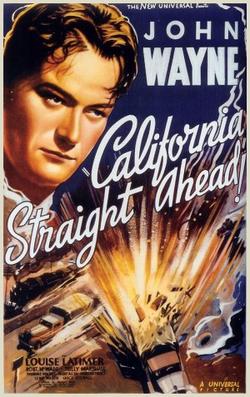
 Biff Smith (John Wayne), fired from his job as a school bus driver, becomes a partner in a trucking company. In order to show-up the railroads that are determined to put any potential competitors out of business, Biff and his fleet race a train to the Pacific Coast, where a boat needs to be unloaded before a labor strike begins. Making this personal for Biff is that he’s in love with Mary Porter (Louise Latimer), the sister of Biff’s late business partner. Embittered by her brother’s death in a trucking accident, Mary is now working for the head of the railroad, James Gifford (Theodore van Eltz). Biff not only wants to prove that his small trucking firm can compete with the big boys but also wants to show Mary that her new boss is nothing but a smooth-talking weasel.
This film is from John Wayne’s B-movie star period, before John Ford cast him in Stagecoach and made him one of the biggest stars in the world. California Straight Ahead! features Wayne in a contemporary role, though the movie still has a western sensibility. There’s not much difference between a wagon train and Wayne’s fleet of trucks and, as in so many westerns, the greedy railroad baron is the villain. This is one of Wayne’s better B-movie performances. He was clearly comfortable in front of the camera by the time he made this movie and was no longer as stiff as he was in his earlier films. California Straight Ahead! is a crowd-pleasing film that finds Wayne standing up for small businesses and their workers. Though this may just be a 61-minute B flick, California Straight Ahead! reveals the movie star that Wayne would soon become.
 Through the Shattered Lens