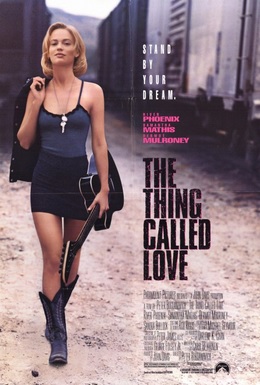
First released in 1993 and directed by Peter Bogdanovich, The Thing Called Love takes place in Nashville, the city that, for many people, has come to define Americana.
Of course, for those who actually love movies, it’s difficult to watch any film about Nashville and the country music scene without being reminded of Robert Altman’s American epic, Nashville. Much like Nashville, The Thing Called Love follows a group of wannabes, stars, writers, and performers. However, whereas Robert Altman used the city and its residents as a way to paint an acidic portrait of a nation struggling to find its way in an uncertain new world, The Thing Called Love is far less ambitious.
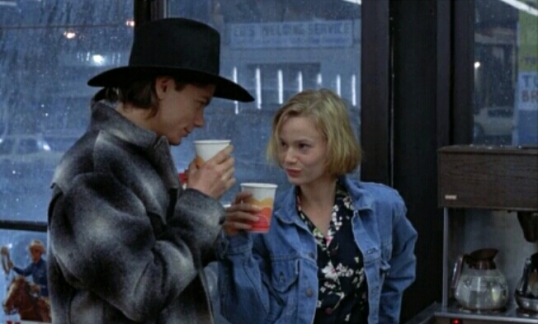
The Thing Called Love centers around Miranda Presley (Samantha Mathis). Miranda is from New York but she loves country music. She comes to Nashville to try to sell her songs and become a star. Instead, she ends up working as a waitress at the “legendary” Bluebird Cafe. While she waits for her big break, she meets two other aspiring writer/performers, Linda Lu (Sandra Bullock) and Kyle Davidson (Dermot Mulroney). Kyle falls in love with Miranda but Miranda falls in love with and marries James Wright (River Phoenix, brother of Joaquin). Unfortunately, while James is talented, he’s also a bit of a jerk.
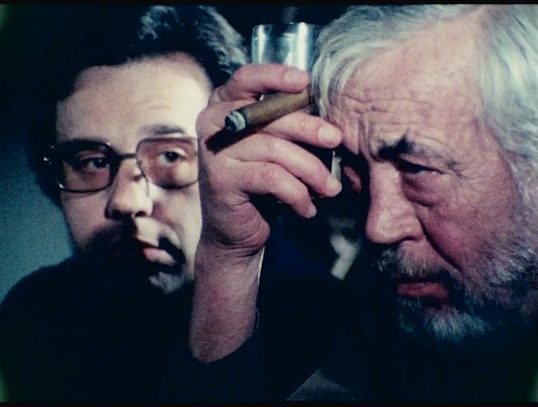
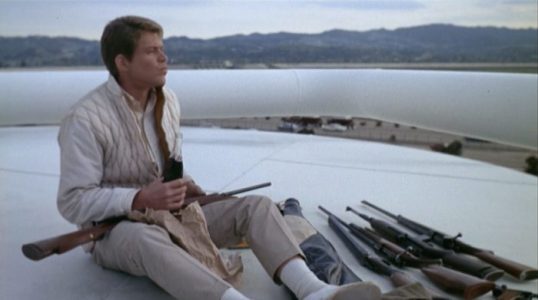
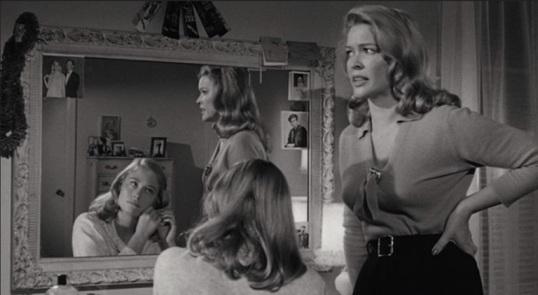
The Thing Called Love aired on TCM last year and I can still remember checking out the #TCMParty hashtag on twitter while the film was airing. The majority of the comments were from people who loved TCM and who couldn’t understand why the channel was showing this rather forgettable movie. The answer, of course, is that the film was directed by Peter Bogdanovich and Bogdanovich was one of the patron saints of TCM. Along with being responsible for some genuinely good films (Targets, The Last Picture Show, Paper Moon, Saint Jack, Mask, The Cat’s Meow), Bogdanovich was also a very serious student of the history of film. Up until he passed away in January, Bogdanovich was a familiar and welcome sight on TCM. Listening to him talk about John Ford, Alfred Hitchcock, and especially Orson Welles was always a delight.
Unfortunately, as Bogdanovich himself often admitted, the majority of his later films failed to reach the heights of his earlier work and that’s certainly the case of The Thing Called Love. It’s not so much that The Thing Called Love is bad as it’s just really forgettable. There’s very little about the film that suggests that it was directed by cineaste who was responsible for The Last Picture Show. Samantha Mathis is likable but a bit bland in the role of Miranda while River Phoenix plays James as being such a jerk that you really don’t care about whether or not he finds success. From what I’ve read, Phoenix based his performance on watching Bob Dylan in the documentary Don’t Look Back. Dylan is notably mercurial in that documentary but, it should be noted, that Dylan eventually abandoned that persona once he realized that it was a creative dead end.
To be honest, I think the film would have worked better if Samantha Mathis had switched roles with Sandra Bullock. This was one of Bullock’s first films and she steals every scene in which she appears, giving an energetic and likable performance as someone who never allows herself a single moment of doubt or despair. As opposed to the self-loathing Phoenix and the bland Mathis and Mulroney, Sandra Bullock represents the hope and optimism that Nashville is meant to symbolize. In the end, her performance is the best thing about The Thing Called Love.
 Through the Shattered Lens