4 Shots From 4 Films is just what it says it is, 4 shots from 4 of our favorite films. As opposed to the reviews and recaps that we usually post, 4 Shots From 4 Films is all about letting the visuals do the talking.
Today’s director: one of the masters of Hammer horror and the director who brought back to life both Dracula and Baron von Frankenstein, Terence Fisher!
4 Shots From 4 Terrence Fisher Films
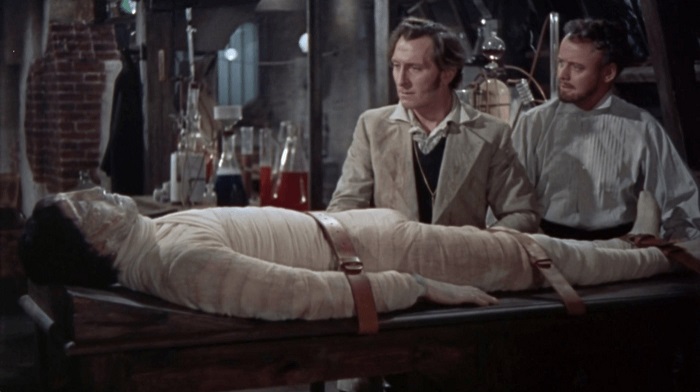
The Curse of Frankenstein (1957, dir by Terence Fisher, DP: Jack Asher)
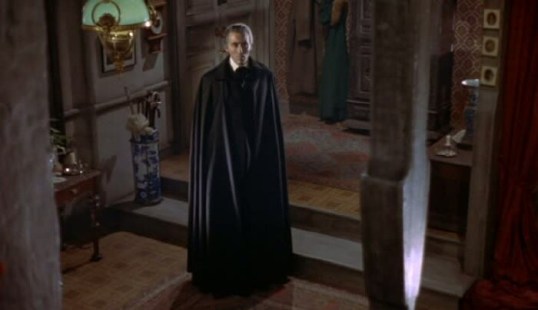
The Horror of Dracula (1958, dir by Terence Fisher, DP: Jack Asher)
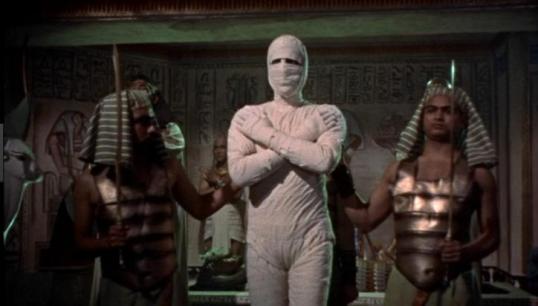
The Mummy (1959, dir by Terence Fisher, DP: Jack Asher)
4 Shots From 4 Films is just what it says it is, 4 shots from 4 of our favorite films. As opposed to the reviews and recaps that we usually post, 4 Shots From 4 Films is all about letting the visuals do the talking.
This October, I am going to be using our 4 Shots From 4 Films feature to pay tribute to some of my favorite horror directors, in alphabetical order! That’s right, we’re going from Argento to Zombie in one month!
Today’s director: one of the masters of Hammer horror, Terence Fisher!
4 Shots From 4 Terrence Fisher Films
Horror of Dracula (1958, dir by Terence Fisher, DP: Jack Asher)
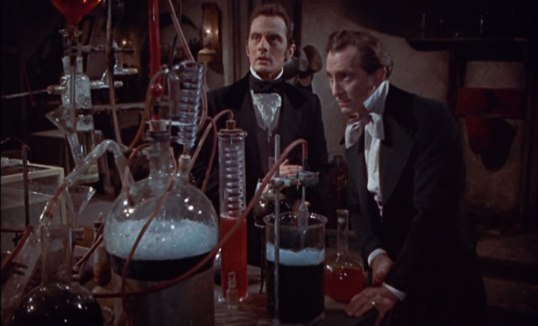
The Revenge of Frankenstein (1958, dir by Terence Fisher, DP: Jack Asher)
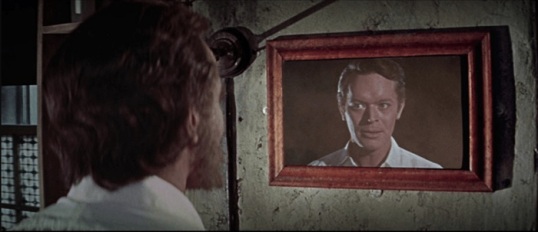
The Two Faces of Dr. Jekyll (1960, dir by Terence Fisher, DP: Jack Asher)
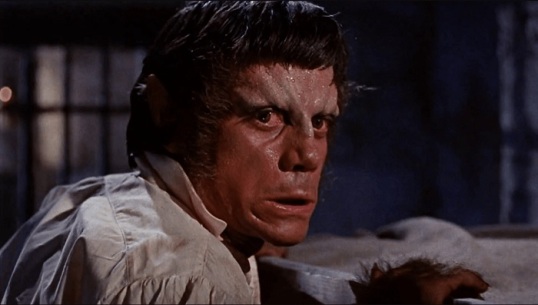
The Curse of the Werewolf (1961, dir by Terence Fisher, DP: Arthur Grant)
Last year, Gary reviewed the first of the Hammer Frankenstein films, The Curse of Frankenstein.For today’s horror film review, I’m going to take a look at the second movie in Hammer’s Frankenstein series, 1958’s The Revenge of Frankenstein!
The Revenge of Frankenstein opens where The Curse of Frankenstein ended. The monster (played by Christopher Lee in the first film) has been destroyed and Baron Frankenstein (Peter Cushing) has been sentenced to be executed for the monster’s crimes. However, the Baron escapes the guillotine. Instead, he arranges for a priest to be beheaded in his place. Working under the name Dr. Stein, the Baron escapes to another village and, after several years, re-establishes himself as a wealthy and respected doctor. While most of his patients are rich, Dr. Stein also helps the poor and the disabled. By all accounts, he’s doing wonderful work but he’s also deliberately enigmatic, refusing to join the local doctors council.
Right from the beginning, we’re reminded of just how different Hammer’s Baron Frankenstein was from Universal’s version of the good doctor. In the Universal films, Dr. Frankenstein — regardless of whether the doctor in question was Henry, Wolf, or Ludwig — was always portrayed as being misguided but ultimately noble. If any of the Universal Frankensteins had been sentenced to death, it’s probable that they would have put on a stoic face, walked to the guillotine, and allow their head to roll. In fact, they would have felt so responsible for the actions of the Monster that they probably would feel it was their moral duty to allow themselves to be executed.
That’s not the case when it comes to Hammer’s Baron Frankenstein. Baron Frankenstein feels no guilt over what the Monster has done. Go the guillotine? No way! Baron Frankenstein is determined to create life and if creating life means that other, lesser mortals end up dead … well, so be it. As opposed to the Universal Frankensteins, who all developed god complexes after the success of their experiment, Baron Frankenstein has his god complex from the beginning. And if Baron Frankenstein is a god, why shouldn’t a priest be sacrificed for the good of the Baron’s work?
Anyway, Dr. FrankenStein and his assistant, Dr. Kleve (Francis Matthews) are determined to once again bring the dead back to life. This time, the plan involves transplanting the brain of hunchback Karl (Oscar Quitak) into a physically strong body (played by Michael Gwynn). Dr. Kleve is worried that a brain transplant could lead to unforseen complications. For instance, one of Dr. Stein’s chimpanzees reacts to being given an orangutan’s brain by turning into a cannibal. However, Stein tells Dr. Kleve not to worry about it. After all, what could go wrong?
Well, a lot goes wrong. It’s a Frankenstein movie, after all.
I have to admit that, while I love Hammer’s Dracula films, I’ve never been a huge fan of their take on Frankenstein. While Peter Cushing always makes for a wonderfully compelling and often chillingly evil Baron Frankenstein, the majority of the Hammer Frankenstein films always seem to move way too slowly. Whenever I watch one of them, I always find myself growing rather impatient with the endless scenes of grave robbery and body stitching. “HURRY UP AND BRING THAT DAMN THING TO LIFE!” I’ll find myself shouting.
However, I was actually pleasantly surprised by how well The Revenge of Frankenstein holds up. That Cushing would give an excellent performance as Baron Frankenstein is to be expected. But really, the entire film is well-acted and both Oscar Quitak and Michael Gwynn give poignant performances as Frankenstein’s latest experiment. It’s a visually vibrant and nicely paced horror film, one that never drags like some of the later Hammer Frankenstein films.
The Curse of Frankenstein and The Revenge of Frankenstein make for a great double feature, especially in October!


 Through the Shattered Lens