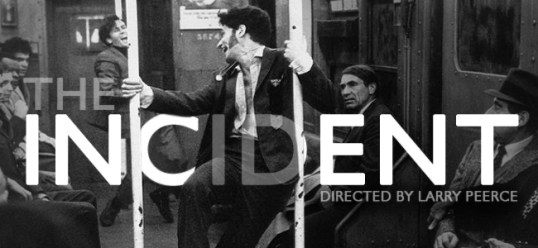
The 1967 film The Incident could just as easily have been called Train of Fools. Much like Ship of Fools, it’s an ensemble piece in which a group of people — all of whom represent different aspect of modern society — find themselves trapped in their chosen mode of transportation and forced to deal with intrusions from the outside world.
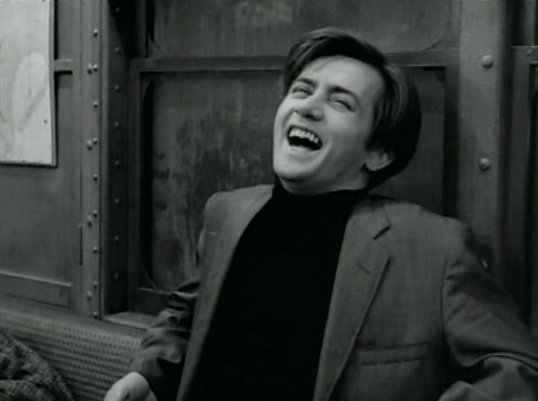
That intrusion comes in the form of two sociopaths who have decided to spend the entire ride tormenting their fellow passengers. The more dominant of the two is Joe (played by Tony Musante, who would later star in Dario Argento’s Bird With The Crystal Plumage), who the film hints might also be a pedophile. His partner is Artie (Martin Sheen), who is less intelligent than Joe but just as viscous. (And yes,even though he does a good job in the role, it is odd to see an intelligent and reportedly very nice actor like Martin Sheen playing a character who is both so evil and so stupid.)
Among the passengers:
Bill (Ed McMahon) and Helen (Diana Van Der Vills) are only on the train because Bill refused to pay the extra money to take a taxi back home. Now, they’re stuck on the train with their young daughter who, in one of the film’s more disturbing scenes, Joe starts to show an interest in.
Teenage Alice (Donna Mills) is on a date with the far more sexually experienced Tony (Victor Arnold). When Joe and Artie start to harass her, her date proves himself to be pretty much useless.
Douglas McCann (Gary Merrill) is a recovering alcoholic who, before Artie and Joe got on the train, was spending most of his time scornfully watching Kenneth (Robert Otis), a gay man who previously attempted to pick Doug up at the train station and who will eventually fall victim to one of Artie’s crueler jokes.
Muriel Purvis (Jan Sterling) resents her meek husband, Harry (Mike Kellin) and see the entire incident as another excuse to cast doubts upon his manhood.
Sam and Bertha Beckerman (played by Jack Gilford and Thelma Ritter) are an elderly Jewish couple who, over the course of a lifetime, have already had to deal with far too many bullies. Sam’s attempt to stand up to Joe and Artie results in both he and his wife being trapped on the train.
Arnold (Brock Peters) and Joan (Ruby Dee) are the only black people on the train. Arnold, at first, enjoys watching the white people fight among each other and even turns down a chance to get off the train because he finds it to be so entertaining. But finally, Joe turns on him as well.
And then there’s the two soldiers, streetwise Phil (Robert Bannard) and his best friend, Felix (Beau Bridges). Felix speaks with a soft Southern accent and has a broken arm.
And finally, there’s the bum. When we first see the bum (Henry Proach) he is asleep. He doesn’t even wake up when Joe and Artie attempt to set him on fire.
One-by-one, Joe and Artie attack and humiliate every single person on the train. The other passengers, for the most part, remain passive. Even when some try to stand up to Joe and Artie, their fellow passengers don’t offer to help. It’s only when one last passenger finally stands up to the two that the rest of them show any reaction at all and even then, it’s not necessarily the reaction that anyone was hoping for.
The Incident, which shows up on TCM occasionally, is a heavy-handed but effective look at what happens when good people choose to do nothing in the face of evil. Joe and Artie can be viewed as stand-ins for any number of distasteful groups or ideologies and both Tony Musante and Martin Sheen are believable as dangerous (if occasionally moronic) petty criminals. For that matter, the entire film is well-acted with the entire cast managing to bring life to characters that, in lesser hands, could have come across as being one-dimensional. The entire film basically takes place in that one subway car but fortunately, the harsh black-and-white cinematography and the continually roaming camera all come together to keep things visually interesting.
The Incident may not be a great film (it’s occasionally bit too stagey and, after watching the first 30 minutes, you’ll be able to guess how the movie is going to end) but it’s still one to keep an eye out for.




 Through the Shattered Lens