Back to School Part II #13: The Last American Virgin (dir by Boaz Davidson)


The_Last_American_Virgin_movie_poster

(SPOILERS BELOW!)

For the past week, I have been doing a chronological review of films about high school, college, and teenagers.  I started things off on Monday by taking a look at Teenage Devil Dolls, a film from the 1950s.  From there, I moved on to the 60s and then the 70s and now, finally, I am now ready to start in on the golden age of teen films — the 1980s!

I started things off by watching The Last American Virgin, a low-budget film from 1982 and oh my God!  Seriously, The Last American Virgin has got to be one of the strangest films that I’ve ever seen.  I can only imagine what teen audiences in 1982 must have thought when they went to see the latest sex comedy and discovered that it was actually one of the darkest and most depressing films ever made.

Actually, The Last American Virgin is two films in one.  The first film is pretty much a typical teen comedy.  Three friends — awkward but sweet Gary (Lawrence Monoson), handsome but shallow Rick (Steve Antin), and funny fat guy Dave (Joe Rubbo) — try to get laid and survive their senior year in high school.  They pick up three girls by pretending to have cocaine.  (They offer them sweet-n-low instead, which leads to a lengthy scene of the girls snorting the artificial sweetner and then saying stuff like, “This is the best Colombian that I’ve ever had.”)  They meet a lonely housewife who had sex with two of them before her husband arrives home.  (As usual, Gary misses out.)  They have sex with a crude hooker and all end up with crabs as a result.  It’s a typically crude teen comedy, distinguished only by the fact that Monoson, Antin, and Rubbo are a lot more believable as teenagers than the usual 25 year-old actors who often starred in these films.  (According to the imdb, Monoson was only 16 when The Last American Virgin first went into production.)

But, right there in the middle of the usual teen movie shenanigans, there’s this other movie taking place.  Gary is in love with Karen (Diane Franklin, who appeared in several teen films in the 80s, including Better Off Dead) but Karen is dating Rick.  When Gary finds out that Karen has lost her virginity to his best friend, he ends up sitting alone in a diner while Just Once (“I did my best … but I guess my best wasn’t good enough…”) plays on the soundtrack.  In fact, that song shows up several times during the movie.  Basically, whenever Gary tries to do anything, we suddenly hear: “I did my best … but I guess my best wasn’t good enough….”

I mean, seriously, poor Gary!  Even the soundtrack is implying that he’s a loser!

Eventually, Karen discovers that she’s pregnant.  Rick refuses to help out and promptly leaves on a ski trip.  Gary and Karen tell their parents but they’re going on the ski trip as well but instead, they go to an empty house that once belonged to Gary’s late grandmother.  Gary points out a huge, old-fashioned radio sitting in a corner and says that Karen can listen to it if she wants.  Karen starts to cry.  Gary starts to cry and swears that he’ll never abandon her.

Karen gets an abortion.  Shots of Karen at the clinic are mixed in with scenes of Gary desperately trying to raise the money to pay for her abortion.  He begs his boss for an advance on his salary.  He pawns his stereo.  All the while, U2’s I Will Follow plays on the soundtrack.

At this point, the film had gotten so serious that I was half-expecting for Gary to come to the clinic to pick up Karen, just to be told that she had died during the procedure.  But no, Karen survives.  They go back to grandma’s house.  Karen thanks Gary for all that he’s done for her.  Gary cries and says that he loves her.  Karen invites Gary to her birthday party.

Gary goes to the birthday party, bringing with him the gift of a ring.  But, as soon as Gary steps into the kitchen, what’s the first thing he sees?

Karen hugging Rick.  Both of them have tears in their eyes.  They look back at Gary.

Gary stumbles out of the party.  He gets in his car and drives away.  We get a close-up of Gary sobbing in the car…

I did my best …. but I guess my best wasn’t good enough…

AND THEN THE MOVIE ENDS!

I mean … MY GOD, HOW DEPRESSING CAN A MOVIE BE!?

And yet, that depressing ending is what sets The Last American Virgin apart.  I mean, it’s not a happy ending but it definitely elevates this low-budget and rather crude movie.  If nothing else, it feels more realistic than having Lawrence Monoson punch out Steve Antin and then live happily ever after.  Sometimes, stories don’t end with love and smiles.  Often times, they end with an awkward teenager sobbing as he drives home.

So, that’s The Last American Virgin.  It’s an odd little movie.  It was also a remake of a film that the same director had previously made in Israel and the film’s mix of low humor and high drama feels more European than American.  This is definitely a film made by an outsider, trying to imagine what American teenagers are like.  It makes for a movie that, though it may appear to be a typical teen sex comedy, is actually something else altogether.

Seriously, this is a weird one.  I’m as surprised as anyone to say that I recommend it.
Horror Film Review: Cat People (dir by Paul Schrader)


Cat_People_1982_movie

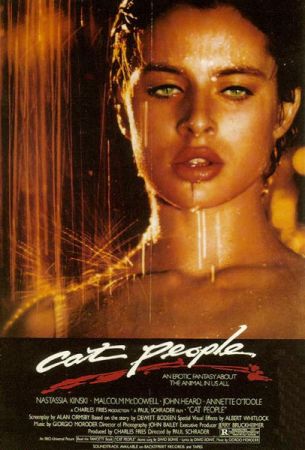
Before I get around to actually reviewing Paul Schrader’s 1982 reimagining of Cat People, I’m going to suggest that you take a few minutes to watch the film’s opening credits.  Say what you will about Schrader’s Cat People, it has a great opening, one that perfectly sets up the rest of the film.

In this version of Cat People, Irena (Natassja Kinski) is a naive young woman (and virgin) who, after the death of her parents, has spent most of her previous life in foster care.  Irena travels to New Orleans, where she reconnects with her older brother, Paul (Malcolm McDowell).  From the minute that Irena meets her brother and his housekeeper (Ruby Dee), it’s obvious that something is off.  When Paul looks at her, he does so with an unsettling intensity.  At night, while Irena sleeps, Paul wanders the dark streets of New Orleans.

One morning, Irena wakes up to discover that Paul is missing.  Having nothing else to do, Irena wanders around New Orleans.  When she visits the zoo, she feels an immediate connection to a caged panther who stares at her with a familiar intensity.  It turns out that the panther was captured the previous night, after he mysteriously appeared in a sleazy motel and mauled a prostitute.

It’s at the zoo that Irena meets zookeeper Oliver Yates (John Heard).  Oliver gets Irena a job working at the zoo gift shop. where Irena is befriended by Oliver’s co-worker, Alice (Annette O’Toole).  One day, Irena witnesses the panther kill another zookeeper before it then escapes from its cage.

That night, Paul suddenly shows up in Irena’s bedroom.  He explains to her that they are a cursed species.  Having sex causes them to turn into panthers and the only way to avoid the curse is through incest.  A terrified Irena flees her brother and soon finds herself living with and falling in love with the increasingly obsessive Oliver, all the while knowing that giving herself to him physically will lead to her transformation.

From the very first second of the film. Schrader’s Cat People is an exercise in pure style.  If the original Cat People was largely distinguished by its restraint, Schrader’s version is all about excess.  Everything that was merely suggested in the original is made explicit in this version.  As tempting as it may be to try, it’s somewhat pointless to try to compare these two versions.  Though they may both be about a woman who turns into a panther when she has sex, they are two very different films.

Schrader’s Cat People walks a very fine line between moodiness and absurdity, which is perhaps why I enjoyed it.  Making great use of both the sultry New Orleans setting and Giorgio Moroder’s atmospheric score, Cat People is compulsively dream-like and enjoyably over-the-top.  Cat People is often described as being an example of a movie that could have only been made in the coked up 80s  and truly, this is one of those films that’s so excessive that it’s becomes fascinating to watch.

(I think that often we are too quick to assume that excess is necessarily a bad thing.  If you can’t be excessive when you’ve got Malcolm McDowell playing an incest-minded cat person in New Orleans, when can you be excessive?)

Schrader’s Cat People may not have much in common with the original version but the film’s best scene is the only one that is a direct recreation of a scene from the original.  In fact, in recreating the scene where Alice is menaced while swimming in a public pool, Schrader actually improves on the original.  Brilliantly performed by both Annette O’Toole and Natassja Kinski (whose cat-like features made her perfect for the role of Irena), it’s the only scene in the film that can truly be called scary.  Starting with a tracking shock that follows Alice as she jogs, the stalking scene is practically a master class in effective horror cinema.  If nothing else, you should see Cat People for that one scene.

And you should also see it for the wonderful soundtrack!  Let’s end this review with David Bowie’s theme song, which you may also remember from Quentin Tarantino’s Inglourious Basterds.


Life is a Beach #3: The Beach Girls (dir by Pat Townsend)


The_Beach_Girls_1982

“You louse!  You hussy!”

“What’s a hussy?”

“Who’s loud?”

— Typical dialogue from The Beach Girls (1982)

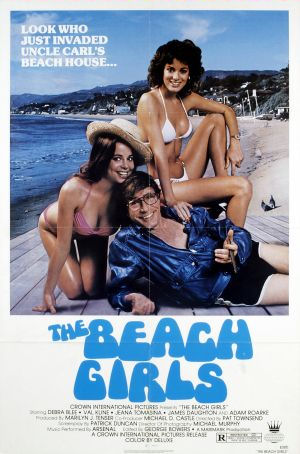
 As you may have guessed from the combination of the film’s title, the film’s poster, and the film’s dialogue, the 1982 comedy The Beach Girls is yet another production from Crown International Pictures.

And if you had any doubts, The Beach Girls quickly erases them by not only featuring the exact same songs that were heard in both The Pom Pom Girls and Malibu Beach but by also reusing a good deal of beach footage that originally appeared in Malibu Beach.  Remember that dog in Malibu Beach that kept stealing everyone’s bikini top?  Apparently, the folks at Crown International really liked that dog because all of his scenes are awkwardly inserted into The Beach Girls.

CIP_Logo

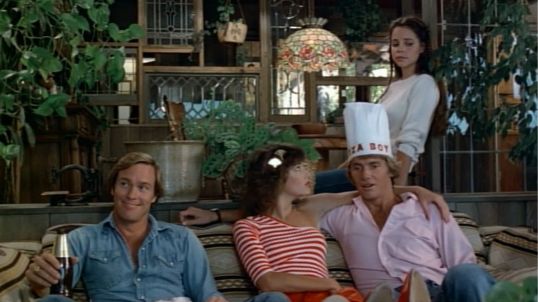
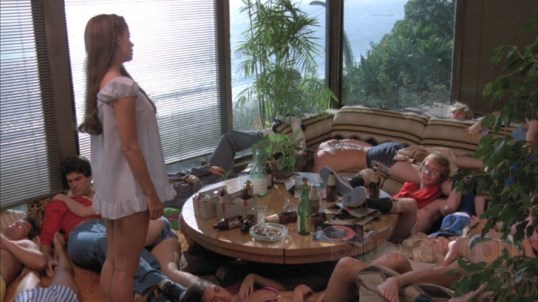
In between all of the Malibu Beach footage, The Beach Girls tells the story of three girls who have a nice beach house for the summer and who proceed to throw a party.  That is literally the plot of the entire film.  Two of the girls — Ginger (Val Kline) and Ducky (Jeana Tomasina) — are up for anything while their best friend, the shy and intellectual Sarah (Debra Blee), desperately needs to relax and have a good time.  Fortunately, there’s a sensitive musician at the party.  His name is Scott and he’s played by James Daughton, who was also in Malibu Beach.  With Scott’s help, Sarah starts to come out of her shell, which largely means that she starts to progressively wear less and less clothes.

Just when it looks like the party might be on the verge of concluding, six garbage bags of weed wash up on the beach.  That comes in handy once all of the uptight authority figures start to show up and demand that the party end.  Fortunately, the super weed inspires everyone to just relax and have fun.  Not even the eventual arrival of the Coast Guard can stop this party…

The Beach Girls

The Beach Girls is pretty much your typical Crown International teen sex comedy.  The main thing that distinguishes it from The Pom Pom Girls and Malibu Beach is that the main characters in The Beach Girls are all female.  And while the three main characters all still required to spend a good deal of the film undressed, this is a rare teen comedy where the guys are just as likely to get naked as the girls and where the girls have as much fun as the guys.  As a result, there’s little of the misogyny that lay underneath the surface of The Pom Pom Girls and, to a lesser extent, Malibu Beach.

Don’t get me wrong.  The Beach Girls, which is currently available Hulu and has also been included in a few Mill Creek box sets, is hardly a great or even a good film.  It’s pretty much a standard sex comedy where both the characters and the jokes are predictably dumb.  But, when taken on its own modest terms, it’s an inoffensive little time capsule.

Plus, the film’s beach house is really nice!  Seriously, that’s one thing that I love about films from the 80s.  Even the low-budget comedies always take place in the nicest houses!

The Beach Girls 2