Wil Hunter (James Maslow) wanted to be a painter in New York but instead, he ended up working for his Dad’s storage unit business with his brother, aspiring filmmaker Orrie (Jesse Pepe). When Wil’s ex-girlfriend, Susan (Lillian Solange Beaudoin), arranges for Wil to have a tent at a local art show, it revives Wil’s dreams of making his living as an artist. While Orrie films a documentary about what’s goes on behind-the-scenes at an art show, Wil gets to know fellow artists like Chief (Robert Wilson Seymone) and Vic (Jason Kypros). He also falls in love with the owner of tent-next-door, Rachel (Ella Lentini).
Art Show Bingo is a sweet movie, a love story with an edge of authenticity. I get the feeling that it was made by people who actually have experience with art fairs and “starving artist” shows because all of the little details feel true, like the customers who try to set their own prices, the kids who don’t often understand that are should be looked at but not touched, and the snooty judges who dislike everything they see. I’ve been to enough amateur art fairs that I immediately recognized a lot of the situations and the characters in Art Show Bingo. (After seeing this movie, I’m definitely going to be nicer the next time I go to one.) Personally, I was not really that impressed by Wil’s paintings but art is often in the eye of beholder and his work did get better as the movie went on. Orrie got on my nerves but I liked both Wil and Rachel and I really wanted to see them get together.
I liked Art Show Bingo a lot more than I thought I would. It wasn’t perfect but it still left me smiling.
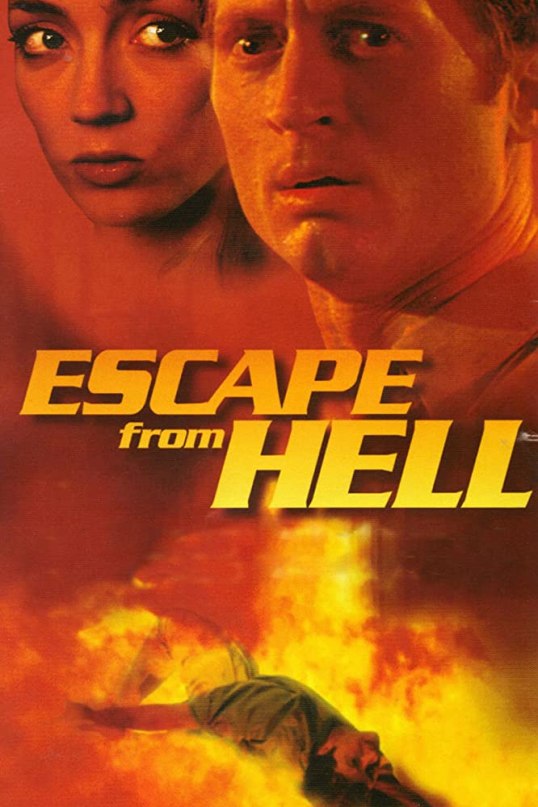
The 2000 film, Escape From Hell, tells the story of two doctors.
Dr. Marissa Holloway (Emily Jo Tisdale) believes that there is a Heaven and that there is a Hell and that, at the end of your life, you go to one of them. The film lets us know, early on, that she’s right by letting us into the mind of a good but irreligious family man who is on the verge of death. At first, the man sees himself heading into a shining light but then, suddenly, he’s plunging into flames! That’s right. The good man who loved his family and helped people out and who never did anything wrong to anyone still went straight to Hell.
Dr. Eric Robinson (Daniel Kruse) doesn’t believe that there’s an afterlife. He believes that everyone who says that they’ve seen either a light or a glimpse of Hell was suffering from a hallucination. He’s hostile to Marissa’s beliefs. Could it have something to do with his difficult relationship with his estranged father? Who knows?
Together, Dr. Holloway and Dr. Robinson solves crimes!
No, actually, they don’t. Instead, they star in a low-budget, evangelically-themed remake of Flatliners. After his father dies, Dr. Robinson is more determined than ever to prove that there’s no afterlife so he decides that the smartest thing to do would be to die for a few minutes and then be brought back to life by another doctor. Like I said, it’s basically Flatliners all over again. The main difference, of course, is that Flatliners imagined a New Agey afterlife with no God while Escape From Hell leaves little doubt that there’s a Heaven and a Hell and just about everyone’s going to the second place.
Dr. Robinson does originally go to Heaven and it’s a nice-looking meadow. (Apparently, he just gets to skip Purgatory so lucky him.) However, the doctor is soon informed that he doesn’t belong in Heaven so bang! It’s down to Hell that he goes. Hell is essentially a rocky place with constantly burning fires. The whole place is tinted red and looks like something you might expect to find in an old video game. Unfortunately, Dr. Robinson doesn’t get to talk to the five people you meet in Heaven but he does get to talk to a handful of people in Hell, the majority of whom are confused as to why they’re down there but who also realize that they somehow massively screwed up and will never get a chance to escape. One of the people that Robinson meets turns out to be a demon. There’s a lot of really cheap CGI that looks kind of silly but, at the same time, still possesses a certain low-rent charm.
While Dr. Robinson is learning about the afterlife, his colleagues are trying to bring him back to life. If they don’t bring him back quickly enough, Robinson, much like Franklin Delano Roosevelt will be stuck in Hell in forever!
(I should admit that we don’t actually see FDR in Hell. I just assume he’s down there.)
If you haven’t picked up on it by now, I have a weakness for achingly sincere films that feature primitive CGI. It’s easy to make fun of movies like Escape from Hell but I tend to view them as being examples of outsider art. Yes, it’s a flawed film that was apparently made by people who weren’t really sure what they were doing but that’s actually the film’s charm. The bad acting, the melodramatic dialogue, the cheap CGI, the extremely literal definitions of Hell and Heaven, and the final message that almost everyone on the planet is destined to suffer eternal torment; all of it contributes to make a film unlike almost any other (except, of course, for the original Flatliners) It’s silly, preachy, and entertaining in its own bizarre way. It’s the cinematic equivalent of the school prayer advocate who says that children who don’t want to pray can, “Simpy lower their heads and think about how they’ve got it all figured out.” It may not be good but it’s always watchable in its own twisted way.
The 2016 film, Forty Nights, opens with John the Baptist (Terry Jernigan) baptizing a surprisingly mellow Jesus (DJ Perry) while John’s followers watch. After Jesus is baptized, the voice of God echoes through the land and, once again, the thing that struck me was just how laid back God sounded. It’s rare that we ever see either Jesus or his Father portrayed as being so calm and easy-going and I have to say that I found it to be a somewhat nice change of pace from the more intense approach the most actors tend to take. Of course, I don’t know if that was intentional or just a happy accident. It was probably the latter.
After getting baptized, Jesus spent 40 days and 40 nights, fasting in the Judaen desert and proving his own faith. During that time, Jesus was tempted three times by the Devil, who appeared in various guises and tried to convince Jesus to not only break his fast but to also wantonly display his power. The Devil tempted Jesus to turn stones into bread. He tempted Jesus to jump from the pinnacle of a temple so that the angels might break his fall. Finally, he offered to give Jesus all of the kingdoms of the world in return for Jesus worshiping him. Not surprisingly, this confrontation between Satan and Jesus has proven popular with both writers and filmmakers. For instance, The Greatest Story Ever Told featured Donald Pleasence as a smug Satan. The more recent Last Days In The Desert featured Ewan McGregor playing both Jesus and Satan.
Forty Nights takes a no-frills approach to the 40 days and nights that Jesus spent in the wilderness, alternating between scenes of Jesus being tempted and flashbacks to Jesus’s youth. Sometimes, the low-key approach is effective and sometimes, you find yourself longing for the more over-the-top approach that other films brought to the same material. For a battle between good-and-evil, there’s not really much of a battle to be found in this film. Over and over again, Satan appears, taunts Jesus, and then Jesus tells him to go away. While that may be faithful to the narrative, it doesn’t quite work in the film because, at no point, does there seem to be any risk of Jesus giving into Satan’s temptations. Because Jesus, in this film, never seems to be truly tempted, there’s less triumph to him refusing to give in. Instead of being about Jesus showing strength and faith, Forty Nights often seems like it’s more about Satan’s inability to take the hint and go away. The film is at its best when Satan and Jesus are debating each other atop of the temple and oddly enough, the effectiveness of that scene is largely due to how badly the film’s green screen effects are integrated into the film. It gives the entire scene an otherworldly, almost dream-like feel.
Anyway, Forty Nights is a film that will probably be best appreciated by those who already agree with the film’s viewpoint. This is not the faith-based film that’s going to convert unbelievers and ultimately, it fails to maintain any sort of real narrative momentum. Still, the temptation in the wilderness is still an effective and intriguing narrative and one to which filmmakers will probably continue to return.


 Through the Shattered Lens