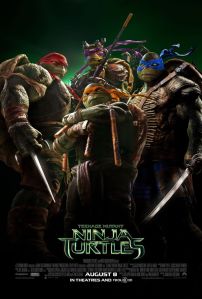
Movie Review: Teenage Mutant Ninja Turtles {2014} (dir. by Jonathan Liebesman)


teenage_mutant_ninja_turtles_ver15_xxlg-720x1066Before I start, I’d like everyone in advance to understand I’m aware this is a kid’s movie. So, when I complain, feel free to throw it out there like the hula hoop in The Hudsucker Proxy (“You know…for kids”). I may be nitpicking about this movie, looking at it with eyes that are older than the intended audience. It may also be somewhat spoiler filled, so a little warning beforehand.

When it comes to Kevin Eastman and Peter Laird’s Teenage Mutant Ninja Turtles, I grew up on the 90’s Era cartoon. Truth be told, though, the Turtles started way back in the early 80s and the new movie may be closer to that in some ways. I can’t really say for sure due to my unfamiliarity with the comics.

I can say that while Jonathan Liebesman’s Teenage Mutant Ninja Turtles may not be my Ninja Turtles, but they may end up being someone’s Ninja Turtles. That’s really the kindest thing I can say about it. A number of kids in my audience seemed to really enjoy it, though the adults who came for the nostalgia factor (myself included) looked a little disappointed. It’s not a horrid movie. I had moments – particularly the snow sequence – that I truly enjoyed, but at best this Turtles feels like an action demo reel sliced together.

The beginning of the movie explains the Turtles, the Foot Clan, and The Shredder in the space of five minutes. This is helped along with some drawings down by Kevin Eastman himself. Everyone in the city is aware of the Foot Clan, and reporter April O’Neil (Megan Fox) is trying to crack her first big story with anything she can find about the Ninja groups criminal acts. This leads her to discovering the Turtles, Splinter and together they try to stop the Shredder’s master plan – one that involves poisoning all of New York City with a deadly mist from the top of a tower. This involves the Turtles because their blood still contains remnants of the Mutagen used to change them, which assists in their amazing healing factors. The Mutagen also acts as an antidote to the poison. It’s almost the same premise used in The Amazing Spider-Man and Batman Begins. Would it hurt to have a little creativity? Didn’t anyone in the writing department say “wait, we’ve seen this trend in movies about as much as we’ve seen the ‘Captured-Villian-taken-to-Hero’s-Base-who-Springs-Trap-that-Disables-Hero’s-Ability-to-do-Good’. Maybe we should try something different here?” Nope. Let’s simply take a tired plot line and do it again. Teenage Mutant Ninja Turtles deserves to be the final film that uses the Toxic Mist angle for a while.

A moment of silence, if you will:

R.I.P. “Toxic Mist, a.k.a. Mutagen Mist, a.k.a. Scarecrow Dust” – Born 2005 (Batman Begins) – Died 2014 (Teenage Mutant Ninja Turtles)

Here’s what I had a problem with:

Exposition by way of Explanation –
The rule of “Show, don’t Tell” states that it’s better to reveal information on screen – to the characters and the audience – than it would be to have someone just tell you what’s up. Most of Turtles moves in this fashion. When April witnesses a crime thwarted by Raphael, she runs to her boss, her room mate and pieces it all together, telling everyone exactly what we just saw – that a vigilante is fighting back against the Foot Clan. The argument could be made that the explanation is done to help kids understand what’s going on, but the scene before that already covered it.

Plot holes within plot holes-
Turtles also suffers from giving the audience information that the writers completely ignore later on. At one point, one of the members is wounded and the remaining Turtles have to get Mutagen to save them. Wait. The story already mentioned that they all had Mutagen in them – the “Mutant” part that accelerates their healing – so why would you need to administer more when what they have can already save them? It’s face palm moments like these that show how much focus was done on making the movie look good, compared to writing a solid plot. Some things don’t make sense here.

What did work:

Brian Tyler’s score for the film may be the best element of the entire movie. It may sound similar to Thor: The Dark World in some ways, but it’s a good theme for the heroes overall. I’ve had some of it on repeat on Spotify, truth be told.

The action is actually pretty good, though it takes some time to get there. Some of the fight scenes suffer from the Bourne Identity and Batman Begins blur effects, but overall, it works out. Again, I wouldn’t mind seeing that snow sequence again if I didn’t have to sit through the entire film. From that point forward, the action picks up. Each turtle (and Splinter) has their own moment in the spotlight and when it happens, it can cause a smile or two, however brief that may be. The Turtles themselves are huge and highly mobile, which make the fights look like Power Rangers battles before the enemy grows to a huge size. There aren’t as many Bay like explosions in this as you’d find in Transformers, but you can feel his influence on this. That could be considered a problem when you compare Turtles with Battle: L.A. (which I enjoyed).

The In Between:

The casting on this movie is a mixed bag. Megan Fox isn’t a bad April O’Neil by any means (she’s good), but April herself in this version isn’t the sharpest tool in the shed. By that, I mean she is as abbreviated in this as Lois Lane was in Man of Steel. In an age where we’re trying to see more well rounded female leads on screen, O’Neil becomes just another Lara Croft / Carol Marcus / Sydney Bristow with issues circulating around her father. Not saying it’s unlikely, but they could have found something else to work with as background. Again, it’s a kid’s movie. Maybe it doesn’t need to be that complex. Will Arnett felt like a sidekick in this, and I found it a little difficult to not hear his Lego Batman when he spoke, but that’s just me. The Turtles themselves could be voiced by anyone, really. I didn’t feel too much of a difference between them, save that they played to their archetypes. Raphael always seemed angry, Mike is playful and so on.

Overall, Teenage Mutant Ninja Turtles is a kid’s film and maybe only young kids will really enjoy it. There’s action for both old and new fans of the Heroes in a Halfshell, but it’s wrapped up in stories we’ve heard before. This probably one you’ll want to wait for video, at best.

VGM Entry 46: Konami in ’91


VGM Entry 46: Konami in ’91
(Thanks to Tish at FFShrine for the banner)

It was to be expected that Nobuo Uematsu and Koji Kondo would make magic on the Super Nintendo. Plenty of other composers did as well at an early stage. Konami in particular launched a number of impressive titles in 1991, and I think I’ll take a moment to showcase three of them.

http://www.youtube.com/watch?v=UjuSIUKdnjA

Super Castlevania IV was composed by Masanori Adachi and Taro Kudo, both of whom remain rather obscure figures in the game music industry. There was actually a false rumor going around that Masanori Adachi died during the 1994 Sega Mega-CD port of Snatcher. In a sort of ‘meet the staff’ easter egg (in which Adachi also participated), Kudo jokingly wrote “Rest in peace, Mr. Adachi!” Credits to his name are so few that this has been taken literally by many, but it would make his future compositions quite a miraculous feat.

Super Castlevania IV marks a major reconception of the series’ sound, which will not be completely apparent in these opening tracks. Skip ahead a bit, to “The Chandeliers” (4:29) and “Secret Room” (6:35) for instance, and you will get a much better feel for the degree of diversity introduced in Adachi and Kudo’s new vision. At times the game embraces its classical roots to the fullest. They take full advantage of the SNES’s capacity for authentic piano, organ, and string sounds to cut out all the rock filler, when the situation calls for it. The album still has plenty of contemporary drumming, but it doesn’t feel quite as rock driven as the NES games, much to its benefit in my opinion. Rock would still infuse plenty of new compositions, but the SNES allowed a lot more room for diversity. I think Adachi and Kudo accomplish the most when they go for the straight classical sound, as on “The Chandeliers”, but they make a commendable effort to explore a large variety of styles appropriate for different elements of gameplay.

The first three tracks in this mix are of course the classic series staples “Vampire Killer” (1:05), “Bloody Tears” (0:00), and “Beginning” (1:50), from Castlevanias I, II, and III respectively. It’s certainly nice to hear the old familiar songs in an improved medium, and they did a fairly good job with them (though I do think this version of “Bloody Tears” could use some work–they play it too safe with the main melody and drum track for the addition of the flute and heavier percussion at the end to accomplish its desired effect), but what I think is more significant is that these three songs don’t stand out as anything really above and beyond the rest of the score. On the Nintendo they were exceptional, and familiarity is definitely a plus, but I honestly like a lot of Adachi and Kudo’s original compositions just as much.

http://www.youtube.com/watch?v=8HkyAiV4Kbc

If you’ve been keeping up with my posts, you should be thoroughly familiar with Ganbare Goemon by now. If you haven’t been, you probably don’t know what I’m talking about. Six years and six sequels after the launch of the series, a Ganbare Goemon game finally made it to North America. The port, retitled The Legend of the Mystical Ninja, didn’t launch until 1992, but the Japanese Ganbare Goemon: Yukihime Kyuushutsu Emaki from which it derives came out in 1991. Though well in keeping with the traditions of the series, The Legend of the Mystical Ninja was something of a musical novelty for western gamers.

Its composers were somewhat obscure. I could find very little on either Kazuhiko Uehara or Harumi Ueko, and though Ueko continues to appear in soundtrack credits up to the present day (mostly under the peculiar alias Jimmy Weckl), Uehara seems to all but vanish after a brief career in the early 1990s. It’s a shame, if the two in collaboration were capable of producing this kind of quality. But Uehara may also be a Yoshihiro Sakaguchi type–a sound programmer confusingly credited with a few other artists’ original compositions. I’ve seen him specified as the programmer in certain liner notes, and it would also explain the occasional credit he receives for what was I believe Mutsuhiko Izumi’s Turtles in Time score. But again, I don’t know just how extensively sound programmers were involved in composition. So this might be the work of Harumi Ueko, or he and Uehara might both have played fairly equal roles.

The Legend of the Mystical Ninja presents an oriental score, as you can tell, and I think it does a delightful job of it. If it is reasonable to expect more out of a SNES title than improvements on the same old NES sounds, then perhaps a little more situational diversity was in order. The light-hearted and adventurous style can only capture so many moods. But what it does well–create a sense of light-hearted adventure–it does exceptionally well. It’s the hoaky town and shop themes that prevent The Legend of the Mystical Ninja from being a consistently excellent soundtrack. The music written for the field of combat is all spectacular.

http://www.youtube.com/watch?v=8-RTENXlwfw

0:36. That is where you’ll want to skip to if you can’t handle some classic 90s cheese. A year before it became known to most of us as Teenage Mutant Ninja Turtles IV, Konami released this game to the arcade under its SNES port’s subtitle, Turtles in Time. I was pretty shocked to find this, actually. Konami’s original Teenage Mutant Ninja Turtles (that is, confusingly, Teenage Mutant Ninja Turtles II: The Arcade Game on the NES) and X-Men were by far my two favorite arcade games as a kid. I had no idea Turtles in Time even existed as such. Anyway, Mutsuhiko Izumi did the hard-rocking soundtrack. The music is largely the same in both games, and while nostalgia leads me to favor the SNES version, the arcade original is probably just a slight bit better–but only slightly, and this is debatable.

http://www.youtube.com/watch?v=SCLt8NcDWaA

For instance, if you skip to 3:38 in the arcade mix and 2:43 in the SNES version–“Bury My Shell At Wounded Knee” if memory serves me–you’ll find a major disparity between the drum tracks. Turtles in Times‘s percussion is essentially indistinguishable from a real drum set. Turtles IV can’t compete there, but it does its best to compensate with some pretty wild sound effects and a really bizzare distorted bass. These features throughout the game grant the SNES port a unique and immediately identifiable sound all of its own. In some cases this paid off to such an extent that the port sounds slightly better than the original. Such is, I think, the case for the Super Shredder fight music.

I am lead to believe that Kazuhiko Uehara or Harumi Ueko, the same names associated with The Legend of the Mystical Ninja, were responsible for Turtles in Time‘s SNES port, and if so 1991-1992 was a pretty successful period for the both of them. Turtles IV is an outstanding and fairly faithful adaptation, recreating the original sound where technology allows and inventively maintaining the spirit of the original where it does not.

I can’t say I’ve heard too many instances, at a time when port soundtracks were necessarily different, of an original game soundtrack and a port both being equally exceptional. It worked out this time, compliments of Mutsuhiko Izumi, Kazuhiko Uehara, and Harumi Ueko.

….

Oh yeah, that brief nightmare at the start of the arcade version sampler? That was from the Turtles’ 1990 “Coming Out of Their Shells” tour. What

the fuck?