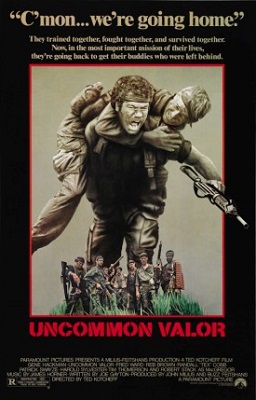
Uncommon Valor (1983, directed by Ted Kotcheff)


Retired Marine Colonel Jason Rhodes (Gene Hackman) and oilman Harry MacGregor (Robert Stack) share a tragic bonf.  Both of them have sons that served in Vietnam and are listed as being MIA.  Believing that their sons are still being secretly held in a POW camp in Loas, Rhodes and MacGregor put together a team to sneak into Southeast Asia and rescue them.

With MacGregor supplying the money and Rhodes leading the mission, the team includes Blaster (Red Brown), Wilkes (Fred Ward), Sailor (Randall “Tex” Cobb), and Charts (Tim Thomerson), all of whom served with Rhodes’s son.  Also joining in his helicopter pilot Curtis Johnson (Harold Sylvester) and former Marine Kevin Scott (Patrick Swayze), whose father was also listed as being MIA in Vietnam.  After a rough start, the group comes together and head into Laos to bring the prisoners home!

Uncommon Valor is one of the many movies released in the 80s in which Vietnam vets returned to Asia and rescued those who were left behind.  In the 80s, there was a very strong belief amongst many Americans that soldiers were still being held prisoner in Vietnam, Cambodia, and Laos and Hollywood was quick to take advantage of it.  The box office success of Uncommon Valor set the stage for films like Rambo and Missing In Action, film in which America got the victory that it had been denied in real life.

What set Uncommon Valor apart from the films that followed was the cast.  Not surprisingly, Gene Hackman brings a lot more feeling and nuance to his performance as the obsesses Col. Rhodes than Sylvester Stallone and Chuck Norris brought to their trips to Vietnam.  The film surrounds Hackman with a quirky supporting cast, all of whom represent different feelings about and reactions to the war in Vietnam.  Fred Ward’s character suffers from PTSD.  Randall “Tex” Cobb, not surprisingly, is a wild man.  Patrick Swayze’s character is trying to make the father he’ll never know proud.  Robert Stack and Gene Hackman represent the older generation, still trying to come to terms with everything that was lost in Vietnam and still mourning their sons.  The raid on the POW camp is exciting but it doesn’t feature the type of superhuman action that’s present in other POW-rescue films.  Col. Rhodes and his soldiers are ordinary men.  Not all of them survive and not all of them get what they want.

Uncommon Valor started out as a screenplay from Wings Hauser, though he’s not present in the cast of the final film and he was only given a “story” credit.  John Milius served as producer. Director Ted Kotcheff is best-known for First Blood, another action film about America’s struggle to come to terms with the Vietnam War.

A Movie A Day #305: Go Tell The Spartans (1978, directed by Ted Post)


One of the best films ever made about Vietnam is also one of the least known.

Go Tell The Spartans takes place in 1964, during the early days of the Vietnam War.  Though the Americans at home may not know just how hopeless the situation is in South Vietnam, Major Barker (Burt Lancaster, in one of his best performances) does.  Barker is a career military man.  He served in World War II and Korea and now he’s ending his career in Vietnam, taking orders from younger superiors who have no idea what they are talking about.  Barker has been ordered to occupy a deserted village, Muc Wa.  Barker knows that occupying Muc Wa will not make any difference but he is in the army and he follows orders.

Barker sends a small group to Muc Wa.  Led by the incompetent Lt. Hamilton (Joe Unger), the group also includes a drug-addicted medic (Dennis Howard), a sadistic South Vietnamese interrogator (Evan C. Kim) who claims that every civilian that the men meet is actually VC, a sergeant (Jonathan Goldsmith) who is so burned out that he would rather commit suicide than take command, and Cpl. Courcey (Craig Wasson).  Courcey is a college-educated idealist, who joined the army to do the right thing and is now about to discover how complicated that can be in South Vietnam.  At Muc Wa, the soldiers find a cemetery containing the graves of French soldiers who died defending the hamlet during the First Indochina War.  The inscription as the cemetery reads, “Go tell the Spartans, stranger passing by, that here, obedient to their laws, we lie.”  

Because the film strives for realism over easy drama, Go Tell The Spartans has never gotten the same attention as some other Vietnam films.  Unlike The Deer Hunter, Platoon, Coming Home, and Born on the 4th of July, Go Tell The Spartans received no Oscar nominations.  It is still a brilliantly acted and powerful anti-war (but never anti-soldier) film.  It starts out as deceptively low-key but the tension quickly builds as the soldier arrive at Muc Wa and discover that their orders are both futile and impossible to carry out.  Vastly outnumbered, the Americans also find themselves dealing with a land and a culture that is so unlike their own that they are often not even sure who they are fighting.  Military discipline, as represented by Lt. Hamilton, is no match for the guerilla tactics of the VC.  By the film’s end, Vietnam is revealed to be a war that not even Burt Lancaster can win.

Lisa Cleans Out Her DVR: Homer and Eddie (dir by Andrei Konchalovsky)


(Lisa is currently in the process of cleaning out her DVR.  It’s taking her such a long time that she’s running out of cutesy ways to talk about how long it’s taking.  She recorded this 1989 comedy off of Starz on May 10th.)

This is another strange one.

Homer and Eddie opens with Homer (James Belushi) standing on the corner of an isolated stretch of desert road.  He is hitchhiking.  When a car finally stops to pick him up, Homer is so excited!  He gets in the back seat, gives the two men in the front seat a really wide smile, and innocently asks them how they’re doing.

One of the men (played by director John Waters) holds up a gun and demands all of Homer’s money.  After Homer hands the money over, he is kicked out of the car.  As the car drives away, Homer pulls a few dollars out of his sock and loudly yells that he fooled them and that they didn’t get all of his money.

The car abruptly stops and, going in reverse, pulls back up to Homer.  Homer gives up his money and the car speeds off.

In short, Homer probably shouldn’t be hitchhiking on his own.  Homer, you see, was hit in the head by a baseball when he was younger.  He has the mind and the innocent outlook of a child.  He is cheerful, he is religious, and he is totally unprepared to deal with real world.

Fortunately, Homer won’t be alone for too long.  Homer comes across an apparently deserted car and, without money or a place to stay, he decides to use the car as shelter.  However, it turns out that the car isn’t as abandoned as it looks!  No, the car is being used by Eddie (Whoopi Goldberg).  Eddie stole the car when she escaped from a mental institution.  Why was Eddie in the mental institution?  She’s a paranoid schizophrenic and she occasionally kills people.  Eddie and Homer are soon taking a very strange road trip, heading up north so that Homer can see his dying father.

It’s a very disjointed film, one that switches tone from scene to scene.  The two stars seem to be acting in totally different movies.  Belushi gives a very broad performance, one that often crosses the line into pure goofiness.  Eddie, meanwhile, is continually and constantly full of rage.  You never know when she’s going to snap and kill someone.  I spent a good deal of the movie waiting for her to kill Homer.  Maybe that was the point but it’s still hard to laugh at scenes of Homer and Eddie waving at a school bus full of cheerleaders when you’re also waiting for Whoopi Goldberg to beat and dismember Jim Belushi.

Homer and Eddie can  summed up by one lengthy sequence.  Eddie takes Homer to a brothel so that he can lose his virginity.  While Homer is dancing around in his underwear, Eddie is at a convenience store, shooting the clerk (played by Pruitt Taylor Vince).  The clerk, who was perfectly nice to Eddie before getting shot, looks at his wound and feebly says, “Why did you do that?” before dying.

It’s a weird little movie.  Usually, I love weird moves but this one is too much of a mess for even me.  As I watched it, I couldn’t help but think of how much more interesting the movie would be if it was the child-like Homer killing people and schizophrenic Eddie trying to keep him calm.  On a positive note, this was decades before Whoopi Goldberg gave up her edginess to co-host The View and she gives shockingly good performance.  When Eddie loses control, she’s actually frightening.  But, unfortunately, the film itself just doesn’t work.