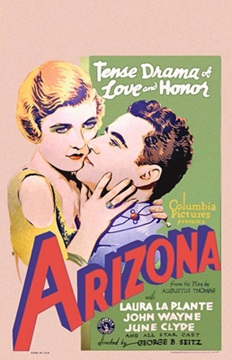
Arizona (1931, directed by George B. Seitz)


In one of his earliest starring roles, John Wayne plays Lt. Bob Denton, a West Point football star who gets assigned to a post in Arizona where he’ll be under the command of his mentor, Colonel Frank Bonham (Forrest Stanley).  Bonham is married to Evelyn (Laura La Plante), who is Bob’s former girlfriend and who only married Bonham after Denton told her that he didn’t even intend to marry anyone.  In Arizona, Denton meets Bonnie (June Clyde), who is the younger sister of Evelyn.  Bonnie and Denton fall for each other so the jealous Evelyn rips her dress and accuses Denton of trying to force himself on her.  Bonham is ready to drum Denton out of the service but then Evelyn learns that Denton and Bonnie are secretly married and destroying Denton’s life will also mean destroying Bonnie’s happiness.

Arizona is a simplistic melodrama and probably one that wouldn’t be made today.  Denton is undeniably a cad, telling Evelyn that he didn’t want to make a commitment to her after dating her for two years and then turning right around and deciding to pursue Evelyn’s sister.  But Evelyn’s reaction goes overboard.  She marries an older man just to get back at Denton (even though Denton didn’t want to marry her so why would he care?) and then she accuses Denton of trying to force himself on her.  Evelyn needs to move on and Bonham needs to get a divorce.  Instead, Evelyn tries to destroy one man’s life and Col. Bonham is very understanding.  What’s a false accusation of rape between friends?

This was one of John Wayne’s first starring roles in a major studio production.  The film was produced by Columbia, where Harry Cohn did seven films with Wayne before exiling him back to Poverty Row, where Wayne did B-pictures before John Ford finally cast him in Stagecoach.  Wayne seems awkward and uncomfortable in much of Arizona.  Top-billed Laura La Plante does a better job as Evelyn but the way the film ultimately shrugs off her false accusations just doesn’t feel right.

Arizona is a misfire in the Duke’s early filmography.
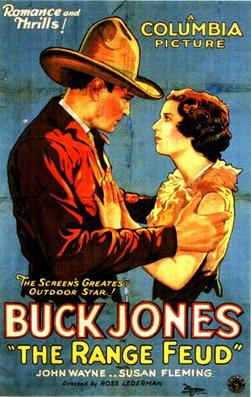
The Range Feud (1931, directed by D. Ross Lederman)


In a frontier town, two ranching families are at war.  The Turners claim that the Waltons have been stealing and reselling their cattle.  Even an attempt to hold a peace meeting at the local church just leads to more fighting.  Complicating things is that young Clint Turner (John Wayne) is in love with Judy Walton (Susan Fleming).  When someone shoots John Walton (Edward LeSaint) through the window of his office, Clint is the number one suspect.  Not helping is that Clint had an empty round in his gun.  Clint says that he fired at a coyote but he missed.  Everyone else in town says that its time to hang Clint without a trial.

Only Sheriff Buck Gordon (Buck Jones) stands between the mob and Clint.  Buck was raised by the Turner family and considers Clint to be his brother.  However, Buck still knows that Clint might be guilty but there’s no way that Buck is going to allow mob justice to rule his town!

The Range Feud was one of the many B-programmers that were released in the 30s.  Running less than 60 minutes, it is a briskly paced western that features a theme that was present in many westerns, the battle between mob justice and the law.  The townspeople who are eager to hang Clint without a trial represent the old ways of doing things while Buck represents the new way, in which everyone is innocent until proven guilty and entitled to a fair trial.

Buck Jones was one of the best of the early western heroes.  He played tough-but-fair men who could definitely handle themselves in a fight but who preferred to try to reason their way out of conflict.  Buck Jones served in a Calvary unit, worked as a cowboy, and started in the film business as a stunt man.  He had an authenticity that set him apart from others who merely pretended to be cowboys.  That authenticity serves him well in The Range Feud.  He may feel bad about having to arrest his stepbrother but any character played by Buck Jones can be guaranteed to follow the law.  In real life, Buck Jones died a hero.  In 1942, Buck Jones was at the Cocoanut Grove nightclub in Boston when a fire broke out.  Though Jones initially was able to get out of the nightclub, he subsequently reentered to help other people get out.  Severely burned, he died of his injuries two days later.

Of course, the main reason that people will track down this film is for a chance to see the young John Wayne playing a key  supporting role as Clint Turner.  It’s always a little bit strange to see Wayne playing a young man.  He’s one of those actors who you always assume was always in his 40s.  Wayne is likable as the free-spirited Clint, though it is again strange to see Wayne playing someone other than an authority figure.  For once, it’s Wayne who ends up in jail and who is dependent on someone else to save him.

The Range Feud is an entertaining and fast-moving western.  Fans of the genre and of Buck Jones and John Wayne will appreciate it.

Goats and Nuts and MILLION DOLLAR LEGS (Paramount 1932)


gary loggins's avatarcracked rear viewer

Hail, hail Klopstokia! MILLION DOLLAR LEGS is  total  movie anarchy, a throwback to the halcyon days of Mack Sennett. It’s a comedy cornucopia filled with sight gags and verbal nonsense, led by legendary W.C. Fields as president of the mythical country of Klopstokia, about to default on its loans until itinerant brush salesman Jack Oakie comes up with a plan to enter the hale and hearty Klopstokians in the 1932 Olympics and win the huge cash prize being put up by his employer!

Klopstokia is noted for “Goats & Nuts”, their chief exports, imports, and inhabitants! All political disputes are settled by arm wrestling, and President Fields is the strongest of all, though he’s constantly being challenged by his Secretary of the Treasury Hugh Herbert. Presidential daughter Angela (Susan Fleming, future wife of Harpo Marx) and brush salesman Migg Tweeny (Oakie) “meet cute” and immediately fall in love. When asking…

View original post 392 more words