As some of our regular readers undoubtedly know, I am involved in a few weekly watch parties. On Twitter, I host #FridayNightFlix every Friday and I co-host #ScarySocial on Saturday. On Mastodon, I am one of the five hosts of #MondayActionMovie! Every week, we get together. We watch a movie. We tweet our way through it.
Tonight, at 10 pm et, I will be hosting #FridayNightFlix! The movie? 1975’s Mitchell, starring the great Joe Don Baker!
If you want to join us this Friday, just hop onto twitter, start the movie at 10 pm et, and use the #FridayNightFlix hashtag! I’ll be there tweeting and I imagine some other members of the TSL Crew will be there as well. It’s a friendly group and welcoming of newcomers so don’t be shy.
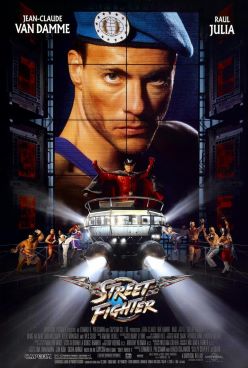
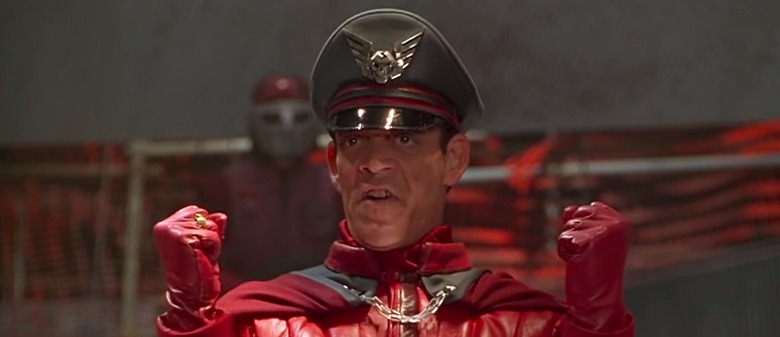
Originally, it was supposed to stand for Mike but my theory is that it stands for Marvelous because how else can you describe Raul Julia’s performance as the villain of StreetFighter? Julia was dying of stomach cancer when he played Bison, a condition reflected by his gaunt appearance. But Julia still obviously threw himself into every scene, delivering every melodramatic line as if it was the most important piece of dialogue that he had ever been trusted with delivering. As a film, Street Fighter is an overedited mess that features one of Jean-Claude Van Damme’s worst performances. Raul Julia saves it, though. He gets some of the worst lines and transforms them into the best lines through sheer determination. That man could have read the phone book and made it interesting.
Jean-Claude Van Damme is Col. Guile in this early video game adaptation. This isn’t one of Van Damme’s better performances. He doesn’t really play the Guile from the game. Instead, he’s just Van Damme with a blue beret and an American flag on his bicep. Far better are Damian Chapa as Ken and Bryon Mann as Ryu, even though neither gets to do as much as a fan of the game would want them to. Ming-Na Wen is a promising Chun Li but, instead of focusing on her fighting skill, the movie gets bogged down in trying to set her up for a sequel that would never come. Are you a fan of Cammy? Don’t get excited because all Kylie Minogue does is ask Guile if he’s okay. I did like Wes Studi as Sagat and Gregg Rainwater and Peter Tuiasosopo as T. Hawk and Honda but it still feels like only Raul Julia gives a performance that can compete with the video game version of his character.
There were four editors credited for StreetFighter and maybe that explains why the fights are a mess and the plot is impossible to follow. It’s a video game adaptation and I don’t demand much but I would like to know who is winning each fight. The film’s visual scheme, meant to duplicate the look of the game, showed some promise but the editing gave the movie a frantic feel that made it difficult to really appreciate the production design.
There’s never really been a good StreetFighter film but I still think it could happen with the right cast and crew. If MortalKombat could (eventually) be turned into a decent movie, why not StreetFighter? I still don’t think anyone will ever top Raul Julia as M. Bison, though. Raul Julia made you believe in Pax Bisonica!
“And peace will reign and all humanity will bow to me in humble gratitude.” — M. Bison
As some of our regular readers undoubtedly know, I am involved in a few weekly watch parties. On Twitter, I host #FridayNightFlix every Friday and I co-host #ScarySocial on Saturday. On Mastodon, I am one of the five hosts of #MondayActionMovie! Every week, we get together. We watch a movie. We tweet our way through it.
Tonight, at 10 pm et, I will be hosting #FridayNightFlix! The movie? 1995’s StreetFighter, with Jean-Claude Van Damme and friends!
If you want to join us this Friday, just hop onto twitter, start the movie at 10 pm et, and use the #FridayNightFlix hashtag! I’ll be there tweeting and I imagine some other members of the TSL Crew will be there as well. It’s a friendly group and welcoming of newcomers so don’t be shy.
VGM Entry 59: Street Fighter II and SNES domination
(Thanks to Tish at FFShrine for the banner)
An enormous disparity had emerged between the Super Nintendo and competing platforms by the early to mid-90s. The Sega Genesis/Mega Drive, released two years sooner, still didn’t have much to offer, and the arcade was fading fast. The former simply couldn’t compete with the SNES’s ability to simulate real instrumentation, and the latter, I suspect, was no longer funded the way it used to be. This lends itself to a number of comparisons, but in consideration of the fact that my available time for writing these articles is rapidly coming to an end, let’s just jump straight to the point.
The Street Fighter II series is a massive and confusing string of titles through which Capcom managed to milk a great deal of money releasing minor updates and new characters over a short period of time. The original Street Fighter II came out for the arcade in 1991. This was followed (in the arcade) by Street Fighter II: Champion Edition (April 1992), Street Fighter II: Hyper Fighting (December 1992), Super Street Fighter II: The New Challengers (October 1993), and Super Street Fighter II Turbo (March 1994).
If that were all, it would be fairly easy to sort out, but each of these games was given a different title based on region and platform. Street Fighter II Turbo for the SNES, for instance, was a port of Street Fighter II: Hyper Fighting, not Super Street Fighter II Turbo. Street Fighter II: Special Champion Edition for the Sega Genesis/Mega Drive was not a port of Street Fighter II: Champion Edition, but rather of Hyper Fighting. The additions made in the original Champion Edition were carried over into most future versions of the game and ports, such that the original Sega Master System Street Fighter II (released in Brazil, where there was inexplicably still an SMS market, in 1997) was actually Street Fighter II: Champion Edition.
I would love to sort all this in a nice coherent list, but it would take me all day, and as I said, my time for writing these articles is starting to run short. So let’s just look at the version currently playing: Super Street Fighter II: The New Challengers. This one was released for the Super Nintendo in 1994 as simply Super Street Fighter II. Skip ahead to 5:12 and you’ll hear a delicious little oriental arrangement reminiscent of Miki Higashino’s Yie Ar Kung-Fu. (Again, time restricts me from actually finding the name of the song.)
Wikipedia credits Isao Abe and Syun Nishigaki with composing the Super Street Fighter II soundtrack. This is a little confusing as well, since Isao Abe and Yoko Shimomura get credited for the original Street Fighter II and a lot of the music is the same, but whoever wrote it, you’ve now heard the arcade version of the song, and I think we can all agree that at least in the 80s sound quality (not necessarily composition and arrangement) was substantially better in the arcade than on any home system.
The same song appears in the SNES Super Street Fighter II song compilation at 4:29, and I don’t think I need to point out how it’s better. Here’s a game released for a 1990 system, and the quality of sound is decisively better than Capcom’s 1993 arcade release. Forget about state of the art technology in the arcade; I think at this point companies were cutting costs, and high-end sound systems had to go.
Here’s another case in point. Shining Force (Sega, 1992) was a tactical RPG released for the Sega Genesis/Mega Drive. Composed by Masahiko Yoshimura, it is one of the most highly regarded soundtracks on the system. Aside from a ton of spin-off titles, Shining Force as a series only saw three installments, and each of these featured a different composer. Motoaki Takenouchi, for all his talents, didn’t do such a hot job with Shining Force II (Sega, 1993), and the third was released on the Saturn, so we’ll just focus on the original.
Masahiko Yoshimura did a really outstanding job here with the limited resources available to him, especially when the gameplay situation called for intensity. The tracks beginning at 1:47 and 2:34 especially impress me in this regard. Yoshimura’s militant snare carries the day, and there’s also something interesting going on in company with the bass. The deep piano tones on this second track play tricks on my ears, projecting a piano vibration onto the bass when I listen to the song as a whole which clearly isn’t there when I focus on the bass specifically. Both at the start of the 1:47 track and mid-way into the next, around 3:19, he musically employs a tone that sounds more like a jumping sound effect in order to simulate an instrument sample that probably wasn’t available on the system, and it works. You can catch some more of this in the track that kicks off at 7:23.
Packed with catchy songs creatively arranged to artificially simulate a higher degree of orchestration than the system allowed, Shining Force was a great success.
But what it took a lot of creativity to pull off on the Genesis the SNES made easy. Jun Ishikawa and Hirokazu Ando (both of Kirby series fame) composed Arcana (HAL Laboratory, 1992) the same year Shining Force came out, and the improvement in sound quality was staggering. RPGs to a large extent defined the SNES. I have no statistics to back this up, but I have to imagine more popular games outside of Japan fell into the RPG/adventure/tactics spectrum on the SNES than on any other system, to such an extent that NOA even incorporated an “Epic Center” column into Nintendo Power for two years (March 1995-November 1996).
An end date of late 1996 roughly coincides with the North American launch of the Nintendo 64, when Nintendo Power subscribers began to feel the effects of the cartridge gaming fallout. RPGs were big games, calling for big capacity, and the Playstation rapidly became developers’ new system of choice.
But this was 1992, and even little known, quickly forgotten titles like Arcana were blowing Sega and arcade gaming out of the water.

 Through the Shattered Lens