Film Review: Hitler — Beast of Berlin (dir by Sam Newfield)


1939’s Hitler — Beast of Berlin opens with a shot of Nazi stormtroopers marching down a Berlin street.  As they pass, every civilian stands and gives them the stiff-armed Nazi salute.  A couple sitting in a park does it.  A woman pushing a baby carriage does it.  A group of children do it.

Despite outward appearances, not everyone in Berlin is a supporter of Hitler or the Nazis.  Hans Memling (Roland Drew) is an intellectual and a veteran of World War I.  He knows that Germany’s economic policies are, in fact, making the country weaker.  He knows that Hitler is determined to provoke a war that Germany cannot win.  Prophetically, Hans speaks of the risk of German citizens being forced to fight in a war that is only being fought on behalf of Hitler’s ego.  He warns that Berlin and Germany will be destroyed if Hitler is not stopped.

Along with a group of other dissidents, Hans prints an underground newspaper, one that presents the truth about what is happening in Germany.  Working with him, among others, is his brother-in-law, Karl (Alan Ladd, in an early role) and a priest named Father Pommer (Frederick Giermann).  Their contact in the Gestapo is Alfred Stahlhelm (played by Hans Heinrich von Twardowski, a German actor who escaped Germany when Hitler came to power).  Stahlhelm is an alcoholic who fears that he will accidentally slip up when he’s drunk.  As he explains it, a member of the Gestapo is expected to drink and visit brothels when he is off-duty.  If he doesn’t, he will be immediately suspected of insubordination.

When the Gestapo does come for Hans’s operation, Hans finds himself separated from his wife (Steffi Duna) and imprisoned.  The only thing that keeps Hans alive is that the camp commandant is an old friend from World War I.  Hans can only watch as his allies are either executed or forced, after torture, to declare their loyalty to Hitler.  When Hans is finally given an opportunity to escape, he must decide whether to flee to Switzerland or to remain in Germany and continue to fight the Nazi regime.

The most interesting thing about this film is that it was made in 1939 and released into theaters a month after Germany invaded Poland.  The film was released at a time when America was still officially neutral and when isolationism was still a popular policy.  It was released at a time when many Americans were still dealing with the trauma of World War I and, as such, felt that Europe should be left alone to deal with its conflicts on its own.  As such, the film struggled with both the enforcers of the Motion Picture Production Code but also with local censors who felt that the film might offend the German communities within their towns.  James G. Stahlman, editor of the Nashville Banner, was moved to write an editorial calling for the film to be banned because it might inspire audiences to want to go to war with Germany.  Despite all that, Hitler — Beast of Berlin did well at the box office, though many theater owners chose to advertise it as being titled either Beast of Berlin or The Goose Steppers.

Seen today, parts of the film seem naive.  Despite the film being fervently and unapologetically anti-Nazi, it is still obviously a film made at a time when the full depravity of the Nazi regime had not yet been revealed.  The scenes in the concentration camp feel as if they could have been lifted from any 1930s prison film and they certainly come nowhere close to depicting what we now know was actually happening.  Indeed, the film barely acknowledges the anti-Semitism that lay at the heart of Nazi ideology.  But the film does do a good job of portraying life in a society where no one can be trusted and where simply saying the wrong word can lead to prison, torture, and even worse.  The film captures the fear and paranoia of living under a dictatorship and certainly, it deserves credit for calling out the Nazis and their leaders by name.  At a time when many people were living in denial about what was happening in Europe, this film took a clear and firm stand.  In 1939, the film may have been called “propaganda” but today, it feels like prophecy.  Everything that Hans predicts in this film would come to pass in reality.  The film was a warning that was heeded too late.
Cleaning Out The DVR: Anthony Adverse (dir by Mervyn LeRoy)


AnthonyAdverse

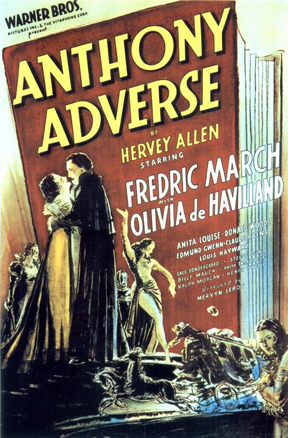
Late last night, I continued to clean out my DVR by watching the 1936 film, Anthony Adverse.

I recorded Anthony Adverse off of TCM, where it was being shown as a part of that channel’s 31 Days of Oscars.  Anthony Adverse was aired because it was nominated for Best Picture of 1936.  That’s significant because, if not for that nomination, I doubt that anyone would ever have a reason to watch Anthony Adverse.  It’s certainly one of the more obscure best picture nominees.  Despite a prestigious cast and being directed by the respectable Mervyn LeRoy, Anthony Adverse only has a handful of reviews over at the imdb.  And most of those reviews were written by Oscar fanatics like me.

Anthony Adverse is an epic historical film, one that tells the story of Anthony Adverse (Frederic March).  Anthony is the illegitimate son of Denis Moore (Louis Hayward) and Maria (Anita Louise), the wife of evil Spanish nobleman, Don Luis (Claude Rains, convincing as a nobleman but not as someone from Spain).  Luis murdered Denis and Maria died giving birth so Luis abandons the baby at an Italian convent.  Anthony is raised by nuns and priests and then, 10 years later, is apprenticed to an English merchant named John Bonnyfeather (Edmund Gwenn).  Bonnyfeather just happens to be Anthony’s grandfather!  Though Luis told him that Anthony died as soon as he was born, Bonnyfeather quickly figures out that Anthony is his grandson.  However, Bonnyfeather doesn’t share that information with Anthony and instead, he gives Anthony the surname “Adverse.”

Bonnyfeather raises Anthony as his own son.  Anthony grows up to be Frederic March and ends up falling in love with and marrying the beautiful Angela (Olivia De Havilland).  However, Anthony is suddenly called away on business to Havana, Cuba.  He doesn’t even have a chance to tell Angela that he’s leaving.  He does leave her a note but it blows away.  Assuming that she’s been abandoned, Angela goes to France, becomes an opera singer, and is soon the mistress of Napoleon.

Meanwhile, in Cuba, Anthony becomes convinced that Angela has intentionally abandoned him.  Consumed by grief, he ends up running a slave trading post in Africa.  He takes one of the slaves, Neleta (Steffi Duna), as his mistress and becomes known for his cruelty.  However, he eventually meets Brother Francois (Pedro de Cordoba) and starts to reconsider his ways.

(The film’s treatment of the slave trade is …. well, it’s awkward to watch.  The film is undoubtedly critical of slavery but, at the same time, it’s hard not to notice that the only slave with a prominent part in the film is played by a Hungarian actress.  Anthony may eventually reject cruelty but it’s left ambiguous as to whether or not he rejects the slave trade as a business.  If Anthony Adverse were made today, one imagines that this section of the film would be handled much differently.)

Meanwhile, back in Europe, Bonnyfeather is dying and his housekeeper, Faith (Gale Sondergaard, who won the first ever Oscar awarded for Best Supporting Actress for her performance here), plots to claim his fortune.

After I watched the movie but before I started this review, I did some research and I discovered that Anthony Adverse was based on a 1,222-page best seller that came out in 1933.  I’m going to guess that the film’s long and ponderous story may have worked better on the page than it does on the screen.  As a film, Anthony Adverse clocks in at 141 minute and it feels even longer.  Despite the impressive cast, the film just never clicks.  It’s never that interesting.

At the same time, I can understand why it was nominated for best picture.  It’s a big movie, full of characters and extravagant sets and ornate costumes.  You can tell it was an expensive movie to make and there’s enough philosophical dialogue that you can pretend there’s something going on underneath the surface.  In the 1936, Anthony Adverse may have been quite impressive but seen today, it’s forgettable.

Anthony Adverse lost best picture to another overproduced extravaganza, The Great Ziegfield.  Personally, I would have given the award to the unnominated My Man Godfrey.

http://www.youtube.com/watch?v=c_OyZlSCpo4

Shattered Politics #6: The Great McGinty (dir by Preston Sturges)


donlevy-angelus-mcginty_opt-1

 “This is the story of two men who met in a banana republic. One of them never did anything dishonest in his life except for one crazy minute. The other never did anything honest in his life except for one crazy minute. They both had to get out of the country.”

— The Great McGinty (1940)

For today’s final entry in Shattered Politics, we take a look at how elections are won north of the Mason-Dixon Line.

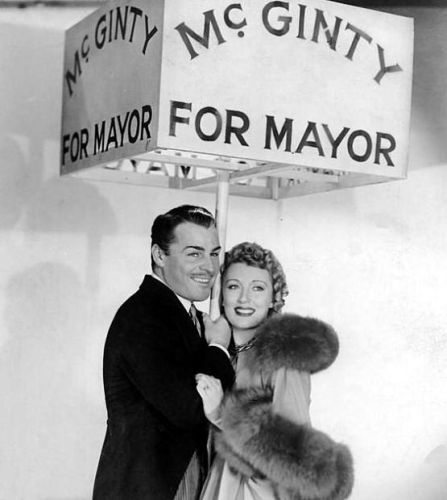
The Great McGinty begins in a bar located in an unnamed country in South America.  Tommy Thompson (Louis John Heydt) attempts to shoot himself but is stopped by philosophical bartender Dan McGinty (Brian Donlevy).  Tommy explains that he can never return to the United States because, in one moment of weakness, he stole some money.  McGinty replies that he can never return to the U.S. either.  Why?  “I was the Governor of a state, baby…” McGinty replies.

In flashback, McGinty explains how he came to power.  One day, while standing in a soup line, the homeless McGinty was approached by a local political operative (William Demarest) and offered $2.00 on the condition that he vote for a certain mayoral candidate.  McGinty agrees and then proceeds to vote 37 times.  When McGinty demands $74.00 for his efforts, he’s taken to the headquarters of the Boss (Akim Tamiroff, giving a wonderfully comedic performance).

The Boss is impressed with McGinty and, despite the fact that the two of them are constantly getting into fights with each other, he employs McGinty as a collector.  Eventually, he also arranges for McGinty to be elected alderman and then, running as a reform candidate, mayor.

Along the way, the Boss arranges for McGinty to get married.  McGinty’s wife (Muriel Angelus) originally has little respect for McGinty but, after they marry, she starts to realize that McGinty is not quite as bad as she originally assumed.  Eventually, she’s even impressed enough that she even stops seeing her boyfriend, George (Allyn Joslyn).

Meanwhile, the Boss arranges for McGinty to be elected governor.  However, once McGinty has won the election, he declares that he’s going to run an honest administration.  How does that turn out?  Well, it should be noted that the film opens with McGinty tending bar in South America…

The Great McGinty is a lot of fun and it’s interesting to think that this unapologetically sardonic look at American politics came out just a year after Mr. Smith Goes To Washington.  Imagine if Mr. Smith Goes To Washington had been told from the point of view of Edward Arnold’s Boss Taylor and you can guess what The Great McGinty is like.

If nothing else, The Great McGinty serves as a great reminder that political cynicism existed long before any of us cast our first vote.

http://www.youtube.com/watch?v=Nari4b23l6A