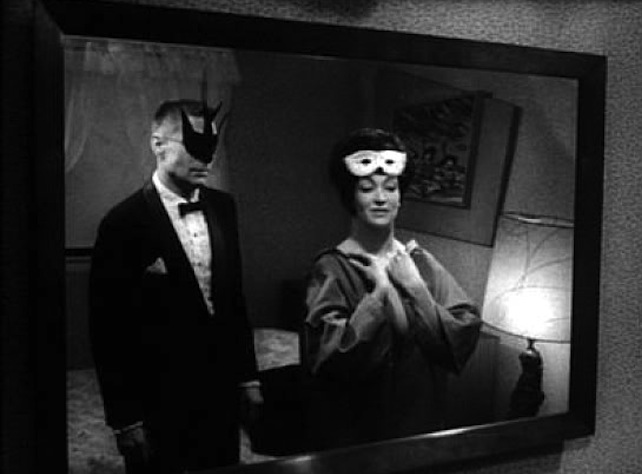
Released in 1964, Sin In The Suburbs is probably one of the best films that you’ve never heard of. The fact that it is also an unapologetic product of and for the grindhouse does nothing to change that fact. Well-acted and telling a disturbingly(and occasionally amusingly) plausible story, Sin In The Suburbs is a masterpiece of exploitation cinema.
As you can probably guess from the title, the setting here is the suburbs. To the naked eye, it’s a perfectly normal and placid neighborhood. However, to the housewives who are expected to spend all of their time in their identical suburban homes while their husbands head into the city for the day, the suburbs have become an existential prison, a world of sexual frustration and repressed desires.
Everyone finds their own way to handle living in the suffocating atmosphere of suburban perfection. Lisa Francis (Marla Ellis), for example, deals with it by sitting around her living room in black lingerie and waiting for various salesmen to come and knock on her door.
Geraldine Lewis (Audrey Campbell) isn’t quite as blatant as her neighbor, though Geraldine does find the time to dance with a teenage boy who comes by looking for her daughter, Judy (Alice Linville). Geraldine does not know how to deal with her developing daughter and, as a result, Judy starts spending more and more time with another neighbor, Yvette Tallman (Dyanne Thorne).
Yvette and her creepy brother Louis (W.B. Parker) run an interesting business on the side. They set up suburban sex clubs, where everyone wears a robe and a mask and gets to engage in anonymous sex with their neighbors. While Louis is certainly creepy looking whenever he puts on a mask that he himself describes as being “demonic,” director Joe Sarno goes out of his way to make this sex club look about as unsexy as possible. The film’s characters may think that they’re being terribly sophisticated but Sarno undercuts their fantasy by playing up the seedy desperation of the sex club’s masked meetings.
In fact, it’s easy to laugh at the Tallmans’ ludicrous little club until the film’s final ten minutes, at which point a case of mistaken identity leads to one of the most downbeat endings ever.
Joe Sarno may have specialized in making what the rest of the world considered to be exploitation films but the fact that he was an artist at heart is obvious from watching Sin In The Suburbs. Even before I decided to embark on this series of melodramatic film reviews, I had already seen a countless number of films about the what goes on behind closed suburban doors and none of them are quite as dark (or authentic) as the suburban Hell that Sarno portrays in Sin In The Suburbs. There’s a seediness to the film that, while not exactly pleasant, is also so all-pervasive and convincing that it becomes oddly compelling.
As opposed to a film like Peyton Place, which gave us small town sin in glamorous technicolor, Sin in the Suburbs is filmed in drab black-and-white and takes place on sets that are notable for their minimal decoration. The only time the film truly comes to life visually is when everyone is wearing a mask and hoping to conceal who they really are. But even then, Sarno refuses to glamorize his characters. Instead, he intentionally plays up the absurdity of a bunch of middle class suburbanites trying to convince themselves that they’re actually decadent free spirits.
If Jean-Paul Sartre had abandoned No Exit to instead write a grindhouse sex film, the end result would probably look a lot like Sin In The Suburbs.

 Through the Shattered Lens