The TSL Horror Grindhouse: The Reverend (dir by Neil Jones)


At the start of 2011’s The Reverend, the Devil (Rutger Hauer) pulls up in front of a luxurious hotel.  He gets out of his limo, enters the hotel, and finds God (Giovanni Lombardo Radice) sitting at his desk, surrounded by armed priests.

God asks the Devil what he’s been doing.  The Devil says he’s been traveling the world and tempting men to do evil.  The Devil says that he wants permission to ruin the life of one man who is virtuous and God-fearing, saying that the man will reject his faith as things get worse and worse.  God agrees, as long as the man is not killed….

Does this sound familiar?  Yep, this is yet another adaptation of the Book of Job.  Or, I should say, this film pretends to be an adaptation of the Book of Job.  The nameless Reverend (Stuart Brennan) is a God-fearing man whose life goes downhill after he’s bitten by a vampire.  That said, there’s really not much of a comparison to be made between the Reverend and Job.  Job lost everything, including his land and his family and the majority of his friends.  The Reverend doesn’t really have any friends to lose and he actually gets better at his job after he is turned into a vampire and proceeds to take out his village’s criminal element.

In fact, the entire prologue between God and the Devil feels as if it was tacked on at the last minute.  It really doesn’t connect to the rest of the film and we certainly don’t learn whether it was God or the Devil who won the bet.  Hauer and Radice only appear in that one scene and then they are never heard from again.  That’s a shame because, to be honest, the only reason I watched this movie was for the chance to see Hauer and Radice together.  They were both incredible character actors and tragically, both of them are no longer with us.  Hauer passed away in 2019 and Radice died last year.  Neither one of them looks particularly healthy in the prologue, though it is nice to see the two of them sharing the screen together, albeit for just a few minutes.

As for the rest of the film, it did have potential.  There’s a lot of blood spilled and that’s always a plus when it comes to a vampire movie.  Doug Bradley gives a good performance as the Reverend’s enigmatic superior.  Stuart Brannen is himself likable enough as the Reverend and the scene where he’s first bitten has a kinetic energy to it that briefly gave me some hope for the rest of the film.

Unfortunately, with the exception of the aforementioned scenes, The Reverend is a rather slow movie and one that never succeeds in building up any sort of narrative momentum.  (I guess that’s a polite way of saying that it’s kind of boring.)  As a character, The Reverend is likable but he’s never compelling and the film ends on a rather anticlimactic note.  The film had potential but sadly, most of it went unrealized.

Blood Harvest (2023, directed by Danny LeGare)


“You have no idea the sacrifice I have made for this land!” Uncle Ollie (Greg Nutcher) yells when his family complain about life on the farm.  They’re about to find out, though.

The audience will figure it out before Neil (Troy Escoda) and his clairovoyant son, Jake (Ian Hernandez-Oropeza).  As soon as they arrive at the farm, Jake starts having visions of sacrifices and women having their tongues cut out.  It’s easy to figure out what the farmers in the town due to ensure that they’ll have a good crop but no one in the movie is as smart as those of us watching at home.

The movie probably would have been scarier if I could have actually heard or understood half the dialogue.  The film’s sound quality is terrible.  I even checked my hearing aid to make sure that it wasn’t a problem on my end.  Some of the dialogue has been obviously dubbed.  Some scenes are too loud.  Some scenes you can’t hear anything at all.

There’s not much of a story here so everything gets dragged out.  “Have you wondered why there are no children her!?” Uncle Ollie yells while swinging around an axe.  Nah, Ollie, we figure it out a while ago.

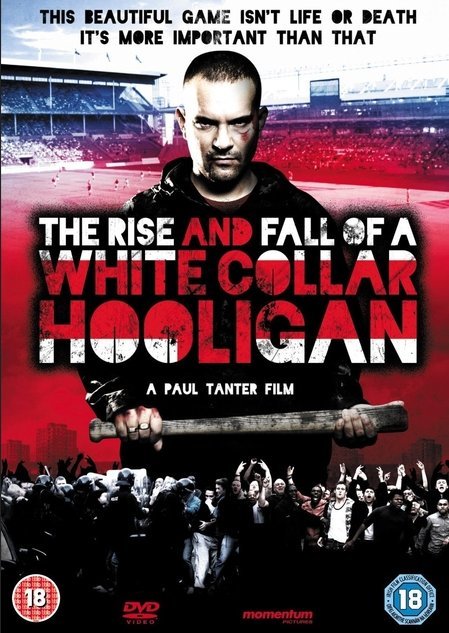
The Rise & Fall of a White Collar Hooligan (2012, directed by Paul Tanter)


Mike Jacobs (Nick Nevern) is an unemployed Brit who has never been able to get much going in his life.  He’s smart but he’s also a university drop-out and he refuses to accept any job that he feels wouldn’t provide a proper mental challenge.  Mike is also a football hooligan, spending most of his time getting into fights with the supporters of rival teams and occasionally with the police.  As Mike explains it, there’s no better thrill than getting angry, destroying stuff, and knowing that your mates are going to back you up.

At the latest soccer riot, Mike runs into an old friend of his named Eddie Mills (Simon Phillips).  Eddie offers Mike a job opportunity.  At first, Eddie just has Mike deliver a few packages, all to determine whether or not Mike can be trusted with something big.  Once Mike has proven himself, Eddie reveals that his business is credit card fraud.  He and his gang steal people’s credit card numbers and then, every night, withdraw as much money as they can on the card.  The scheme works because  the gang only uses a card once and then tosses the number away.  By the time the fraud has been discovered, the gang is using a totally different card.  Eddie explains that it’s a victimless crime because the banks are insured and the card holders don’t have to pay the bill once the fraud has been uncovered.

Despite his initial misgivings, Mike goes to work with Eddie.  At first, everything is great.  Mike is making a lot of money, doing a lot of drugs, and having a lot sex.  However, because this is a crime film, eventually Mike discovers that there’s no such thing as a victimless crime and the world of credit card fraud is much more dangerous than he realized.

It’s a tradition that movies about football hooligans rarely involve much football and that’s the case with The Rise and Fall of a White Collar Hooligan.  By my count, there are three short scenes that take place at a match and none of them are particularly important.  Instead, for Mike and Eddie, the point of football is the fight after the match.  The rush that they get from defying the police and smashing car windows is the same rush that they get from stealing money from the banks and the credit card companies.  The main difference between the two activities is that one just leads to black eyes and broken bones while the other makes them rich.

I liked The Rise and the Fall of White Collar Hooligan.  Though the story’s predictable, it’s stylishly directed and Nick Nevern and Simon Phillips are both good in the main roles.  What I especially liked is that the credit card scheme actually made sense and it was easy to understand how someone like Mike could convince himself that what he was doing really wasn’t that big of a deal.  There’s nothing surprising about the movie but it’s undeniably entertaining.

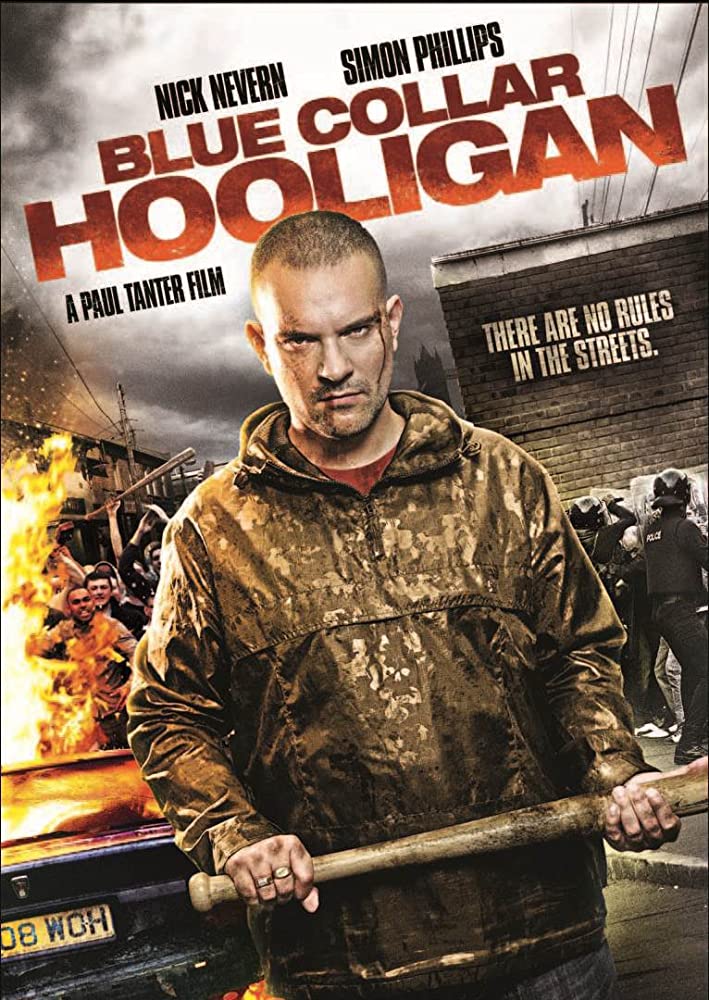
In the U.S., it was released as Blue Collar Hooligan.  I’m not sure why the title was changed.  Mike is blue collar but, throughout the film, he brags about how his crimes are all white collar and he even calls himself as “white collar hooligan.”  Maybe someone thought Americans would be more likely to watch the movie is they thought it was about a blue collar criminal instead of a white collar one.  They’re probably right.