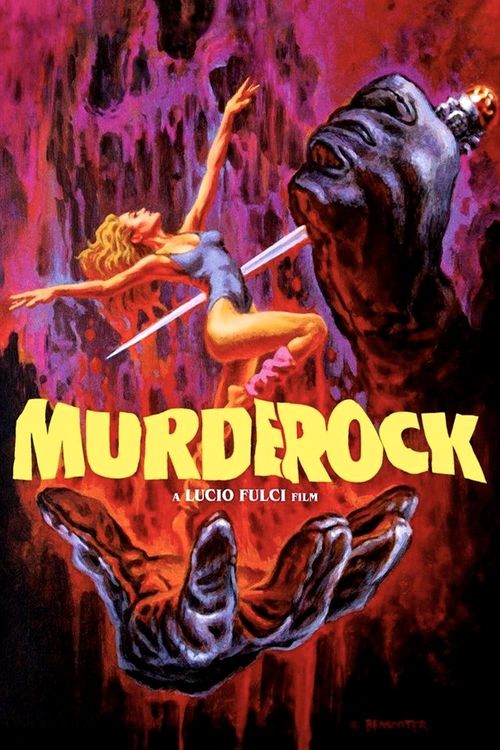
October Hacks: Murder Rock (dir by Lucio Fulci)


Are the streets to blame?  Paranoia’s coming your way….

Ah, Murder Rock.

This 1984 film is often dismissed as being one of director Lucio Fulci’s lesser efforts, an attempt to combine the trappings of the giallo genre with the sexy, choreographed dance routines of Flashdance.  And certainly, the film does lack the visceral, dream-like horror of The Beyond trilogy and Zombi 2.  The film’s killer isn’t even as interesting as The New York Ripper‘s killer who talked like a duck.  That said, I think some critics have been a bit too hard on Murder Rock over the years.  Taken on its own terms, it’s a well-made slasher with a healthy does of 80s style.  Of course, I should admit that, as someone who grew up attending dance classes and dancing through the pain, I could relate to the film’s milieu.  I’ve never had to deal with a zombie in real life but I did meet my share of dancers who would do anything to move up.

The film takes place at the Arts For The Living Center in New York City, where young dancers are hoping to land a spot on a televisions show and also hoping to avoid getting killed by the murderer who is haunting the locker rooms and using a long hairpin needle to stop the hearts of his victims.  (The sound of a previously healthy victim’s heart beating on the soundtrack and then abruptly stopping is far more powerful than one might expect.)

Previously seen losing an eye in Fulci’s Zombi 2, Olga Karalatos plays Candice Norman, the owner of the dance studio.  When one of her dancers is murdered while taking a shower, Candice is just one of many suspects.  Candice, however, is haunted by a dream in which she sees herself being stalked by a handsome man (Ray Lovelock) carrying a hairpin.  Later, Candice realizes that she’s seen the handsome man before.  He’s George Webb, a male model whose face adorns a billboard.  Candice starts to investigate George on her own, discovering that he’s apparently an alcoholic who lives in a run-down apartment.  When evidence starts to show up suggesting that George could be the murderer, he claims that he’s being framed.

Of course, George isn’t the only suspect.  There’s also Willy Stark (played by Christian Borromeo), a dancer whose girlfriend ends up as a victim of the murder spree.  With his blonde hair and aristocratic bearing, Christian Borromeo was one of the most handsome actors to appear in Italian films in the early 80s.  He didn’t do many films before retiring but he still managed to appear in films directed by Dario Argento, Federico Fellini, Ruggero Deodato, and Lucio Fulci.  He played very different characters in all of his films and gave a good performance each time.  One reason why I specifically want to single out Christian Borromeo here is because there’s still a lot of people online who are under the impression that Borromeo died a heroin overdose in the 80s.  This is largely due to a comment that was made during an interview with David Hess, who co-starred with Borromeo in The House At The Edge of the Park.  Hess was confusing Borromeo with their co-star, Garbiele Di Giulio.  Di Giulio did indeed die of a heroin overdose.  Christian Borromeo is still alive, though retired from acting.

As for Murder Rock, the killings are nowhere near as gory as in Fulci’s other films but that actually adds to the film’s creepy atmosphere.  The killer is frightening because the killer is coolly efficient and can kill without resorting to the out-of-control, manic violence of quacking sociopath at the center of The New York Ripper.  As is usual with Fulci, the film’s visuals are Murder Rock‘s greatest strength.  The first murder occurs while the locker room’s light blink on and off, creating a truly frightening sequence as the camera seamlessly assumes the killer’s point of view.  When the police investigate the crime, the flashes of the police cameras are almost blinding as they record the stark crime scene.  Candice’s nightmares play out like a particularly macabre perfume commercial (and yes, that it meant as a compliment).  Fulci’s camera roams from location to location, keeping the audience off-balance throughout the film.  As he did in so many of his other films, Fulci makes New York look like the grimiest, most claustrophobic city in the world.

As for the dance sequences, they’re so over-the-top that you can’t help but love them.  The film was obviously envisioned as a way to cash in on the popularity of Flashdance but Fulci’s dispenses of the romanticism that made Flashdance a hit and instead just focuses on bodies moving in a explosion of choreographed carnality.  There’s nothing subtle about the way the film lingers on the spandex-clad dancers but then again, that’s why we love Fulci.  He was not one to make apologies.

Fulci once said that Murder Rock was meant to be the first part of a projected trilogy of musical gialli.  Who knows whether or not that’s true.  (As an interview subject, Fulci was always quick to boat of the grand projects he had planned for the future.  As the diabetic Fulci was in precarious health at the same time that he made his most popular horror films, there was always something rather poignant to Fulci’s constant boasting about all of the great films he planned to make.)  As I said at the start of this review, Murder Rock is one of Fulci’s less-appreciated films but, as someone who loves both dancing and watching horror movies, I’ve always liked it.  Even the fact that the killer is exposed in a way that doesn’t really stand up to close scrutiny just adds to the film’s charm.  (Seriously, a good giallo rarely makes that much sense.)

In closing — SING IT!

Are the streets to blame?

Paranoia’s coming your way!
 

Italian Horror Showcase: The House By The Cemetery (dir by Lucio Fulci)


Lucio Fulci’s 1981 masterpiece, The House By The Cemetery, begins as so many slasher movies have begun.

A teenage couple fools around in the basement of the deserted Oak Mansion.  Just from listening to them talk, we can surmise that the mansion has a reputation for strange events.  Suddenly, the boy vanishes.  The girl looks for him, telling him that whatever he’s doing stopped being funny a long time ago.  Suddenly, a knife is driven through the back of her head, the blade eventually exiting through the girl’s mouth.  Fans of Italian horror and Fulci films in particular will not be shocked by this grisly turn of events, mostly because the girl was played by Daniela Doria.  Doria appeared in several Fulci films and, in each film, her character was brutally murdered.  The House By The Cemetery was her third Fulci film.  She would later appear and get killed in Fulci’s The New York Ripper.

From that rather conventional horror movie opening, The House By The Cemetery goes on to become progressively more bizarre and surreal.


The Boyles — Lucy (Catriona MacColl), Norman (Paolo Malco), and their young son, Bob (Giovanni Frezza) — are to spend the next six months living in a mansion in New England.  It’s all so Norman can work on a research project.  His colleague, Peterson, previously stayed at the house and basically went crazy, killing his family, his mistress, and himself.  This doesn’t seem to particularly disturb Norman.  Before they leave New York, Bob stares at a picture in his father’s office.  It’s a black-and-white picture of a dilapidated house.   There’s a young girl staring out the window of the house.

Suddenly, we can see and hear the girl (Silvia Collatina) as she yells at Bob to stay away from the house.

In the small town of New Whitby, the girl — who is named Mae — stands on a sidewalk.  She’s clutching a doll and it doesn’t appear that anyone else can see her.  Mae stares into the window of tailor’s shop.  One of the mannequins has fallen over and its head has become detached.  Mae watches a dark blood oozes out of the plastic head.

Sitting in the back seat of his parent’s car, Bob watches Mae.  Mae turns to stare at him.  Despite the fact that there’s a road in between them, Mae and Bob are able to calmly speak to each other.  Again, Mae tells Bob that he shouldn’t have come.

When the family arrives at their new home, Lucy says that the Oak Mansion looks a lot like the house in the picture in Norman’s office.  Norman shrugs it off as a coincidence.  As for the house itself, it turns out to be a bit of a dump.  Yes, it’s big but the inside of the house is covered in dust and cobwebs and there’s a particularly nasty bat living in the basement.  However, what really upsets Lucy is the fact that there’s a tombstone in the middle of the front hallway.  Norman dismisses her concerns, saying that it used to be very common for people to be buried in their homes.

Much as how Jack Torrance was “always the caretaker,” everyone in town seems to be convinced that they’ve met Norman before.  Norman swears that he’s never been to New Whitby before.  Meanwhile, Lucy grows more and more anxious inside the house.  Sometimes, she thinks she can hear noises in the walls.  Are they alone or is there someone else living in the house?  Bob spends his time playing with his new friend Mae, who shows him a nearby headstone for someone named Mary Fruedstein.  “She’s not really buried there,” Mae tells him.

Things get stranger.  A mysterious young woman named Ann (Ania Pieroni, who has previously played The Mother of Tears in Dario Argento’s Inferno) shows up and says that she’s the new babysitter.  A real estate agent (played by Dagmar Lassander) comes by the house while the Boyles are out and is promptly murdered.  Lucy wakes up one morning to discover Ann scrubbing a huge blood stain and says nothing about it.

Norman’s research reveals that the house once belonged to a Dr. Jacob Freudstein, a Victorian-era scientist who conducted illegal experiments.  Could that have something to do with all of the strange things that have happened in the house?  Norman goes to New York to do further research and once again, he finds himself dealing with people who are convinced that they’ve seen him before….

In an interview, Lucio Fulci once described The House By The Cemetery as being his answer to Stanley Kubrick’s adaptation of The Shining and there are some obvious similarities, from the ghostly girl to the little boy who appears to have psychic powers.  Fulci said that he didn’t feel The Shining was dark enough and make no mistake about it, The House By The Cemetery is a very dark film.  Even by the standards of Lucio Fulci, there is very little hope to be found in The House By The Cemetery.

As a follow-up to both The City of the Living Dead and The Beyond, it’s also the concluding chapter of Fulci’s Beyond trilogy.  When Mae offers Bob a chance to escape to a safe place, those who have viewed The Beyond will immediately realize that she’s talking about the same dimension that was visited by David Warbeck and Catriona MacColl at the end of Fulci’s previous film.  And while Mae may be offering Bob an escape from what’s happening the House, those who have seen the entire trilogy know that the Beyond is just as dangerous as our world.  The end of the film seems to suggest that there is no escape from the horrors of the world.  At best, there’s just a temporary delay to the inevitability of doom.

The House By The Cemetary is Fulci at his most atmospheric as he combines the gothic visual style of City of the Living Dead with the aggressive dream logic of The Beyond.  In much the same way that the The Beyond indicated that the price for discovering the truth about the world was blindness, The House By The Cemetery indicates that the longer the Boyles remains in the house, the more incapable they are of seeing the horror right in front of their faces.

And what horror!  When Dr. Freudstein does make his appearance, he’s a monster straight out of Lovecraft, a mix of Frankenstein, Freud, and the Great Old Ones.  And yet, the film’s real horror is not to be found in the monster but in the disintegration of the family living in the house.  In the end, Bob is stalked not only by the monster in the basement but also by his parent’s increasingly unhappy marriage.

Giovanni Frezza actually does a pretty good job in the role of Bob, though you might not notice because he’s been so atrociously dubbed.  (Far too often, in Italian horror films, children were dubbed by adults speaking in squeaky voices and that seems to be what happened here.)  Frezza would later appear in Fulci’s perplexing Manhattan Baby while Paolo Malco would play another arrogant academic in The New York Ripper.  And then there’s Catriona MacColl, appearing in her third and final Fulci film.  Fulci was often criticized for the way women were portrayed in his films but MacColl gave strong lead performances in The City of the Living Dead, The Beyond, and The House By The Cemetery and, most importantly, her instantly relatable presence helped to provide some grounding for Fulci’s surreal vision.  Even if the films didn’t always make perfect logical sense, audiences would continue to watch because they wanted things to turn out well for whichever character MacColl was playing.  (Of course, they rarely did.)

The House By The Cemetery was the third and final part of Fulci’s Beyond trilogy and one of his strongest films.  Lucio Fulci passed away in 1996 but, like the inhabitants of the Beyond, his films live forever.