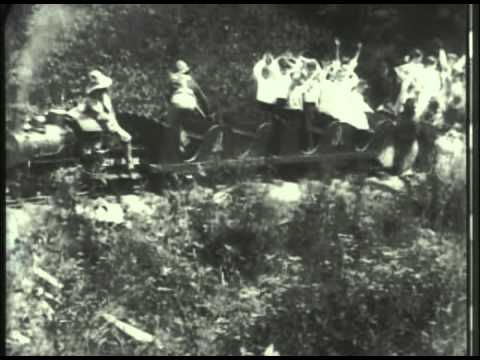
Edwin S. Porter’s THE GREAT TRAIN ROBBERY is one of early cinema’s best known films. More obscure is 1905’s THE LITTLE TRAIN ROBBERY, Porter’s parody of his own film, with a cast of kids robbing a miniature train, kind of a precursor to Keystone comedies to come. So by popular demand (awright, one person!), here’s THE LITTLE TRAIN ROBBERY:
When we talk about the pioneers of silent film, we usually end up talking about men like D.W. Griffith, Rex Ingram, Fritz Lang, Cecil B. DeMille, Charles Chaplin, and William Desmond Taylor. And it is true that these men were essential to creating the language through which future filmmakers would tell stories of their own.
However, for every important silent filmmaker who continues to be celebrated, there are hundreds of just as important directors who are no longer remembered. When you combine the tendency of the public to automatically dismiss any film made before the advent of sound with the fact that many of the best silent films are now lost films, it’s both understandable and unfortunate that several pioneering directors have been forgotten.
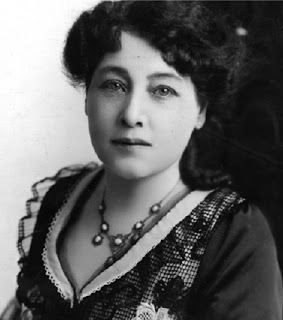
Alice Guy-Blaché may be a forgotten director but, in her way, she is just as important to the development of film as Griffith and DeMille. The French-born Alice Guy directed her first film in 1896, when she was only 23 years old. She is considered, by most film historians, to be the first female director and she was also one of the first directors to experiment with ways to use film to tell a narrative story. (Narrative is something that we now take for granted but, when the movies were still in their infancy as an art form, the idea of using the techniques of filmmaking to tell a story was truly revolutionary.)
Alice Guy married Herbert Blaché in 1907 and moved with him to the United States. It was here that she made the majority of her films. She eventually founded the New York-based Solax Company, which was the largest film studio in pre-Hollywood America. As of this writing, she remains the first and only woman to have owned her own film studio.
Below, you’ll find Alice Guy Blaché’s 1912 film, Fallen Leaves. With a running time of 11 minutes, Fallen Leaves tells the story of a young woman stricken with tuberculosis and her younger sister’s desperate attempts to save her life. This is one of my favorite silent films because it is just such an incredibly emotional and sweet-natured story. Tears come to my eyes whenever I see the little sister starting to gather up her leaves. So, put on some properly dramatic music and enjoy Fallen Leaves.
Originally released in 1928 and produced by Howard Hughes, The Racket was one of the first films to ever be nominated for an Oscar. It was also one of the first films to miss out on its chance to claim Oscar glory as the first statuette for Best Picture was given to the producers of Wings.
Like many films that were made in during the silent era, The Racket subsequently sunk into obscurity and, for several decades, it was considered to be a lost film. After the death of Howard Hughes, the last remaining copy of The Racket was discovered hidden away in his vast film collection. This print has been preserved at the University of Nevada, Las Vegas. After several years of restoration, the film made its first appearance on TCM in 2004 and it has since been frequently broadcast on that network. That’s how I first saw it way back in 2012.
Based on a play by Bartlett Cormack, The Racket is a gangster film. Nick Scarsi (played by Louis Wolheim) is a powerful and politcally-connected bootlegger. He’s pursued by one of the few honest cops in town, Captain McQuigg (Thomas Meighan). When McQuigg proves to be incorruptible, Scarsi uses his political influence to get McQuigg transferred to a precinct in the suburbs. However, when Scarsi’s younger brother is arrested for a hit-and-run in McQuigg’s new precinct, the captain uses the incident to launch a complex plan to bring down both Scarsi and the corrupt public officials that allow him to run the city.
Seen today, The Racket is an almost quaintly traditional gangster film. According to the film’s title cards, everyone in the film speaks in hard-boiled slang and the characters — from the honest cop to the cynical reporters to the nightclub singer played by Marie Prevost — will all seem very familiar to anyone who has ever seen a classic Warner Bros. crime film. That said, The Racket is still a lot of fun to watch and director Lewis Milestone keeps the story moving at a good pace. At the very least, it’s interesting to see a gangster film that was actually made during the gangster era. Nick Scarsi was based on Al Capone and, perhaps not surprisingly, the film was banned in Chicago when it was originally released.
The film shows up frequently on TCM and it’s also available on YouTube. And it can be watched below!

 Through the Shattered Lens