VGM Entry 40: End of the NES era (part 2)


VGM Entry 40: End of the NES era (part 2)
(Thanks to Tish at FFShrine for the banner)

Once again, by 1990 the Nintendo had fallen way behind the times. The Sega Genesis/Mega Drive, the Commodore Amiga 500, and the NEC PC Engine/TurboGrafx-16 had all left it in the dust. The fourth generation of home and computer gaming was in full swing, and Nintendo were not prepared to launch their version until November. NES composers struggled to keep up with higher standards in the meantime, pushing the Nintendo to its limits.

http://www.youtube.com/watch?v=hCL2lMUP_U4

Mega Man 3 (Capcom, 1990) had a lot to offer. Yasuaki ‘Bun Bun’ Fujita (not to be confused with my favorite talking rabbit) picked up the job this time, and it’s pretty amazing that three different musicians could all so effectively maintain the series’ quintessential sound. Mega Man 3‘s opening theme is as excellent as any of them, and the rest of the music really is a good bit more compositionally consistent than may meet the ear.

“Hard Man” (1:52) for instance is written in unmistakable Mega Man fashion. The only reason it doesn’t sound entirely up to par is a product of bad mixing at the final stage. Every take I’ve heard of it just sounds a bit washed out. The volumes of each track don’t feel properly balanced, and they could perhaps have chosen fuller percussion. But the fundamental song-writing is ideal, and I think if you put it in the hands of say, Bit Brigade, it would shine as brightly as any track from the first two games. Whatever flaws it may have are only visible if you seek them out.

While I think this minor mixing problem persists throughout the game, the next track in this collection, “Snake Man” (2:45), is just so well written that any potential flaw in the final production is masked entirely. Mega Man 3 does have some less memorable tracks; it’s not quite as consistent as the first two games in that regard. You won’t hear them in this mix. garudoh did yet another excellent job of choosing only the best, and “Spark Man” (3:42), “Get Your Weapons Ready” (4:40), and “Proto Man” (5:18) finish off a very well-conceived compilation. But the likes of “Gemini Man” and “Magnet Man”, not featured here, leave something to be desired. Mega Man 3 is not quite as good as the first two, but Yasuaki Fujita definitely finds and maintains the Mega Man sound throughout, and by any other standard this is an excellent NES soundtrack.

http://www.youtube.com/watch?v=8hGWMeazlhg

The best NES music of 1990 though, as you may have guessed from my previous hints, belongs to Tim Follin. Follin carried his capacity to pack a huge punch into limited sound systems over to the NES, and the introduction to Solstice (CSG Imagesoft, 1990, produced by Software Creations) is not afraid to employ a little shock value. I’m not sure why the music in this sample is out of order, but you can hear how the game kicks off if you skip to 3:37. The cute little 10 second jingle at the start is almost tongue-in-cheek, mocking typical NES songs before exploding into musical fireworks in bombastic Follin fashion. The majority of the album feels to have benefited heavily from his recent work on Ghouls’n Ghosts. No individual tracks really stand out with the memorable qualities of that previous work, but you can definitely appreciate the level of imagination that went into the whole soundtrack. Follin had more up his sleeves for the NES anyway. He reserved his best efforts for a game which we would all expect to have an outstanding soundtrack….. Pictionary?

http://www.youtube.com/watch?v=7bWV2kC8ZG4

I don’t know. Tim Follin’s music was seldom relevant to the game. I suppose it’s quite possible that he submitted this soundtrack to Software Creations without even knowing what game it would be used for. But I picture a giddy Follin setting out to intentionally make Pictionary (LJN, 1990) one of the most exciting and absurdly uncharacteristic soundtracks on the NES, laughing all the way.

That’s about all I have to offer from the Nintendo for the time being, but it’s worth taking a brief look at some other systems before we move on. I don’t want to say the pickings were slim outside of the Nintendo–that would certainly contradict my entire point in these past two posts–but I did struggle to find much of interest in 1990 specifically. The PC Engine is quite obscure to me as a western gamer, and many of the Amiga titles that best caught my eye date to 1988 and 1989. The Genesis/Mega Drive was still a musical disappointment in so far as it rarely lived up to its full potential. Elemental Master (TechnoSoft) by Toshiharu Yamanishi deserves an honorable mention, but its music is nothing special really. I think the system just lacked much competition to spur it on. With the Amiga appealing to European computer gamers and the PC Engine pushing the Japanese market, the Genesis/Master System for a time stood alone in a number of markets as the only available fourth generation home gaming console. Phantasy Star III (Sega) saw Izuho Takeuchi take over Tokuhiko Uwabo’s role as composer, and the transition brought a whole new style of sound to the game. I would describe it as unremarkable but more consistent–where Tokuhiko Uwabo presented a rather unique RPG soundtrack that was fairly hit or miss, Izuho Takeuchi is a little more traditional and at no point that I’ve noticed really falls flat. But his music is nothing to brag about either.

Before I move on to the Super Nintendo, one final 1990 release that really caught my attention was Iron Lord (Ubi Soft). Now, this version that you’re hearing above is the original 1989 Atari ST version. I want you to hear it first, because I want you to know what Jeroen Tel had to work with when he made the Commodore 64 and Amiga ports.

I don’t know who the original Atari ST composer was. I don’t know who was responsible for the MS-DOS version either. But I bet it wasn’t Jeroen Tel. C64 composers had a certain attitude about them. They knew they were the best, and they were going to keep on proving it every chance they could get. And let’s not forget here; the Commodore 64 was a year older than the Nintendo.

http://www.youtube.com/watch?v=1ovo9BsBSFM

Hence why Jeroen Tel’s Iron Lord could introduce a power metal song. The effects of layering a medieval tune with big chippy bass and that same higher spacey tone he used on Cybernoid 2 are almost comical, but they’re entirely effective. Like a typical C64 musician, Tel expanded way beyond the scope of the original composition and made it entirely his own.

VGM Entry 38: Follin’s Ghouls’n Ghosts


VGM Entry 38: Follin’s Ghouls’n Ghosts
(Thanks to Tish at FFShrine for the banner)

Even as the Sega Genesis was coming into its own and the Super Nintendo was on the verge of release, Tim Follin reappeared to give the “old systems” a final touch of perfection. Though his non-ZX Spectrum works immediately following the 1987 Bionic Commando arrangement were fairly insignificant, he had learned a lot (not to mention ceased to be a teenager). By 1989 he was ready to take on the world, and put to the task of reworking the Ghouls’n Ghosts (Capcom) soundtrack for the Amiga and Commodore 64, he suffered a stroke of genius which few have yet to match.

This is the title theme to Ghouls’n Ghosts for the Amiga, released in 1988. Enjoy it.

Even the tracks which were not originally his took on a whole new life. With all due respect to Tamayo Kawamoto, Tim Follin’s work on the Commodore 64 rendition of “Stage Two” was a drastic improvement. From the very get-go, Kawamoto’s oompa tuba and staccato flute are replaced by a booming four-note bass line and a much smoother flute tone. The song exhibits delicious dynamics, with the flute sounding out loud for the first two seconds and then immediately quieting down to make room for a wavy, ghost-tone main melody line decisively more appropriate for the theme of the game than Kawamoto’s clarinet. Kawamoto’s counterpoint on the repeat isn’t entirely convincing, and after one time through the song transitions. Follin avoids layering the melody entirely, perhaps out of necessity, but the creativity of his additional repeats and the awkward yet delightful added percussion more than compensate. Limited in the number of tracks he could produce, Follin had no hope of replicating the second half of the song on a C64, so after faithfully playing out the lower track he just took off into his own imaginative world, leaving Kawamoto behind altogether from about the 1 minute mark on. Where Kawamoto’s entire song loops at 54 seconds, Follin’s is extended to a two and a half minutes and doesn’t loop at all, fading out as a completed piece before starting over.

The music to Level 5 on the Commodore 64 is another Follin original, and it kicks off with enough amplifier worship to make Sunn O))) proud. Unlike pretty much all of his previous works, Follin’s original tracks in Ghouls’n Ghosts exhibit a sense of awareness of the game itself. He wasn’t about to let the needs of the game hold him back, but he was for once shaping his music around an appropriate theme. Follin maintains the relativity until 1:18, at which point we’re suddenly treated to an Emerson Lake & Palmer progressive rockout. The soft distortion in the background of the whistle starting at 1:58 is just brilliant, if by now completely out of touch with the game. It briefly reminds me of foggy seaside songs like Jeremy Soule’s “Pirates of Crustacia” (Secret of Evermore, Square, 1995).

Make what you will of the “End Theme” track which follows. It’s nothing to brag about, but it’s part of the package. I think the “Hi-Score” tune wrapping up the video more than compensates.

So there’s perhaps your first encounter with Tim Follin outside of the ZX Spectrum. He’s by no means forgotten, but not overwhelmingly famous either. His work on Bionic Commando 1987 made a loud statement, and his ZX Spectrum works stand in a league of their own on the system, but the Commodore 64 and Amiga arrangements of Ghouls’n Ghosts are what really brought him into full form for the first time and cemented his place in history. He would never surpass his accomplishments in 1989, in my opinion, but he would maintain an impressively high standard for many years to come, and he would excel on a more diverse range of systems than most any other composer in the business.

VGM Entry 34: Stormlord


VGM Entry 34: Stormlord
(Thanks to Tish at FFShrine for the banner)

There were only so many things a musician could do within the limited capacity of the Commodore 64, and though a rare boundary-breaking exception or two snuck by, I think that by 1989 most music sounded like a rehash of the same old thing. It wasn’t declining in quality, but it was getting a little repetitive, while many of the best musicians were moving on to other platforms or beginning to burn out. The amount of games I feel inclined to exemplify diminishes in turn.

Dominator (System 3, 1989), composed by Matt Gray, is a perfect case in point. It was a solid four-song work that incorporated a lot of standard C64 innovations while remaining pretty laid back. It’s definitely a pleasant listen, and in a way it reminds me of Jeroen Tel’s work on Cybernoid II the previous year. It is one of the best Commodore 64 soundtracks of 1989 that I’ve found, but it offers absolutely nothing new. There’s no stylistic innovation here. It doesn’t employ the SID in any sort of novel way. It’s just a catchy tune in C64 style. That’s all well and good, but if the whole SID musical movement was defined by constant experimentation and expansion then it was surely by 1989 well in decline.

Part of Jeroen Tel’s real claim to fame was his ability to keep pushing forward in the midst of this:

http://www.youtube.com/watch?v=9Z5-88XP1x0

Stormlord (Hewson, 1989) is a joint effort by Johannes Bjerregaard and Jeroen Tel. Its sort of cheesy extra-terrestrial vibe does little to reflect the gameplay, but that’s to be expected. I’m more impressed by how effectively poppy it is compared to Commodore 64 titles of the past. It sounds almost too pop to be SID, with even a tip of the hat to Michael Jackson (0:37) as far as I can tell, and that’s a lot of what makes it a significant composition. Jeroen Tel kept on incorporating new styles of popular music into a chiptune medium long after most SID composers had become set in their ways. Johannes Bjerregaard was of course also involved in Stormlord, and I don’t know the extent to which either contributed to this tune in particular (or if there even are other tunes in the game). Bjerregaard is a name I seldom run across, although Lemon 64 credits him with 63 compositions.

Stormlord also comes with an amusing story. The game caused Hewson Consultants a bit of trouble, and the box art you see above is not the original design. The original, if fairly innocent, would probably still cause a ruckus today.

Hewson Consultants didn’t beat around the bush. They knew that finding out the princess was in another castle wasn’t what gamers really wanted, and they attempted to deliver the real deal. So in Stormlord you play a behemoth, loin-cloth laden viking who runs around saving hot naked chicks. Sexist? Maybe, but not really sexual. This wasn’t an “adult” game by any means. Your interaction with the distressed damsels was in no way suggestive, and there was no discernible full-blown nudity. It would have surely landed a safe PG-13 rating were its contents in a movie today, but… is that the side of a pixilated breast I see? Good heavens!

VGM Entry 33: Amiga 500


VGM Entry 33: Amiga 500
(Thanks to Tish at FFShrine for the banner)

It was around 1988 that European computer gaming really started to make the transition over to the Amiga 500 from the Commodore 64. While the Amiga line had been around since 1985, the Amiga 500 launched in 1987 and was designed to be a much more cost effective, mass consumer-friendly product.

With a change in platform came a change in composers, oddly enough. Rob Hubbard is mentioned in a measly nine game credits on Lemon Amiga, and Martin Galway not at all. Suddenly David Whittaker, a Commodore 64 composer with an expansive library but little fame, ruled the roost. If we consider again a simple Lemon Amiga search result, his name pops up in 86 different Amiga titles. Platoon (Ocean Software, 1988) was not actually originally his, but as a faithful port of Jonathan Dunn’s 1987 C64 original (unless of course the music appeared in the movie itself; I’ve never seen it) it makes apparent the audio improvements the Amiga could offer. Whittaker’s Platoon was not necessarily better than the Jonathan Dunn original if we consider what the two artists had to work with, but he certainly did not squander or misuse the expansive new options that the Amiga 500 brought.

Whittaker’s most famous work would arrive the following year. Shadow of the Beast (Psygnosis, 1989) was a 12 song collection which really helped to solidify what we might think of as the Amiga 500 sound. The old Commodore 64 crew typically failed to carry on their legacies in the Amiga era, true, but most of the composers who replaced them did get their start programming for the C64 and enjoying the works of Hubbard and co. Artists had to be very selective about the styles of music they pursued in the C64, given its limited capacity, and what I think you hear on soundtracks like Shadow of the Beast is a continuation of those styles set to pretty decent instrument samples. This song could easily be translated into a SID piece and retain its original character. The actual C64 conversion sounded bad, as it turned out, but only because Fredrik Segerfalk did a shoddy job of it, not because the music was incompatible.

My favorite Amiga 500 tune by far though is Crystal Hammer (reLINE Software, 1988) by Karsten Obarski. The game itself is a mere Breakout copycat, but Obarski really made it shine. From what I can tell it was one of his only game compositions–Sarcophaser (Rainbow Arts, 1988) is another good one–and the brevity of his works is quite a shame. He made his name known more as a software developer, creating the highly criticized but frequently employed Ultima Soundtracker for the Amiga. Despite having almost no involvement in Commodore 64 composition whatsoever, Obarski’s music sounds just as indebted to Rob Hubbard as the rest of them. This is especially apparent on Sarcophaser, where you can get a feel for how the standard SID sounds and the more original style of Crystal Hammer existed side by side.

Chris Hülsbeck was a bit of an exception to the rule of new names on the new platform. One of his most shining moments was the Amiga 500 port of R-Type (Electric Dreams, 1989). Though Hülsbeck did, to the best of my knowledge, create the loadscreen music to the Commodore 64 version of R-Type as well, he chose two completely different songs. Never fully conforming to the ‘standard’ sound of any system, Hülsbeck was going to forge ahead with his own unique sound, and the product might not be backwards compatible.

That being said, while I have no doubt that Hülsbeck composed the Amiga title screen–it is unmistakably his style–I can’t say with certainty that he actually wrote the C64 one. Ramiro Vaca is additionally credited as a musician on the C64, as is Darius Zendeh on the Amiga, and I am not sure what role either played.

VGM Entry 32: Arcade and C64 in ’88


VGM Entry 32: Arcade and C64 in ’88
(Thanks to Tish at FFShrine for the banner)

Beyond the NES, a lot of great things were going on in 1988 that I am largely still unaware of. Late 80s arcade and computer gaming gets a lot less publicity today than the Nintendo counterpart, and even some of the best require a bit of digging to uncover, but here are a few I found worthy of mention.

http://www.youtube.com/watch?v=skXQAXpN0As

Jeroen Tel is a Dutch composer born in 1972. I am not sure when he first got into the business, but his works really start to stand out for the first time in 1988. Cybernoid and Cybernoid II, both developed by Raffaele Cecco and published by Hewson Consultants, were also both released in 1988. The latter’s main theme is particularly catchy. The game was a sort of weird combination space shooter and action side scroller, hedging more towards the latter. It appeared on a number of platforms, but its C64 version is by far the most memorable, specifically because of Tel’s musical contributions. He would go on to be remembered alongside Rob Hubbard as one of the greatest Commodore 64 composers. His Cybernoid II music has even been performed by live orchestras, though the success of converting such an essentially chippy tune is dubious. Suffice to say this track is catchy in its original form, and clocking in at 6 minutes, it provides a pleasant motivation for extended gameplay.

The arcade had long established itself as the primary venue for optimal sound quality. The general lack of great arcade soundtracks in my experience makes me wonder if I’m not missing an enormous and important range of video game music. The works of Tamayo Kawamoto in Ghouls’n Ghosts (Capcom, 1988) certainly upholds the higher standard. The majority of the soundtrack is rather dark and ambient, and quite successful as such, but it’s the unique “Stage Two” theme which really stands out. For a relatively unknown video game composer, Tamayo Kawamoto has quite a history. She began her career on Capcom’s Alph Lyla house band, composing arcade music as early as 1984 to include the classic Commando. A few years after Ghouls’n Ghosts she would move on to join Zuntata, the Taito house band responsible for Darius and quite a number of other arcade classics.

The Ghouls’n Ghosts soundtrack, and “Stage Two” in particular, would ultimately be remembered in the form of Tim Follin’s Commodore 64 arrangement, not Tamayo Kawamoto’s original, and for good reason, but let’s give credit where credit’s due.

http://www.youtube.com/watch?v=GVGBQuYvWsk

Even so, the world of the arcade was fading fast, and Zuntata were one of the few acts still putting their all into it. Some bad research on the part of youtube posters lead me to believe for a time that the music of the 1993 Sega-CD/Mega-CD port of The Ninja Warriors (Taito, 1988) was in fact the original, and it’s this latter version for which the game is probably most famous. But unlike with Ghouls’n Ghosts, the music to The Ninja Warriors didn’t conceptually change over time. It just improved in the light of better technology.

The soundtrack of The Ninja Warriors was headed by Hisayoshi Ogura, who also lead the composition of Darius. The track featured here, “Daddy Mulk”, is the most famous in the game. (I have no idea what the origin of this peculiar name is, and I wonder if it’s not an afterthought in consideration of the apparent sound of the electronic voice in the music.) Now that I am aware of the difference between the 1988 arcade soundtrack and its 1993 Sega-CD counterpart I’m a bit surprised that the arcade quality is quite this low. I mean, it’s outstanding compared to anything on competing platforms, but it doesn’t sound like any technological upgrades had been made since Darius two years prior. Another sign of the arcade’s fading significance? Perhaps. Zuntata certainly weren’t cutting corners, as their live renditions and later adaptations of the soundtrack would show. They were still kings of the arcade in 1988, even if this was a dying kingdom, and their legacy is well earned.

VGM Entry 26: Tim Follin’s noise machine


VGM Entry 26: Tim Follin’s noise machine
(Thanks to Tish at FFShrine for the banner)

In most cases it’s fairly reasonable to think of the ZX Spectrum as a secondary system for game music. It didn’t seem to have the capacity of the Commodore 64, and a lot of the game themes that ended up there were toned down takes on C64 originals, attempting to emulate the SID sound as closely as possible. But the ZX Spectrum did have its own unique if seldom exploited flavor, and over the course of three years one ingenious artist in particular would develop that into a brilliant new chiptune style to rival anything produced for the SID.

Some time in 1985, or perhaps a bit earlier, Mike Follin scored a programming job at Insight Software. Mike passed the soundtrack of what would be his first commercially released game, Subterranean Stryker (Insight, March 1985), down to his musically inclined younger brother Tim, who thereby got his first taste of programming. The result was fairly simple–little more than an amateur doodle–but for a 15 year old kid with no prior programming experience it was a pretty sound start. Insight Software were satisfied enough to keep Tim Follin around, and over the next year he familiarized himself with the sounds of the ZX Spectrum.

What he probably didn’t do was familiarize himself with the sounds of Rob Hubbard. What emerged from Tim Follin’s early experimentation on the ZX Spectrum was a sound all of its own. Agent X (Mastertronic, 1986) was heavily influenced by progressive rock, a feature which would characterize Tim’s work across multiple decades and platforms, but its uniqueness rested on his productive employment of the system’s excessively distorted tones. Rather than viewing the distortion as an obstacle blocking the path to quality arrangements, Tim Follin made it an essential and intrinsic feature of the music.

Agent X didn’t appear out of nowhere. Follin’s sound steadily improved during his short stint with Insight Software, such that on Vectron (late 1985) you can definitely hear a rough draft of things to come. His better works also coincided with his first real job. Follin was hired by developers Software Creations in 1986 (they developed all of the Mastertronic games I’ll be featuring here); he was no longer tailing his brother and composing for spare change. The compositional quality understandably improved in turn.

Tim Follin’s ZX Spectrum sound was unlike anything heard on the Commodore 64. It was a sort of post-rock prog shoegaze madness before any such notion formally existed, meant to be blasted at maximum volume, encasing the listener in a wall of sound. Future Games (Mastertronic, June 1986), my personal favorite on the system, was a far more intelligent piece than Agent X. The way the song slowly builds up into a glitch-beat explosion at 2:06 is a tremendous feat given how little Follin had to work with. The song essentially ends unfinished at 2:31, but I think that can be forgiven in light of what all he accomplished here.

I think a lot of this style is the product of Follin’s own originality, and fairly unprecedented in its day. Certainly outside influence on some of the progressive rock elements is self-evident, and in an interview probably dated to 1999 or 2000, the original of which is now lost, Follin acknowledged that he was exposed to a lot of Genesis, Yes, and Rush growing up. But the shoegazey layer of static and especially the glitch beats are features I don’t start to identify in other musical scenes until some time later. It’s not like he was listening to Aphex Twin and Venetian Snares at home.

Agent X II (Mastertronic, 1987) was a good deal more accessible than most of his previous works, featuring a bluesy groove and plenty of rock and roll soloing, but noise was still the glue that held it all together. I think it’s pretty telling that when Tim Follin programmed the Commodore 64 port sound–Agent X II and Scumball (Mastertronic, 1987) were his first attempts at C64 composition–he wrote an entirely new set of songs. Follin based everything he wrote around the instrument with which he wrote it, and however much other artists were trying to make the ZX Spectrum sound like a C64, these were two different animals.

http://www.youtube.com/watch?v=ses2wOj43pU

Chronos (Mastertronic, 1987) is probably his most famous ZX Spectrum theme, and understandably so. Technically, or so I gather from the comments I’ve read, it is his most outstanding effort on the system. I don’t know enough to recognize technical skill in chiptune programming when it slaps me in the face. But I think the music speaks for itself. Tim Follin was to the ZX Spectrum what Rob Hubbard was to the Commodore 64, and it was only his first of many legacies.

VGM Entry 25: Meanwhile in Europe…


VGM Entry 25: Meanwhile in Europe…
(Thanks to Tish at FFShrine for the banner)

It can be pretty easy to get boxed into a NES perspective and forget that, while Nintendo may have controlled the majority of the gaming market, they weren’t a total monopoly. The Commodore 64 in particular was still a close rival in the area of gaming music.

The same small handful of names seem to pop up everywhere I turn for C64 music. I don’t know if there were in fact fewer musicians, if their works drastically outshines the competition, or if most C64 composers have been unfairly forgotten, but I can tell you this much. Between 1985 and 1987 Rob Hubbard composed the music for over 60 video games. That is completely unheard of for any other time and any other system. Monty on the Run, the first Hubbard work to catch my attention, also happened to be one of his earliest. He would carry on the innovative tradition for many years to come, with such original (to the best of my knowledge) compositions as Nemesis the Warlock (Martech, 1987) rivaling his more famous 1985 works.

The tendency towards covers continued as well. Rob Hubbard visited Larry Fast and his Synergy project again on Zoids (Martech, 1986), this time arranging “Ancestors” from Audion, the same album that featured “Shibolet”. This time around, a version of the original music is conveniently available.

Which Hubbard music I post from here is really quite arbitrary, because the quality of his works is consistently high. Delta (Thalamus, 1987) is among my favorites. Delta is an interesting example of just how low-key video game development used to be. The sequel to Sanxion (Thalamus, 1986), both Delta and its predecessor were programmed by Stavros Fasoulas and composed by Rob Hubbard. To the best of my knowledge, that’s it. Perhaps this is why Hubbard was not composing ending credits themes.

I’ve read that the music to Delta was inspired by Koyaanisqatsi by Phillip Glass, but I have no reliable source to confirm this, and I have not heard the song myself.

Ben Daglish is another prolific C64 composer with dozens upon dozens of titles to his name. It’s pretty easy to miss soundtracks like Mountie Mick’s Death Ride (Ariolasoft, 1987) in the sea of material out there, especially with Daglish not getting quite the excessive attention of Hubbard and Galway. A great stand-alone song, Mountie Mick’s Death Ride also achieves a much higher level of game relativity than the average C64 composition. Unless this video is misleading, the game doesn’t seem to have had a seperate sound effects track at all; Daglish’s composition incorporated the chug of the train into the basic beat of the music.

http://www.youtube.com/watch?v=n8jI_BUvUGI

(This video must have been removed in the past day or two, and I could not find a replacement nor did I have time to overhaul my article to adjust for it. I do hope this was deleted by the poster’s choice and not another victim to the most recent string of copyright threats by these media conglomerates who seem to be buying up massive quantities of obscure, out of print material and erasing all record of their existence. A whole ton of similarly innocent videos from different users seem to have vanished in the past few days.)

A Commodore 64 composer I drew attention to in an early post was Martin Galway, for his work in Yie Ar Kung-Fu and Roland’s Rat Race. I didn’t quite realize how significant the guy was at the time, but the more C64 soundtracks I look at (at least up through 1987), the more he comes across as the guy who scored every soundtrack that Hubbard didn’t. The two both put out ridiculous numbers. To Hubbard’s 60+, Galway can add another 30. Just how many games were released in this three year span?

By 1987, Galway seems to have gotten pretty experimental. A lot of his works don’t feel quite as “safe” as Hubbard’s. Game Over (Imagine, 1987) is a case in point. Weird as it may be, the first 1:50 still constitute a functional game soundtrack. But as the melody all drops out and nothing but Galway’s bizarre experimental drumming is left behind, well… whatever your take on the composition, I think you’ll be hard pressed to conceive of a relevant gaming context.

http://www.youtube.com/watch?v=jZcB_WOuPhQ

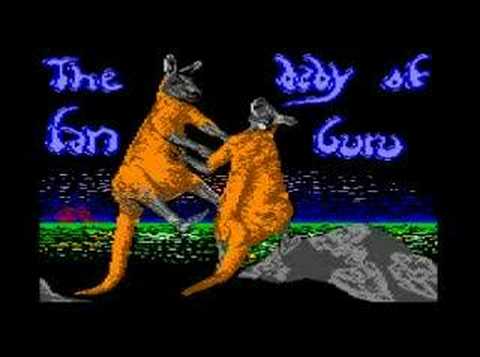
Maybe it’s just Game Over‘s cool box art that makes me think a relevant gaming context matters in the first place. I mean, if you tried to musically capture the title screen of The Baby of Can Guru (Rainbow Arts, 1987) you would probably be fired. So just as he did with The Great Giana Sisters that same year, Chris Hülsbeck said “to hell with this” and wrote whatever pleased him.

I mean, if the significance of what you’re now hearing hasn’t sunk in yet, let me try to clarify:

THIS GAME has a wicked soundtrack.

Anyway, this about wraps up my thoughts on SID music up through 1987. I will leave you with another Martin Galway piece: the Commodore 64 port of Arkanoid (Imagine, 1987), which is really just as absurd as Hülsbeck’s music for The Baby of Can Guru when you consider that the game is nothing more than a Breakout copycat.

http://www.youtube.com/watch?v=1stW0J7Myew

Rob Hubbard and Martin Galway were not the only two people writing music for the Commodore 64–I still know next to nothing about David Whittaker, for instance–but it is consistently their works which strike me as noteworthy in the mid-1980s. Chris Hülsbeck, or Huelsbeck if you prefer, seems to really start to make his presence known in 1987, and the works of Jeroen Tel would soon follow. Tim Follin, the mastermind behind the Bionic Commando port arrangement, would also start to really expand his impact beyond the ZX Spectrum in the late ’80s. ’85-’87 might for many people constitute the real glory days of Commodore 64 music, but there was much greatness still to come.

———————-

Notice: Square Enix have apparently deemed one of my soundtrack reviews a copyright infringement and demanded I remove the offending content (brief audio samples from an out of print ost). I have complied, and I kindly encourage you to boycott all Square Enix products in the future. Since their games are terrible these days anyway I am probably doing you a favor.

VGM Entry 08: Ports complicate the picture


VGM Entry 08: Ports complicate the picture
(Thanks to Tish at FFShrine for the banner)

While I have noted that composers remained within regional spheres, games certainly did not. Ports reigned supreme, and it was not uncommon for a game to appear around the world in a half dozen different formats. Each of these required a group of programmers familiar with the given system, and it was certainly not always the case that the original arcade version remained the best at the end of the day.

Take Commando (Capcom, 1985) for instance. The original main theme was composed by Tamayo Kawamoto, an obscure name which will persistently resurface throughout this series of articles. It’s certainly a commanding little march (utilizing the YM2203, if my previous article has peaked anyone’s interest in this regard), and I’d have fed in my quarter in the hopes of hearing more. But quite a number of Kawamoto’s soundtracks are better known for what other artists made of them in the port process than in their original form, and Commando is no exception.

Put it in the hands of Rob Hubbard and, well, did you expect anything less? This wild ride might be his most famous 1985 work after Monty on the Run, and it’s all the more enhanced when you realize how distinct it was from the original. Again Hubbard shines best when he is expanding and improvising upon the music of others. The potentially performable original work is completely lost here, transformed into a uniquely SID sound and style, and with all due respect to Tamayo Kawamoto, its certainly not worse off in consequence. The problem, which would go on to haunt countless composers down the line, is that most fans of Commando have no idea Kawamoto had any part in writing it.

The composition was actually a single day project, and the entire port was pushed through by Elite Systems in a mere two months. Hubbard briefly discussed it in an interview by Jason ‘Kenz’ Mackenzie’s Commodore Zone magazine. (Issue 10 as best I can tell, probably released in 1997): “There is an interesting story behind Commando. I went down to their office and started working on it late at night, and worked on it through the night. I took one listen to the original arcade version and started working on the c64 version. I think they wanted some resemblance to the arcade version, but I just did what I wanted to do. By the time everyone arrived at 8.00am in the morning, I had loaded the main tune on every C64 in the building! I got my cheque and was on a train home by 10.00 am…

Yie Ar Kung-Fu (Konami, 1985) is an especially odd game to consider, because its ports varied so drastically. I couldn’t find a stand-alone sound sample of the original arcade version, but you can hear it well enough beneath the sound effects of this gameplay video. The upbeat, distinctly Asian sound is a refreshing change of pace from the usual video game song styles, and in consideration of what Rob Hubbard did with Commando, you can imagine the potential for new arrangements this presents. Arguably the most famous version of the game’s music, however, is a completely bizarre departure.

The only rational explanation I can think of for Martin Galway having replaced the traditional Asian music theme with a completely irrelevant cover of “Magnetic Fields” by Jean Michel Jarre is that the title screen music is, in fact, completely irrelevant. I think perhaps Galway, either by request or on his own initiative, submitted the song as an all-purpose Commodore 64 option for Imagine Software, who produced the European computer ports of the game, and that it found its way into Yie Ar Kung-Fu simply because it happened to be available at the time. It is not one of Galway’s finer works, but I suppose you can do what you want to the loader screen. It was the combat music that really defined the game.

http://www.youtube.com/watch?v=rC2SBO_-NX4

Even so, the actual gameplay music to the Commodore 64 port of Yie Ar Kung-Fu is as unexpectedly similar to the arcade as the title screen is unexpectedly divergent. The arrangement makes no effort whatsoever to expand upon or even properly convert the original arcade gameplay music to suit the SID sound. Instead we’re met by an unimaginative attempt to emulate the original as closely as possible, marred by SID distortion which could have so easily emphasized the music’s finest features but instead just drowned them out. I mean, this is far more appropriate than Galway’s load screen, but so much for a middle ground between total disregard for the original and a carbon copy.

http://www.youtube.com/watch?v=5OOm4CyFutQ

And then you have the Famicom/NES version, released in April 1985. (That’s five months before Super Mario Bros., to put things in context.) Without altering the style of the arcade version in the slightest, it offers an almost entirely original song. It’s really the best version of Yie Ar Kung-Fu out there–you’d be hard-pressed to argue otherwise–and its existence is a bit puzzling. Who composed it?

The notes I’ve found on Yie Ar Kung-Fu credit Miki Higashino, but they fail to distinguish between the arcade and NES versions, as if these weren’t completely different songs. Now, I am inclined to think Higashino wrote both, which is quite remarkable considering she was only 17 years old at the time. (The only other really famous game musician I can think of to get this early of a career start is Tim Follin.) The other titles credited to Higashino in the mid-80s don’t exhibit this kind of quality, but in consideration of the fact that ten years later she would compose one of the greatest game soundtracks of all time (Suikoden), I know she had it in her. The Suikoden soundtrack is predominantly folk and traditional music (like Yie Ar), and the consistency of style between the arcade and Famicom songs favors a single composer.

The other thing Higashino-authorship has going for it is that she worked for Konami, who made both the arcade and Famicom versions. She would have been involved in the sound team of both, so it’s reasonable to believe she would have had the liberty to create an entirely new song when it came time to program the port. Her hands would have been tied for the European versions, which were produced by Imagine Software. On a final interesting note, the MSX version ports the Famicom soundtrack, not the original arcade music.

It’s all just speculation though. Anyone at Konami could have potentially been responsible for the changes. I’ll leave you with one final version that was most certainly not arranged by Miki Higashino. … Ok, I’m really going to try to avoid video game covers where they aren’t historically relevant, but you have to admit this Markdoom Shehand cover is one of the most awesome things ever.

VGM Entry 06: Hubbard’s covers


VGM Entry 06: Hubbard’s covers
(Thanks to Tish at FFShrine for the banner)

Monty on the Run is arguably Rob Hubbard’s most famous work today, and perhaps because of that I am inclined to believe it was one of his most distributed songs at the time, but it remains one game among many. A broad and stylistically diverse collection of games released in 1985 all featured Hubbard’s novel techniques as well as his high standard of quality, and it was through this larger catalog that Hubbard really made his mark on the future of game sound. What may come as a surprise is that a lot of these songs were not actually original. Hubbard had a knack for finding obscure preexisting songs that could translate well into the SID sound.

In fact, Monty on the Run was essentially a cover song. It was a rock arrangement of “Devil’s Galop”, a classical piece by Charles Williams which served as the theme to the radio show Dick Barton – Special Agent. Dick Barton, moreover, aired from 1946 until 1951, and Hubbard was born in 1955, so I doubt the choice was merely nostalgic. But whatever inspired him to choose the song, rock and roll was no obvious style through which to reinterpret it. It took a pretty unique ear to hear this and envision a C64 chiptune epic.

It helped that Hubbard was an experienced musician. His career began as a studio musician, not a programmer, and his first effort as a programmer was to design musical education software for the Commodore 64. When he submitted the project to Gremlin Graphics, it was his demo songs rather than the associated software that peaked their interest, and his new career was born.

http://www.youtube.com/watch?v=QRmcv_bR4oE

Elsewhere, Hubbard took more recent and relevant inspiration. Master of Magic (Richard Darling, published by Mastertronic, 1985) was an arrangement of “Shibolet”, written by Larry Fast for his Synergy project and released on Audion in 1981. Trying to obtain more than a 10 second clip of the original has become more trouble than it’s worth for me, but I have to imagine that, as with all else, Hubbard made it uniquely his own.

The fact that he was even listening to contemporary synth composers–far more relevant to chiptunes than say, classical music–says a bit about how he viewed his work. Certainly Monty on the Run had a ‘guitar’ solo, but I doubt he intended the song to sound like an actual rock band in the same sort of way that some early NES composers tried to emulate real orchestras. In covering a synth artist, he was turning to a style of music designed for precisely the type of instrument the Commodore 64 was. He employed the sounds available to him for what they were, not for what they distantly resembled. This concept of viewing the SID as an instrument, not as a means to approximate instruments, is not an obvious step, and it’s much to his credit that C64 sound came to evolve as an instrument in the first place. I think it’s telling that when the likes of Tim Follin and Neil Baldwin began composing for the NES their music had a distinct Commodore 64 sound; Hubbard’s SID manipulations manifested as a unique and classifiable style of music.

http://www.youtube.com/watch?v=uKGbPZtEmVc

His most exciting early work to consider is Rasputin (Firebird, 1985). It is derived from traditional and early Soviet-era Russian folk tunes, but wait a minute here. Yes, Tetris was created in 1984, but Alexey Pajitnov’s original was silent, and in any case it was initially isolated to the U.S.S.R. Hirokazu Tanaka, another video game music legend, composed its famous tunes based on Russian folk songs, but that wasn’t until 1989. Whether Rob Hubbard influenced him or not, the reverse is certainly not the case.

szigand on youtube actually took the trouble to dissect the components of this song and the order they appear in. It’s an amalgamation of Katyusha by Soviet composer Matvey Blanter, Czardas by Italian composer Vittorio Monti, and the traditional Hungarian folk song Kaljinka. Where Hubbard might have found them, let alone what inspired him to combine them into a chiptune classic, is anyone’s guess, but the result is brilliant.

VGM Entry 05: SID comes to life


VGM Entry 05: SID comes to life
(Thanks to Tish at FFShrine for the banner)

1985 was the year that changed video game music forever, and this transpired primarily through the mediums of the Commodore 64 and the Nintendo Entertainment System. At a glance it can seem a lot easier to discuss the latter, what with Koji Kondo’s classics being performed around the world in symphonies today. The former still lacks a formalized history. Where people will readily make the bold and overpresumptuous claim that Super Mario Bros. revolutionized NES music, or even all game music, you don’t really hear the same claim being made about Monty on the Run. This is good, because neither are entirely true. The main difference I suppose is that Super Mario Bros. was undeniably the most popular game of its day, while you may well have never even heard of Monty on the Run. I don’t know if its priority over other Commodore 64 works stems from greater marketing success in 1985 or from a later acknowledgement that it was probably the best among a whole lot of excellent songs.

Let’s focus on the Commodore 64 first. The C64 sound revolution required a lot of programming innovations. The sort of sounds Rob Hubbard, Martin Galway, and the like were able to produce weren’t preset to the click of a button, and they weren’t at all obvious. Hubbard was most certainly the first prolific composer for the system, and a lot of SID programming innovations were his in origin, but to what extent C64 musicians influenced each other at this point in time is hard to say.

http://www.youtube.com/watch?v=93nIljXpqUY

Monty on the Run (Gremlin Graphics, 1985) is probably Rob Hubbard’s most famous work, granted it was one of many he composed in 1985, and the improvement here over C64 examples from previous years is certainly staggering. I mean, games like 3D Skramble in 1983 may serve as fine examples of the SID’s naturally appealing tones, but they certainly don’t predict a chip and roll epic. With Rob Hubbard in 1985, and with Monty on the Run as the hallmark, we can really mark the end of serious technological limitations for home gaming sound. Programming sound for the Commodore 64 was a painstaking process no doubt, but its sound capacity was not so limiting as to physically deny quality in anything but the obscure/avantgarde. It took sound programmers a while to catch on, and perhaps, in light of the fact that they were not previously expected to compose great music for home game systems, it took a while for developers and real musicians to partner up. But three years after the release of the Commodore 64 and its legendary SID chip, home gaming music really came into its own.

Despite both making their first major waves in 1985, western and Japanese sound programming probably developed independently at first. Early game composers tended to stay within their regional spheres of influence. The European movement was not exclusive to the SID, but rather to local systems. Rob Hubbard for instance composed for the ZX Spectrum as well as the Commodore 64 early on, scoring such games as Spellbound (Mastertronic, 1985), but he never really branched out to Japanese gaming mediums. The Commodore 64, ZX Spectrum, and Amstrad CPC formed a fairly isolated pocket of platforms. Similarly, Koji Kondo composed exclusively for Nintendo, and Nobuo Uematsu’s non-NES works were all on computers of Japanese origin, such as the PC-8801 and MSX. A few British musicians, notably Tim Follin and Neil Baldwin, would later turn to the Nintendo, but the language barrier proved daunting. Some of Neil Baldwin’s best works were never commercially released due to communication difficulties between British developers and Japanese producers.

The most interesting indicator of what was going on with the Commodore 64 might be “Synth Sample” by Georg Feil. Composed in 1984 or 1985, it was a widely distributed file in the early days of the internet and had no affiliation with any sort of commercial enterprise. No one needed to ‘invent’ game music. It wasn’t discovered; it didn’t come to the first sound programmer as a sort of epiphany. It was the natural result of improvements in sound chips. Once the potential for good music was out there, it would happen with or without support from major game developers. The SID sounded great, it still sounds great, and it was an inspirational instrument in its own right. Hubbard and others might have been lucky enough to be paid a pittance for their works, but I like to think of them as musicians more so than ‘composers’ in the commercial sense.