VGM Entry 13: Darius


VGM Entry 13: Darius
(Thanks to Tish at FFShrine for the banner)

Taito have kindly sent me a letter informing me of their intention to sue me for this post, and in particular for its visual and audio depictions of an out of print soundtrack for an out of print arcade machine, if I do not remove such content immediately. Taito being a subsidiary of Square Enix, I highly encourage you to boycott all Square Enix products in the future. Since their games are terrible these days anyway I am probably doing you a favor.

Unfortunately Hisayoshi Ogura is the one that suffers here, since Square Enix have simultaneously expressed no intention of legally distributing his work and barred all attempts by fans to share it.

It is very easy to get on a one-track mind and focus down home gaming in total disregard for the arcade. Arcade composers rarely had the lasting impact of Nintendo and computer game music, perhaps in part because arcade gaming as a business was pretty much dead by the end of the 80s. Where arcade music is still remembered today, it is usually in the form of NES and C64 port renditions. Yet in the mid-1980s, some producers still placed their finest resources into refining the arcade game first and foremost. Taito’s Zuntata sound team most significantly, and also Konami’s Kukeiha Club and Capcom’s Alph Lyla, were composing arcade music that far exceeded in sound quality anything ever heard on a home system. Taito did it best, and among their eccentric and innovative staff no one shines brighter than Hisayoshi Ogura. When Taito released its arcade shooter Darius in 1986, it achieved a level of sound quality that would not be surpassed until at least the late 1990s.

***Video removed due to Square Enix’s corporate bullying.***
Chaos and Boss 4

A collection of experimental oddities both catchy and disturbing, it could not have been better suited for the game it represents. Darius was experimental and innovative in many ways, featuring a triple-screen ultra-wide display and a non-linear level progression which would mix up the seven stages between (I believe) twenty-six possible maps, creating a slightly different experience on every play through. It even featured multiple endings–something you might not expect from a shooter game.

You probably wouldn’t expect to be fighting giant evil space fish, either. Darius receives pretty mixed reviews from a lot of shooter junkies these days, but if I was going to spend my quarters on anything in 1986 I know it’s the first game I’d have tried. It attempts to awe and bewilder, and it succeeds.

***Video removed due to Square Enix’s corporate bullying.***

You can really tell that Ogura designed his score to exploit every technological possibility available to him. The depth and fullness of the sound is overwhelming. It reminds me of the sort of audio experience I got from Square’s Einhänder–a game I bought specifically for the music. But Einhänder was released in 1997! Darius was 11 years old by then.

If it doesn’t sound that special to you, try plugging in headphones. Much like Kenneth W. Arnold’s Ultima soundtracks, my lousy laptop speakers can’t do it justice. I also recommend you try to get your hands on a copy of the soundtrack; Taito released a version as early as 1987, fully aware of its significance. I included a gameplay video of “Chaos” to showcase the music in action, but a playlist of the ost is also available. (Youtube link removed due to threats by Square Enix.) You can find full gameplay videos of each level with music on youtube thanks to *censored*.

***Video removed due to Square Enix’s corporate bullying.***

“The Sea” might be the most eclectic song in the mix. It’s certainly my favorite. You quickly discover that it does not intend to be a typical aquatic theme when the demented chime tones come into play. The next transition back to relative normalcy is quickly derailed by an erratic explosion of mechanized blast beats, and Hisayoshi Ogura wraps it all up in fittingly weird form with what feels like some sort of proto-dubstep.

Taito knew they were kings of the arcade. Their house band, Zuntata, even went so far as to perform some of the Darius soundtrack live.

***Video removed due to Square Enix’s corporate bullying.***
Chaos, performed live by Zuntata

A lot of game developers had “house bands” in the early days. This is part of why it is difficult to attribute authorship to a lot of game soundtracks of the era. Taking a closer look at these bands could prove pretty interesting–perhaps another task for another summer. Hisayoshi Ogura was not the first video game composer to perform his material live. I believe that credit goes to Koichi Sugiyama. But this concert, dated to 1990, has to be among the first.

Darius–a 1986 video game music masterpiece. Considering how easily it might have slipped by me unnoticed, I have to wonder how much more I am leaving behind.
Review: Trouble Witches NEO


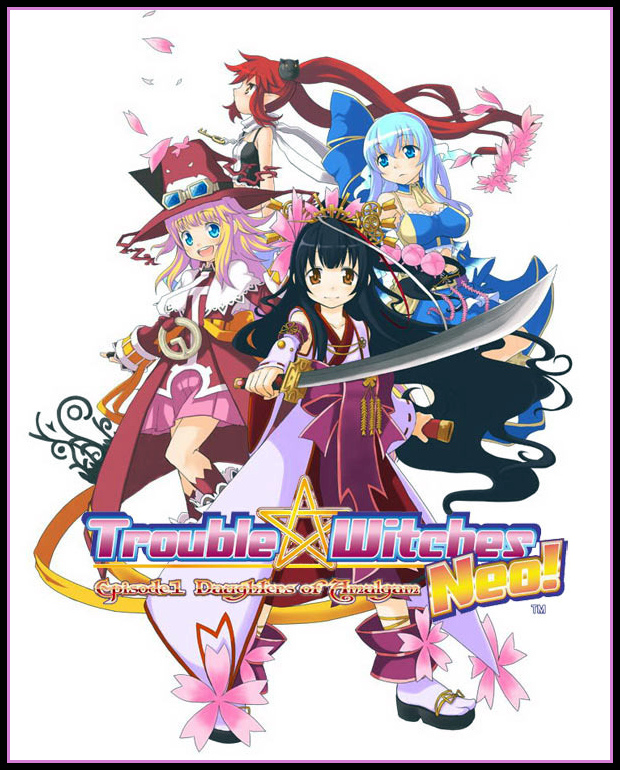
Over this weekend I came across a little game over on Xbox LIVE Arcade listings that I knew I had to buy and play. Of late, I’ve been playing quite a bit of the so-called “shmup” (shoot ’em up) arcade shooters. While I’ve played such games in the past the niche shmup titles of the gothic lolita variety which have become quite popular in Japan was still new to me. My first introduction to this subgenre of the shmup was when I bought a copy of the gothic lolita arcade shooter Deathsmiles for the Xbox 360. Less than a year later I’ve bought a second game which improves on the previous one I bought. Trouble Witches NEO from SNK was seen, downloaded and soon played for countless hours over the weekend.

Trouble Witches NEO (developed by the doujin team from Studio Siesta in conjunction with Bouken and SNK) is quite similar to the many shmup arcade shooters now coming out of Japan and being discovered by Western gamers. Like Cave’s Deathsmiles series (there’s two games released for the series and plans for more), this title is bullet hell taken to the next level. It also uses the popular trend of using “moe” (overly cute) character designs that usually range means all characters will look like gothic lolita in design. While Trouble Witches NEO does have it’s gothrori look it does share lots of similarities with the cult shmup series Touhou Project. That series is pretty much a “mahou shoujo” (magical girl) smorgasbord and Studio Siesta’s own title bear’s similarities.

Sure, one would say the game is very cute to the point of sickening (for some but not to me), but is the game any good they would ask. I would happily declare that the game is quite good. It boasts three different difficulty levels that should allow for all sorts of gamers to try from the pathetically newbie to the shmup genre to the hardest of the hardcore who have mastered all the shmup titles Japan has to offer. The game also offers several game modes from the title’s Original version which pretty much ports the Japanese arcade version straight to the console as seen by the 4:3 aspect ratio gaming screen. There’s also the “Arrange 360 Mode” which updates the game’s graphics for the Xbox 360 and gives it widescreen gaming window. It’s in this newer mode that one can play single-player, multiplayer (offline with another controlled and player), Story Mode and an online co-op through Xbox LIVE. There’s also the usual Score and Boss Attack modes which should challenge even the most hardcore shmup gamer.

It’s in the Story Mode where one can unlock two other maid-witches (the term generally used for the playable characters in this game and others of its kind) by playing through the mode with each of the 6 available playables. For 160 MS Points a player can download a 9th playable character. It’s not necessary to buy this playable, but for 160 points it’s not bad and she’s actually much more powerful then the other 8 which should help in trying to rack up a major high score in the Score and Boss Attack Modes. The former just needs a player to score as many points in the time allowed (3 or 5 minutes). The latter mode just has a player fighting the 6 bosses in the game over and over until all their lives are spent. So, as you can see this game doesn’t lack for replayability value. Just trying to go up in the online leaderboard ranks should occupy a gamer days if not weeks to try and accomplish.

The gameplay itself is not to difficult to do. The left analog stick or the D-Pad ( I recommend using the analog stick option) controls the player’s maid-witch while the A-button fires her basic attack. The B-button activates one of three Magic Cards a player can buy in a floating magic shop. Each card gives a player different attack options. Some are as basic as a 7-way fire which fills the screen to a decoy that attracts enemy fire to the ultra-powerful Fire Bomb which literally takes out everything it touches on the screen. The shop itself also sells extra health (lives in this game) and a magic potion which will increase the time a player can use the all-important Magic Barrier.

The Magic Barrier (activated by pressing the X-button) creates a circular barrier around the player which slows down incoming fire by turning them a purplish-pink. To make it even more interesting, if a player destroys the enemy whose fire has been caught in the Magic Barrier those very enemy fire turns into Gold Coins (Star Coins if a Magic Card ability is used to destroy the enemies) which can now be used to buy replacement Cards or buy new health/increase magic level. The Magic Barrier lasts only as long as the player’s total amount of magic which begins at a default 120. One can remove the barrier at any time by pressing the X-button again which will allow it replenish on its own. Gamers will soon learn to use this Magic Barrier strategically. It’s best used when there are a lot of enemies on the screen who give off tons of fire.

Overall, Trouble Witches NEO is another shmup arcade shooter which has made its way into the Xbox 360 and one that is worth the 800 MS points needed to buy it (960 points if one buys the 9th playable). It’s a fun game that’s readily accesible to all levels of gamer, but still very challenging to the veteran shmup gamer (I’d dare say even those would have a hard time mastering this title). While only a couple of these shmup titles have been available to North American Xbox 360 users there’s many more available to Japanese Xbox 360 owners and hopefully those other titles will make the jump to the West just like Trouble Witches NEO.

PS: As a treat to fans of this type of game Trouble Witch NEO comes not just with the localized English-language voice acting (which is hilarious in it’s awfulness when heard during the Story Mode cutscenes), but with the original Japanese-language voice. Just my preference I always switch the setting to Japanese language. The game retains it’s “moe” factor in that setting and definitely loses it when the English-language was picked.