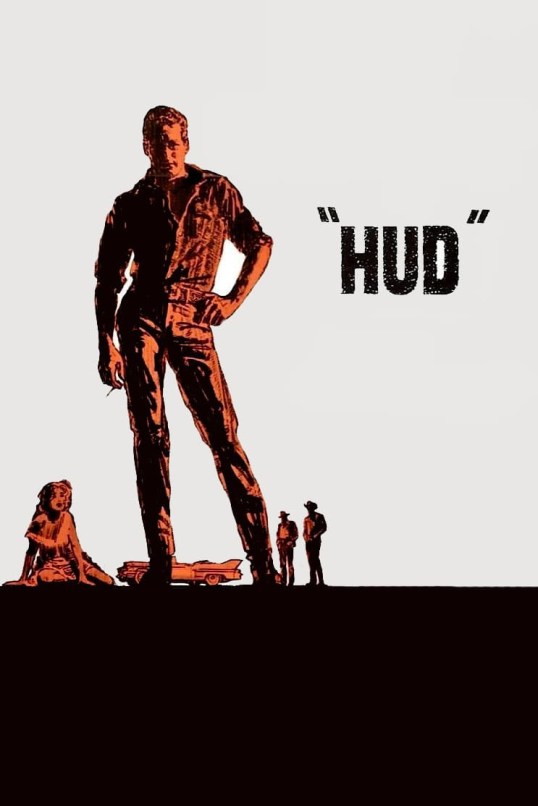
In 1963’s Hud, Paul Newman plays a monster named Hud.
Hud Bannon is the son of rancher Homer Bannon (Melvyn Douglas). Hud lives in a small Texas town, where he’s known for his pink Cadillac, his heavy-drinking, and his womanizing. When we first meet him, he’s leaving the home of a married woman and narrowly escaping the rage of her husband. Throughout the film, he mentions that he’s heading into town to meet “Mrs.” So-and-So. Hud’s father fears that Hud might be incapable of caring about anyone but himself. Hud’s nephew, Lonnie (Brandon deWilde), at first looks up to Hud but, over the course of the film, he comes to see his uncle for who he truly is. Though Hud is quick to defend Homer from others, he himself views Homer with contempt and even plots to have the old man declared incompetent so that he can take over the ranch. His flirtation with the family housekeeper, Alma (Patricia Neal), soon crosses the line into something much more dangerous. Hud is charming and handsome in the way that only a 30-something Paul Newman could be. But he’s also a complete monster.
In Hud, Newman gave one of his best performances and director Martin Ritt and cinematographer James Wong Howe captured some haunting images of the most barren parts of the Texas panhandle. Howe’s black-and-white imagery not only captures the harsh landscape but also the harsh outlook of the people who live there. Hud’s ruthless personality as is much a product of the demands of the land as his own narcissism. The characters in Hud live in a land that doesn’t allow sentimentality. It’s a land that’s allowed Hud to become the monster that he is.
At least, that’s the way that Paul Newman saw Hud. That was also the way that the film’s director, Martin Ritt, viewed Hud. They viewed him as being about as villainous and unlikable as a character could be but, to Newman’s surprise, audiences actually walked out of the film embracing the character and making excuses for him. Newman was shocked to learn that teenagers were putting posters of him as Hud on their walls.
Why did viewers embrace Hud?
Some of it is due to the fact that Brandon deWilde gives a remarkably bland performance as Lonny. We first see Hud through Lonny’s eyes and we are meant to share Lonny’s growing disillusionment with his uncle. But Lonny comes across as being such an empty-headed character that it’s hard to really get emotionally invested in his coming-of-age. When Hud eventually dismisses Lonny and his concerns, Lonny really can’t defend himself because there’s not much going on inside of Lonny. On the other hand, Paul Newman gives such a charismatic performance as Hud that we find ourselves continually making excuses for his bad behavior. When he talks about how he was raised and his difficult relationship with his father, we have sympathy for him even though we know we shouldn’t. The viewer makes excuses for Hud because that’s what we tend to do when it comes to charismatic bad boys who don’t follow the rules.
Indeed, Hud is proof of the power of charisma and screen presence. As a character, Hud does some truly terrible things and yet, because he’s Paul Newman, we want to forgive him. We want to try to figure out why someone who is so handsome and so charismatic would also be so angry. Lonny may be the “good” character but Hud is the one who we want to get to know. When Lonny flips through a paperback to read the sex scenes, he comes across as being creepy. When a drunk Hud flirts with a woman who he has just met, we ask ourselves what we would do if Hud ever tried that with us. The truth is that we all know what we would do. That’s what makes Hud both a dangerous and an intriguing character.
In the end, Hud is an excellent film that features Paul Newman at his best and which uses the downfall of Homer’s ranch as a metaphor for a changing American society. Though Hud was not nominated for Best Picture, it was nominated for almost everything else. Melvyn Douglas and Patricia Neal won acting Oscars. James Wong Howe’s cinematography was also honored. Paul Newman was nominated and perhaps would have won if not for the fact that Sidney Poitier was nominated for playing the exact opposite of Hud in Lilies of the Field. Hud was meant to be a picture about Lonny discovering his uncle was a monster. Instead, the film became about Hud’s refusal to compromise. It turns out that people like good-looking rebels who do what they want.
Even if viewers missed the point, Hud was one of the best films of the early 60s and Paul Newman’s powerful performance continues to intrigue.
 Through the Shattered Lens