I was basking in the golden glow of San Francisco’s Great American Music Hall when I first laid eyes on The Decemberists. It was Summer 2004, and it was a day I still remember well. I arrived alone, but I ended up befriending two girls about my age from Sacramento. It was a pretty thing–three kids too young to buy drinks and too engaged to harbor ulterior motives, thrilled to witness a band that seemed to capture every novelty of a world we were only barely old enough to traverse independently. It wasn’t particularly crowded–we walked right up to the front of the stage–but there wasn’t a stranger in the audience. “Billy Liar” was a hall-wide sing-along. On “Red Right Ankle” you could hear a pin drop. Chris Funk dawned a fake beard and marched through the audience pounding a drum strapped to his chest for “A Cautionary Song”. “California One / Youth and Beauty Brigade” was a swaying dream that will resonate in me until the day I die. I wanted to marry those girls by the end of it–both of them, and I never bothered asking their names.
Austin Texas, fall 2006, I stumbled into Stubb’s BBQ in a daze. “Indie rock” had become the musical movement of the decade, and I felt like a king in the middle of it all. It was a crazy two-week stretch: The Album Leaf, The Mountain Goats, a trek out to Houston for Built to Spill, a return to my metal roots for Between the Buried and Me, and somewhere in the midst of it all I found my sleepless self in a sea of humanity as Colin belted “Culling of the Fold” outdoors to a sold-out crowd. He was exhausted but elated, grinning from ear to ear the whole set, and so was I. The irony of “I was Meant for the Stage” was not lost on either of us.
Pittsburgh, 2009, I took my seat at the Byham Theater to witness The Decemberists in a traditional performance hall. I had traded in faded proofs of attendance for garb with actual buttons, and the band was decked out in full suit and tie. The Hazards of Love was larger than life–Shara Worden striding across the stage like a spidery temptress to a majestic display of lights and an unprecedented rock opera. The Decemberists rose to their fame as only they could, and the result was in one breath a self-aware mockery of their grandiose ambitions and a brilliant realization of the same.
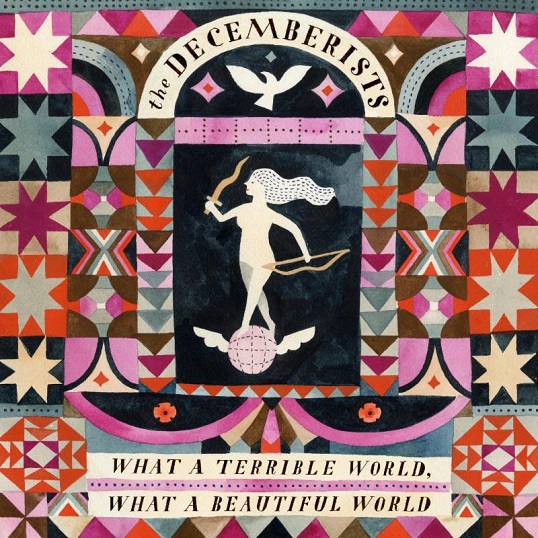
…I wrote of The King is Dead‘s simple folk rock sound that it seemed like The Decemberists were “coming down off their own high. I imagine it’s difficult to be as… musically intelligent as they are without some fear of becoming pretentious.” The album title might even hint at this, and the band’s subsequent three year hiatus seemed to confirm it. Now it is 2015, more than a decade since that wonderful night in San Francisco, and What a Terrible World, What a Beautiful World is due out in just over a week. I don’t really know what I expected, but I know what I was feeling. It certainly wasn’t the grandeur of The Hazards of Love, nor epic ballads reminiscent of “The Mariner’s Revenge Song” and “The Island”. I was waxing nostalgic on Colin at his sweetest. “Grace Cathedral Hill”, “Shiny”, “Red Right Ankle”, “Of Angels and Angles”… Because The Decemberists were no longer a novel in their own right. That beautiful rise ended with The Hazards of Love, and the hiatus laid it all to rest. Theirs was a tale to look back on fondly; the story had come to an end.
What a Terrible World, What a Beautiful World gives me that sweetness, in a way. Tracks like “Lake Song”, “Make You Better”, and “12/17/12” are absolutely beautiful. All of the songs fall somewhere between these mellow numbers, blues/folk tracks like “Carolina Low” and “Better Not Wake the Baby”, and upbeat pop like “The Wrong Year”, “Cavalry Captain”, and “Philomena”. I could live without the latter three, but suffice to say the album is generally pleasing to listen to, though Jenny Conlee’s accordion has sadly all but left us. “Lake Song”, “Make You Better”, and “12/17/12” definitely steal the show for me, but I won’t soon forget the catchy choruses of “Anti-Summersong” or “Mistral”, nor the lulling blues melancholy of “Till the Water is All Long Gone”.
But this album breaks my heart. Through it all, I can’t escape the feeling that some fell force sucked away Colin’s joie de vivre, substituting mellow content to lead a normal life where once the world had been a playground. The music is still great, but I can’t feel the synergy between it and the lyrics anymore. At least “Lake Song” has been spared this fate. Here is what I can understand of “Mistral”: “So we already wrecked the rental car, and I’ve already lost my way. I feel entombed in this tourist bar, for a day anyway. So lay me out on the cobblestone, and unfurl this aching jib. The streets are built on ancient bones, and the crib of the rib. Won’t a mistral blow it all away? Won’t a mistral blow away? So it’s me and you and the baby boy, and a ? shed away, reeking out a little joy. What a waste. Bad mistakes. Won’t a mistral blow it all away? Won’t a mistral blow away?” I don’t know. It’s just… kind of shallow–a bit of babbling around the surface of a theme–and it’s pervasive through much of the album. “Better Not Wake the Baby” is packed with creative one-liners, all tied by a refrain of “but it better not wake the baby“. What does that mean? Plenty of Decemberists tracks have sent me to Wikipedia in the past, but I’m not going to find an answer here, and for that the song means nothing to me. “12/17/12”, my favorite track, still totally jars me out of my happy daze when Colin appears to rhyme “grieving” with “grieving” and “belly” with “belly”.
Go ahead. Crucify me. Point out the most obvious meanings; remind me that Colin still has a robust vocabulary; explain how it’s none of my business to criticize someone else’s creativity; note that it’s still better than 90% of popular music; tell me to shut my mouth and go listen to something else if I don’t like it. I don’t care, because the sad fact is I will go listen to something else. I spent more time on Castaways and Cutouts than on What a Terrible World, What a Beautiful World while writing all this. I don’t want that. I want to love this album and hold it dear, but I can’t. I listen to the lyrics and more often than not I just hear Colin going through the motions without any of the magic. From the 5 Songs EP all the way to The Hazards of Love it was a constant indulgence, and now it is gone.
The opening track, “The Singer Addresses His Audience”, is the reason I can still listen with a faint smile. It is not one for the album, but for the memory of all that The Decemberists have meant to me over the years. In almost a parting farewell to Colin’s old stage persona, he sings in classic form: “We know, we know we belong to ya. We know you built your lives around us. Would we change? …We had to change some. We know, we know we belong to ya. We know you threw your arms around us in the hopes we wouldn’t change… But we had to change some, you know, to belong to you.”
And they still do, and I still love them, and I still look forward to catching them on their upcoming tour, but What a Terrible World, What a Beautiful World is a bittersweet experience.
 Through the Shattered Lens