Scenes I Love: The Opening of Shaft


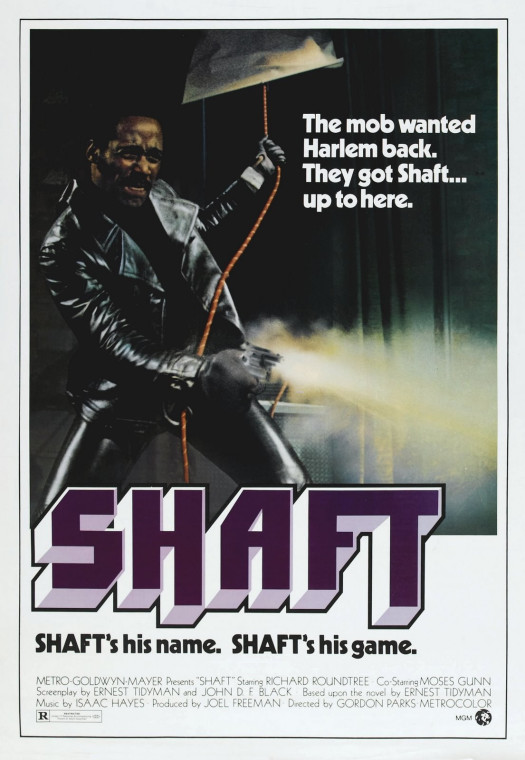
Today would have been the birthday of Richard Roundtree so, of course, today’s scene that I love could only be the classic opening of 1971’s Shaft.

By doing something as simple as walking down a street in New York, Roundtree showed us exactly who Shaft was and why Shaft did what he did.  This is one of those scenes that’s been parodied so many times that it’s actually surprising to rewatch and see how just defiant and sexy Richard Roundtree’s confident strut actually was.

On another note, I enjoy seeing all of the names of the movies that were playing on 42nd Street when this scene was filmed.

Scenes I Love: The Opening of Shaft


Today is the birthday of Richard Roundtree so, of course, today’s scene that I love could only be the classic opening of 1971’s Shaft.

By doing something as simple as walking down a street in New York, Roundtree shows us exactly who Shaft is and why Shaft does what he does.  This is one of those scenes that’s been parodied so many times that it’s actually surprising to rewatch and see how just defiant and sexy Richard Roundtree’s confident strut actually was.

On another note, I enjoy seeing all of the names of the movies that were playing on 42nd Street when this scene was filmed.

That’s Blaxpolitation! 12: SHAFT (MGM 1971)


gary loggins's avatarcracked rear viewer

“That Shaft is a bad mother…”

“Shut your mouth!”

“But I’m talkin’ about Shaft”

“We can dig it!”

  • – lyrics from Isaac Hayes’ “Theme from SHAFT

1971’s SHAFT, starring Richard Roundtree as “the black private dick that’s a sex machine to all the chicks”, is the movie that kicked off the whole 70’s Blaxploitation phenomenon.  Sure, Mario Van Pebbles’ indie SWEET SWEETBACK’S BADASSSSS SONG was released three months earlier, but it’s X-rating kept younger audiences out of the theaters. SHAFT reached more people with it’s R rating, and the publicity machine of MGM behind it. In fact, John Shaft not only saved the day in the film, but helped save the financially strapped MGM from bankruptcy!

The opening sequence alone makes it worth watching, as the camera pans down the gritty mean streets of New York City (42nd Street, to be exact!) and that iconic funky theme song by Isaac…

View original post 458 more words

“Shaft” #1 Brings Blaxploitation Bad-Ass To The Printed Page


4252960-01a

Right off the bat, I should probably apologize for the misleading headline here — Dynamite Entertainment’s Shaft #1 (the first of a six-part series) isn’t “bringing blaxploitation bad-ass to the printed page” so much as it’s bringing it back to the printed page, given that “the black private dick that’s a sex machine to all the chicks” actually started out life not on the silver screen, but in a series of pulp novels by the legendary Ernest Tidyman. And it’s probably down to the fact that Tidyman’s widow owns the copyright to the character of John Shaft that we even have this new spin-off comic at all, seeing as how negotiating a licensing rights deal with her is probably a lot easier than dealing with, say, MGM. Even so — am I the only one who’s surprised that this comic even exists?

I mean, when I think of licensed properties making the leap to the four-color world, I think Star WarsStar TrekBattlestar Galactica. Heck, this week Boom! Studios even released the first issue of a new Escape From New York ongoing monthly, and that didn’t exactly come out of left field in my estimation, but this? A comic based on a cult blaxploitation hero who “peaked” about 40 years ago in terms of his popularity? I gotta say, I didn’t see that one coming at all.

4253652-01b

Still, I’m glad it’s here, and in the hands of writer David F.Walker and artist Bilquis Evely, Tidyman can rest easy in his grave — they seem to know what they’re doing every bit as much as Gordon Parks and Richard Roundtree did when they translated the urban adventures of “the cat who won’t cop out when there’s danger all about” onto celluloid. Is this a good comic? Damn right.

Walker (who’s also penning a six-part Shaft prose story available by scanning QR codes included in the printed versions of each of the comics) has opted to go the “prequel” route here, taking us back to 1968 when a newly-returned-from -Vietnam John Shaft is trying to make a go of it an as Brooklyn-based amateur boxer. We learn a lot about our main character’s backstory here — certainly more than we ever did in the film — and I have to say that all the revelations we’re served ring very true indeed to the Shaft we’ve always known, while somehow being at least modestly surprising at the same time. The fact that Walker is able to convey all this info with a sparse and breezy prose style is an added plus, and while the main through-line of the plot is a pretty simple one — Shaft is ordered to throw a fight, what’s he gonna do about it? — that doesn’t mean the impact of our guy John’s decision, predictable as it may be, has any less of an impact on readers. He’s headed for big trouble, and I’m looking forward to it already.  This first issue is pure table-setting, to be sure, but where’s the harm in that? Set the table nicely enough and I’ll want to stick around for the meal.
4253651-01c

The art from Evely, whose prior work I confess to being unfamiliar with, can also be fairly categorized as “not flashy, but certainly effective.” It’s pretty simple and straightforward, but displays a kind of professionalism and eye for craft that were more common in the comics of 1971 — the year that Shaft hit theaters — than they are today. It suits the subject and time period quite well and invests the  reader in the proceedings rather than alienating you with so much of the unskilled “flashier” art we find in, say, the average DC “New 52” comic. The panels in this book  look good without sacrificing realism and plausibility along the way, and  are more concerned with drawing you in than bowling you over. All in all, a job very well done.

4253650-01d

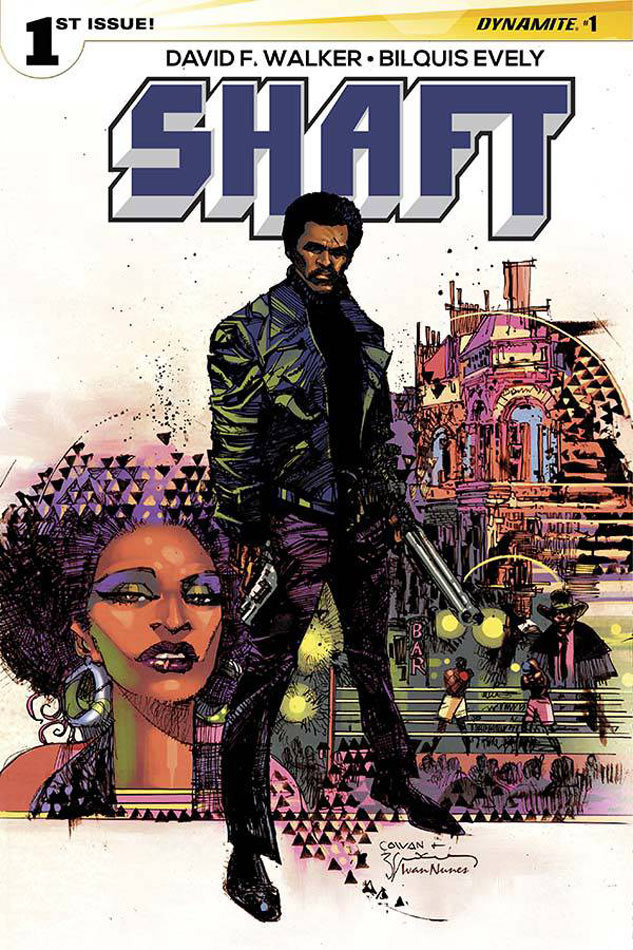
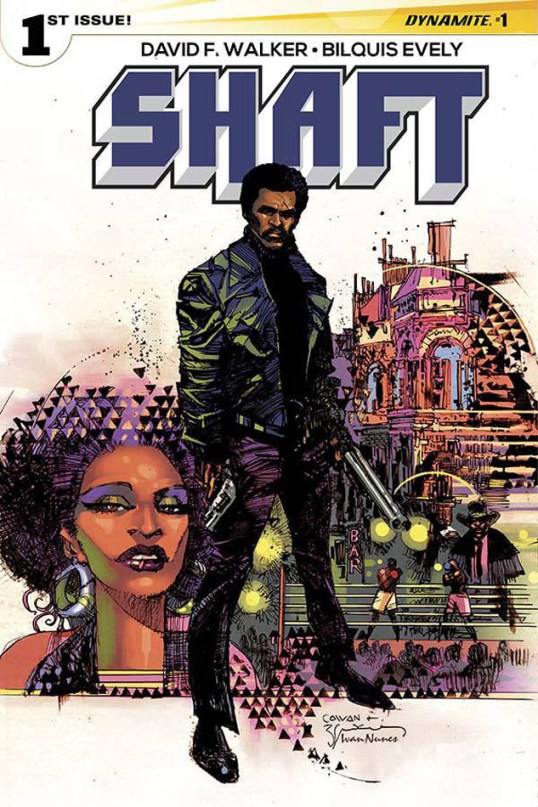
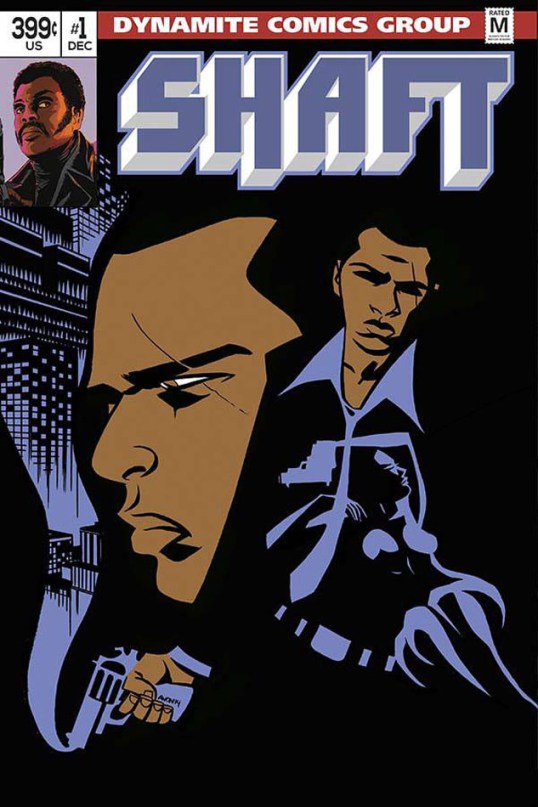
As with pretty much all Dynamite first issues, Shaft #1 has hit the stands with about a bajillion different variant covers. I’ve included my four favorites with this review (by Denys Cowan and Bill Sienkiewicz, Francesco Francavilla, Michael Avon Oeming, and Ulises Farinas, respectively), and while they all portray a more Richard Roundtree-looking Shaft than Evely does in his interior pages (well, except for the one by Farinas, since that’s not Shaft at all, but the bad guy of the story), you really can’t argue with the awesome-ness of any of them. I opted for the Francavilla cover since I always opt for Francavilla covers, but I was sorely tempted by the main Cowan/Sienkiewicz one, as well. Any way you go, though, you can’t lose — either with what’s on the outside of the book or what’s in it. This is the John Shaft we’ve always known, but shown in a whole new light that I think almost all fans will appreciate.


Anime You Should Be Watching: Puella Magi Madoka Magica


“mahou shoujo” –  def. subgenre of Japanese anime and manga involving young girls (usually early to mid teens) with superhuman abilities who either volunteer or forced to fight for good and protect the Earth from destruction.

It has been awhile since I’ve profiled an anime series or OVA on the site. The great thing about attending anime/manga conventions is one discovers new anime or manga to obsesse over. This year, after a visit at this past April’s Anime Boston 2011, my latest anime obsession looks to be our latest “Anime of the Day”. My choice happens to be the latest in a long line of mahou shoujo anime series: Puella Magi Madoka Magica.

This series was actually recommended to me by someone on Twitter months ago but I was still hesistant to check it out until recently. It was while doing some last-minute research before heading over to Anime Boston 2011 that I finally latched onto Puella Magi Madoka Magica. This is peculiar since I’m not that much into the mahou shoujo (“magical girl”) subgenre of anime and manga. Fellow site writer pantsukudasai56 is the one who probably knows about this subgenre than I. It didn’t stop me from finally checking it out. Once back from Anime Boston 2011 I went and found all 12-episode of the first season (it’s just been recently announced that there’s to be a second season). I ended up watching all twelve episodes over a week and fell in love with it.

Puella Magi Madoka Magica is about very cute teen high schoolgirls who suddenly get thrust into a world of magic and science. There’s a major character that I always call an anime series’ mascot and this time it’s a creature resembling something crossed between a bunny and a siamese cat. Kyuubei (others spell it’s name Kyubey, Kyubei, QB, etc…) is a very cute creature who will grant a chosen girl any wish they want as long as they enter into a contract with it to become a Puella Magi who is a girl with magical powers to fight evil and witches.

How can you not love this little guy…

The series’ animation and characters actually make it out to be a very cutesy anime. From the playful and gothic lolita-style design of the girls. Even the creature known as Kyuubei was drawn to elicit nothing but “awwwws” and “d’awwwws” from those who first see the initial episodes. But it’s not that which got me to love this series. Unlike most other mahou shoujo series this one actually becomes quite serious after a couple episodes and turns a major corner into becoming quite a dark series. This turn is even more disturbing considering that the animation continues to be cute and lighthearted. The look of the character design might turn some people off, but for this particular series the gosurori (“gothloli” aka “gothic lolita”) style fits the series and should change the minds of even those who hate the look.

The animation by the anime studio SHAFT is exquisite despite a few inconsistencies here and there, but overall it’s one of the more beautiful and inventive looking anime series of late. The writing by Urobuchi Gen is what sells the series as it combines the early cutesy nature of the series with the darker turns it makes until the very end which is heartbreaking and emotional, to say the least. Here’s to hoping that some enterprising and brave licensor in the U.S. like Sentai or FUNimation will take a chance and license the series for a North American release.

Puella Magi Madoka Magica looks to be the anime series of 2011 and has only been seen in Japan. How those outside Japan are able to see the twelve episode is something to be left unsaid. Maybe those still wanting to know the answer can enter into a contract with Kyuubei and find out.

Some of the transformation animations from the series…